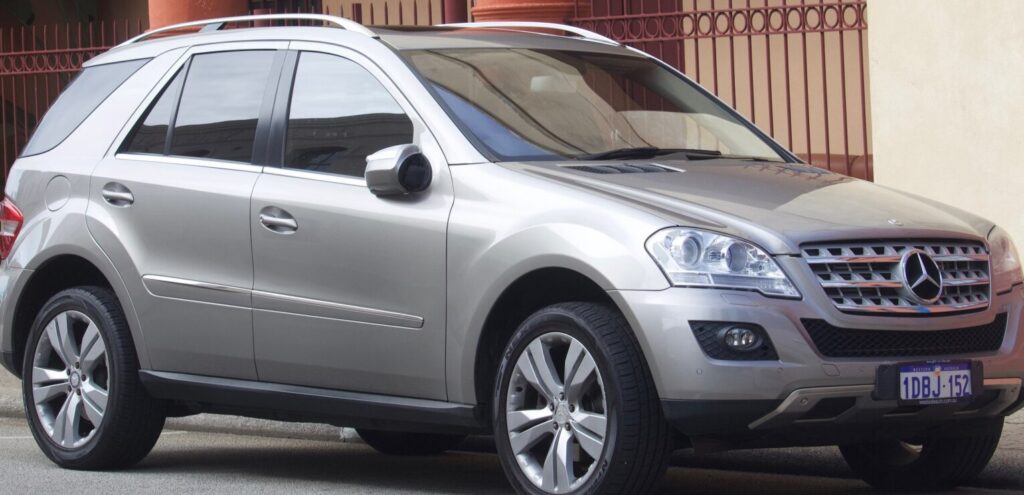
The Mercedes-Benz M-Class (W164), particularly the facelifted version introduced in 2008, represented a significant step forward for the German automaker in the burgeoning mid-size luxury SUV segment. The ML 500 V8 4MATIC, produced from 2008 to 2009, was the range-topping model, offering a potent combination of performance, luxury, and all-weather capability. Positioned as the premium offering, it catered to buyers seeking a powerful and refined SUV experience. It built upon the foundation of the 164 platform, sharing its core structure with the GL-Class, but distinguished itself through its exclusive V8 engine and enhanced features.
Technical Specifications
| Brand | Mercedes-Benz |
| Model | M-Class |
| Generation | M-Class (W164, facelift 2008) |
| Type (Engine) | ML 500 V8 (388 Hp) 4MATIC 7G-TRONIC |
| Start of production | 2008 |
| End of production | 2009 |
| Powertrain Architecture | Internal Combustion engine |
| Body type | SUV |
| Seats | 5 |
| Doors | 5 |
| Fuel consumption (economy) – urban (NEDC) | 17.6 l/100 km (13.4 US mpg, 16.1 UK mpg, 5.7 km/l) |
| Fuel consumption (economy) – extra urban (NEDC) | 10 l/100 km (23.5 US mpg, 28.2 UK mpg, 10 km/l) |
| Fuel consumption (economy) – combined (NEDC) | 12.8 l/100 km (18.4 US mpg, 22.1 UK mpg, 7.8 km/l) |
| CO2 emissions (NEDC) | 304 g/km |
| Fuel Type | Petrol (Gasoline) |
| Acceleration 0 – 100 km/h | 5.8 sec |
| Acceleration 0 – 62 mph | 5.8 sec |
| Acceleration 0 – 60 mph | 5.5 sec |
| Maximum speed | 250 km/h (155.34 mph), Electronically limited |
| Emission standard | Euro 4 |
| Weight-to-power ratio | 5.4 kg/Hp, 183.9 Hp/tonne |
| Weight-to-torque ratio | 4 kg/Nm, 251.2 Nm/tonne |
| Power | 388 Hp @ 6000 rpm |
| Power per litre | 71 Hp/l |
| Torque | 530 Nm @ 2800-4800 rpm (390.91 lb.-ft. @ 2800-4800 rpm) |
| Engine layout | Front, Longitudinal |
| Engine Model/Code | M 273.963 |
| Engine displacement | 5461 cm3 (333.25 cu. in.) |
| Number of cylinders | 8 |
| Engine configuration | V-engine |
| Cylinder Bore | 98 mm (3.86 in.) |
| Piston Stroke | 90.5 mm (3.56 in.) |
| Number of valves per cylinder | 4 |
| Fuel injection system | Multi-port manifold injection |
| Engine aspiration | Naturally aspirated engine |
| Valvetrain | DOHC |
| Engine oil capacity | 9 l (9.51 US qt | 7.92 UK qt) |
| Coolant | 12 l (12.68 US qt | 10.56 UK qt) |
| Kerb Weight | 2110 kg (4651.75 lbs.) |
| Max. weight | 2830 kg (6239.08 lbs.) |
| Max load | 720 kg (1587.33 lbs.) |
| Trunk (boot) space – minimum | 833 l (29.42 cu. ft.) |
| Trunk (boot) space – maximum | 2050 l (72.4 cu. ft.) |
| Fuel tank capacity | 95 l (25.1 US gal | 20.9 UK gal) |
| Permitted trailer load with brakes (12%) | 3500 kg (7716.18 lbs.) |
| Permitted trailer load without brakes | 750 kg (1653.47 lbs.) |
| Length | 4781 mm (188.23 in.) |
| Width | 1911 mm (75.24 in.) |
| Width including mirrors | 2124 mm (83.62 in.) |
| Height | 1815 mm (71.46 in.) |
| Wheelbase | 2915 mm (114.76 in.) |
| Front track | 1636 mm (64.41 in.) |
| Rear (Back) track | 1639 mm (64.53 in.) |
| Front overhang | 866 mm (34.09 in.) |
| Rear overhang | 1000 mm (39.37 in.) |
| Ride height (ground clearance) | 186-261 mm (7.32 – 10.28 in.) |
| Drag coefficient (Cd) | 0.37 |
| Minimum turning circle (turning diameter) | 11.6 m (38.06 ft.) |
| Approach angle | 25-31° |
| Departure angle | 24-29° |
| Ramp-over (brakeover) angle | 14-21° |
| Climb angle | 45° |
| Wading depth | 500 mm (19.69 in.) |
| Drivetrain Architecture | The Internal combustion engine (ICE) drives permanently the four wheels of the vehicle. |
| Drive wheel | All wheel drive (4×4) |
| Number of gears and type of gearbox | 7 gears, automatic transmission G-TRONIC |
| Front suspension | Double wishbone, Transverse stabilizer, Air suspension |
| Rear suspension | Independent multi-link suspension, Air suspension, Transverse stabilizer |
| Front brakes | Ventilated discs |
| Rear brakes | Disc |
| Assisting systems | ABS (Anti-lock braking system) |
| Steering type | Steering rack and pinion |
| Power steering | Hydraulic Steering |
| Tires size | Front wheel tires: 255/50 R19; 265/45 R20; 265/40 R21Rear wheel tires: 255/50 R19; 285/45 R19; 265/45 R20; 265/40 R21 |
| Wheel rims size | Front wheel rims: 8J x 19; 8.5J x 19; 8.5J x 20; 9J x 21Rear wheel rims: 8J x 19; 9.5J x 19; 8.5J x 20; 9J x 21 |
Powertrain & Engine Architecture
The heart of the ML 500 was the M273.963 5.5-liter naturally aspirated V8 engine. This engine, a mainstay of Mercedes-Benz’s performance lineup during the period, produced 388 horsepower at 6000 rpm and 530 Nm (390.91 lb-ft) of torque between 2800 and 4800 rpm. It featured a three-valve per cylinder design (two intake, one exhaust) and a relatively high 10.5:1 compression ratio. Fuel delivery was handled by a multi-port fuel injection system. The engine’s architecture was a 90-degree V-configuration, contributing to its smooth operation. Paired with the engine was the 7G-TRONIC seven-speed automatic transmission, known for its smooth shifts and wide gear ratio spread. This transmission was a crucial component in balancing performance and fuel efficiency.
Driving Characteristics
The ML 500 offered a distinctly different driving experience compared to the lower-trim models. The V8 engine provided effortless acceleration, achieving 0-60 mph in approximately 5.5 seconds. The 7G-TRONIC transmission, while not as sporty as some contemporary gearboxes, offered smooth and predictable shifts. The 4MATIC all-wheel-drive system provided excellent traction in various conditions. Compared to the ML 350, the ML 500 felt significantly more powerful and responsive. While the ML 320 CDI (diesel) offered comparable torque, the V8’s power delivery was more linear and immediate. The air suspension, standard on the ML 500, contributed to a comfortable ride, absorbing bumps effectively while maintaining body control.
Equipment & Trim Levels
The ML 500 came standard with a comprehensive list of features, reflecting its position as the flagship model. These included leather upholstery, heated and ventilated front seats, a premium sound system, a sunroof, and automatic climate control. Optional extras included a rear-seat entertainment system, parking assist, and upgraded interior trim options. The interior design was characterized by Mercedes-Benz’s signature blend of luxury and functionality, with high-quality materials and a well-laid-out dashboard. Exterior features included unique alloy wheel designs and chrome accents.
Chassis & Braking
The W164 M-Class featured a robust chassis with a double wishbone front suspension and an independent multi-link rear suspension. The ML 500 benefited from an air suspension system, which allowed for adjustable ride height and improved comfort. Braking duties were handled by ventilated discs at all four corners, providing ample stopping power. The anti-lock braking system (ABS) was standard, along with electronic stability control. Stabilizer bars were fitted front and rear to minimize body roll during cornering.
Market Reception & Comparison
The ML 500 was generally well-received by automotive critics, who praised its powerful engine, comfortable ride, and luxurious interior. However, its fuel economy was a common criticism, as expected for a V8-powered SUV. Compared to the ML 350, the ML 500 offered a significant performance upgrade but came at a higher price point. The ML 320 CDI was often seen as a more practical alternative, offering comparable torque and better fuel economy. The ML 500 appealed to buyers who prioritized performance and luxury over fuel efficiency.
Legacy
The M-Class W164, and particularly the ML 500 variant, has established a reputation for reasonable long-term reliability, although maintenance costs can be higher due to the complexity of the V8 engine and air suspension system. Common issues include oil leaks, electrical glitches, and air suspension compressor failures. On the used car market, the ML 500 remains a desirable option for buyers seeking a powerful and luxurious SUV from the late 2000s. Its combination of performance, comfort, and all-wheel-drive capability continues to appeal to a niche segment of the market.