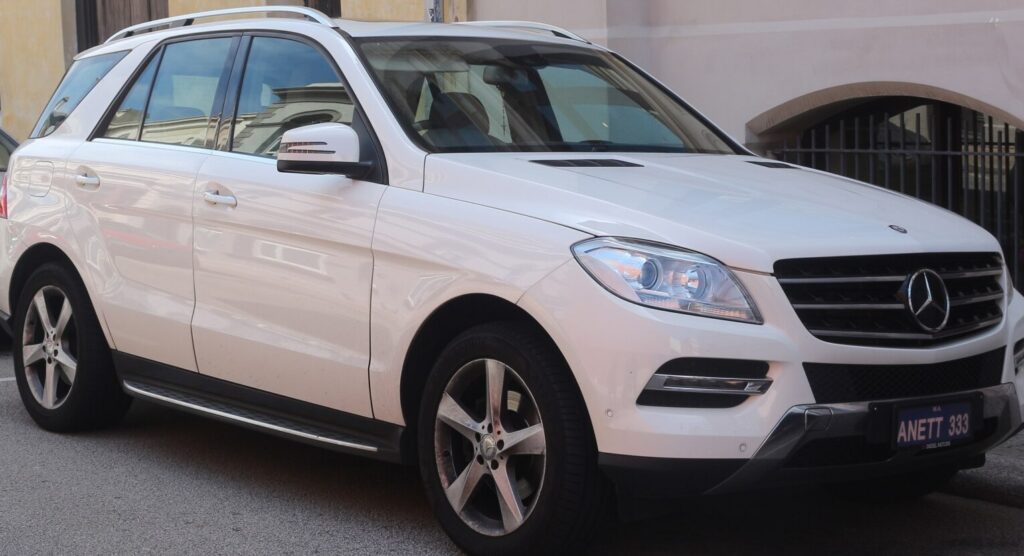
The Mercedes-Benz W166 M-Class AMG ML 63, produced from February 2012 to April 2015, represented the high-performance variant of the second-generation M-Class. Positioned as the flagship model, it offered a substantial increase in power and performance compared to the standard M-Class trims. This vehicle was primarily aimed at the North American and European markets, where demand for high-performance luxury SUVs was strong. The ML 63 competed directly with vehicles like the Porsche Cayenne Turbo and the BMW X5 M.
Technical Specifications
| Brand | Mercedes-Benz |
| Model | M-Class |
| Generation | M-Class (W166) |
| Type | AMG ML 63 V8 (523 Hp) 4MATIC SPEEDSHIFT G-TRONIC |
| Start of production | February, 2012 |
| End of production | April, 2015 |
| Powertrain Architecture | Internal Combustion engine |
| Body type | SUV |
| Seats | 5 |
| Doors | 5 |
| Fuel consumption (urban) | 15.7 l/100 km (15 US mpg, 18 UK mpg, 6.4 km/l) |
| Fuel consumption (extra urban) | 9.6 l/100 km (24.5 US mpg, 29.4 UK mpg, 10.4 km/l) |
| Fuel consumption (combined) | 11.8 l/100 km (19.9 US mpg, 23.9 UK mpg, 8.5 km/l) |
| CO2 emissions | 276 g/km |
| Fuel Type | Petrol (Gasoline) |
| Acceleration 0 – 100 km/h | 4.8 sec |
| Acceleration 0 – 62 mph | 4.8 sec |
| Acceleration 0 – 60 mph | 4.6 sec |
| Maximum speed | 250 km/h (155.34 mph) |
| Emission standard | Euro 5 |
| Weight-to-power ratio | 4.5 kg/Hp, 223 Hp/tonne |
| Weight-to-torque ratio | 3.4 kg/Nm, 298.5 Nm/tonne |
| Power | 523 Hp @ 5250-5750 rpm |
| Power per litre | 95.8 Hp/l |
| Torque | 700 Nm @ 1750-5000 rpm (516.29 lb.-ft. @ 1750-5000 rpm) |
| Engine layout | Front, Longitudinal |
| Engine Model/Code | M 157.982 |
| Engine displacement | 5461 cm3 (333.25 cu. in.) |
| Number of cylinders | 8 |
| Engine configuration | V-engine |
| Compression ratio | 10:1 |
| Fuel injection system | Direct injection |
| Engine aspiration | Twin-Turbo, Intercooler |
| Engine oil capacity | 8.5 l (8.98 US qt | 7.48 UK qt) |
| Kerb Weight | 2345 kg (5169.84 lbs.) |
| Max. weight | 3050 kg (6724.1 lbs.) |
| Max load | 705 kg (1554.26 lbs.) |
| Trunk (boot) space – minimum | 690 l (24.37 cu. ft.) |
| Trunk (boot) space – maximum | 2010 l (70.98 cu. ft.) |
| Fuel tank capacity | 93 l (24.57 US gal | 20.46 UK gal) |
| Length | 4804 mm (189.13 in.) |
| Width | 1926 mm (75.83 in.) |
| Height | 1796 mm (70.71 in.) |
| Wheelbase | 2915 mm (114.76 in.) |
| Front track | 1648 mm (64.88 in.) |
| Rear (Back) track | 1663 mm (65.47 in.) |
| Minimum turning circle | 11.8 m (38.71 ft.) |
| Drive wheel | All wheel drive (4×4) |
| Front suspension | Double wishbone |
| Rear suspension | Independent multi-link suspension |
| Front brakes | Ventilated discs |
| Rear brakes | Ventilated discs |
| Assisting systems | ABS (Anti-lock braking system) |
| Steering type | Steering rack and pinion |
| Power steering | Electric Steering |
| Tires size | 265/45 R20 |
| Wheel rims size | 20 |
Powertrain & Engine Architecture
The heart of the ML 63 was the M157.982 5.5-liter V8 engine. This engine featured direct injection, twin turbochargers, and an intercooler, producing 523 horsepower and 516 lb-ft of torque. The engine utilized a sophisticated combustion process designed for both power and efficiency. The SPEEDSHIFT G-TRONIC seven-speed automatic transmission was specifically tuned for the ML 63, offering quick and precise shifts. This transmission featured paddle shifters for manual control, allowing drivers to engage more directly with the powertrain. The 4MATIC all-wheel-drive system distributed power between the front and rear axles, enhancing traction and stability, particularly in adverse weather conditions.
Driving Characteristics
The ML 63 delivered a markedly different driving experience compared to the standard M-Class variants. The substantial power output resulted in brisk acceleration – 0 to 60 mph in approximately 4.6 seconds. The automatic transmission, while providing smooth operation in normal driving, could shift rapidly and decisively in Sport mode. The suspension was tuned for performance, offering a firmer ride than the comfort-oriented setups found in other M-Class models. While capable on-road, the ML 63 wasn’t primarily designed for serious off-roading, focusing instead on delivering a dynamic and engaging driving experience on paved surfaces. The gear ratios were optimized for acceleration, with shorter ratios in the lower gears.
Equipment & Trim Levels
The ML 63 came standard with a comprehensive list of features, including leather upholstery, heated and ventilated front seats, a premium sound system, and a navigation system. Standard exterior features included AMG-specific body styling, 20-inch alloy wheels, and stainless steel exhaust outlets. Optional extras included a panoramic sunroof, adaptive cruise control, and a rear-seat entertainment system. Interior trim options allowed for customization, with choices in wood, aluminum, and carbon fiber accents. The overall interior ambiance was luxurious and sporty, reflecting the vehicle’s performance-oriented character.
Chassis & Braking
The ML 63 featured a reinforced chassis and upgraded suspension components to handle the increased power and performance. The front suspension utilized double wishbones, while the rear employed an independent multi-link setup. Both front and rear brakes were ventilated discs, providing ample stopping power. The AMG braking system, often included as an option, featured larger rotors and calipers for even greater performance. The steering system was a rack-and-pinion setup with power assistance, offering precise and responsive handling. Stabilizer bars were thicker than those found on standard M-Class models, reducing body roll during cornering.
Market Reception & Comparison
The ML 63 received generally positive reviews from automotive critics. It was praised for its powerful engine, responsive handling, and luxurious interior. However, some reviewers noted the firm ride quality and relatively high fuel consumption. Compared to the standard M-Class models, the ML 63 offered a significantly more engaging driving experience but came at a substantial price premium. Against competitors like the Porsche Cayenne Turbo and BMW X5 M, the ML 63 offered a compelling combination of performance, luxury, and value. Fuel economy, averaging around 19.9 US mpg combined, was typical for a high-performance SUV of its class.
Legacy
The W166 ML 63 has proven to be a relatively reliable vehicle, with the M157 engine generally considered robust. However, like any complex machine, it requires regular maintenance. Common issues reported by owners include occasional turbocharger problems and oil leaks. Today, the ML 63 remains a desirable vehicle in the used car market, appealing to buyers seeking a high-performance luxury SUV. Its combination of power, luxury, and relative reliability has ensured its continued popularity among enthusiasts. The M157 engine, while thirsty, is known for its tunability, allowing owners to further enhance its performance.