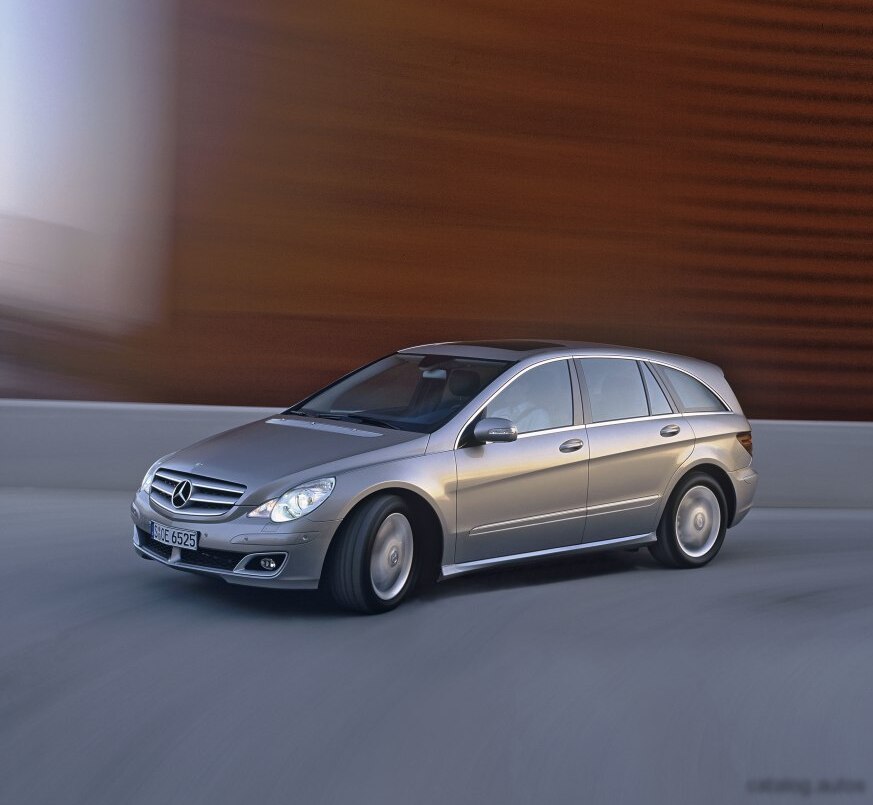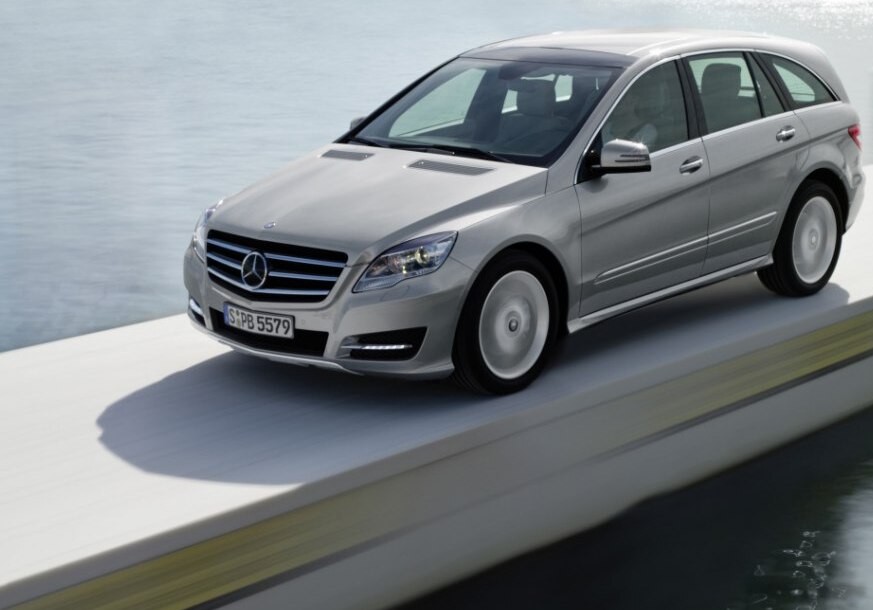
The Mercedes-Benz R-Class Long (V251 series, post-facelift) R 500 V8 4MATIC G-TRONIC was a luxury grand tourer produced from 2010 to 2014. Positioned as a unique offering within the Mercedes-Benz lineup, the R-Class aimed to blend the space and practicality of a minivan with the driving experience and prestige of a luxury SUV. The “Long” designation refers to the extended wheelbase version, offering increased passenger space, particularly in the third row. The R 500 represented the top-of-the-line engine option for the R-Class, offering substantial performance and a premium driving experience. It was primarily marketed in Europe and North America, though sales were relatively limited compared to more conventional Mercedes-Benz models.
| Brand | Mercedes-Benz |
| Model | R-Class |
| Generation | R-Class Long (V251, facelift 2010) |
| Type (Engine) | R 500 V8 (388 Hp) 4MATIC G-TRONIC |
| Start of production | 2010 |
| End of production | 2014 |
| Powertrain Architecture | Internal Combustion engine |
| Body type | Station wagon (estate) |
| Seats | 5-7 |
| Doors | 5 |
| Fuel consumption (urban) | 18.6-18.8 l/100 km (12.6 – 12.5 US mpg) |
| Fuel consumption (extra urban) | 10-10.2 l/100 km (23.5 – 23.1 US mpg) |
| Fuel consumption (combined) | 13.2-13.4 l/100 km (17.8 – 17.6 US mpg) |
| CO2 emissions | 306-311 g/km |
| Fuel Type | Petrol (Gasoline) |
| Acceleration 0 – 100 km/h | 6.3 sec |
| Acceleration 0 – 62 mph | 6.3 sec |
| Acceleration 0 – 60 mph | 6 sec |
| Maximum speed | 250 km/h (155.34 mph) |
| Emission standard | Euro 5 |
| Weight-to-power ratio | 5.6 kg/Hp |
| Weight-to-torque ratio | 4.1 kg/Nm |
| Power | 388 Hp @ 6000 rpm |
| Torque | 530 Nm @ 2800-4800 rpm (390.91 lb.-ft. @ 2800-4800 rpm) |
| Engine layout | Front, Longitudinal |
| Engine Model/Code | M 273.963 |
| Engine displacement | 5461 cm3 (333.25 cu. in.) |
| Number of cylinders | 8 |
| Engine configuration | V-engine |
| Compression ratio | 10.7:1 |
| Number of valves per cylinder | 4 |
| Fuel injection system | Multi-port manifold injection |
| Engine aspiration | Naturally aspirated |
| Engine oil capacity | 9 l (9.51 US qt | 7.92 UK qt) |
| Kerb Weight | 2190 kg (4828.12 lbs.) |
| Max. weight | 2920 kg (6437.5 lbs.) |
| Max load | 730 kg (1609.37 lbs.) |
| Trunk (boot) space – minimum | 633 l (22.35 cu. ft.) |
| Trunk (boot) space – maximum | 2385 l (84.23 cu. ft.) |
| Fuel tank capacity | 80 l (21.13 US gal | 17.6 UK gal) |
| Permitted trailer load with brakes (12%) | 2100 kg (4629.71 lbs.) |
| Permitted trailer load without brakes | 750 kg (1653.47 lbs.) |
| Length | 4922 mm (193.78 in.) |
| Width | 1922 mm (75.67 in.) |
| Width including mirrors | 2183 mm (85.94 in.) |
| Height | 1674 mm (65.91 in.) |
| Wheelbase | 2980 mm (117.32 in.) |
| Front track | 1661 mm (65.39 in.) |
| Rear track | 1651 mm (65 in.) |
| Front overhang | 922 mm (36.3 in.) |
| Rear overhang | 1020 mm (40.16 in.) |
| Minimum turning circle | 12.6 m (41.34 ft.) |
| Drive wheel | All wheel drive (4×4) |
| Number of gears | 7 |
| Gearbox type | Automatic transmission G-TRONIC |
| Front suspension | Double wishbone |
| Rear suspension | Independent multi-link spring suspension with stabilizer |
| Front brakes | Disc |
| Rear brakes | Disc |
| Assisting systems | ABS (Anti-lock braking system) |
| Tires size | 255/50 R19 |
| Wheel rims size | 19 |
Powertrain & Engine Architecture
The R 500 V8 was powered by the M273.963 engine, a 5.461-liter (333.25 cubic inches) naturally aspirated V8. This engine featured a three-valve-per-cylinder design (two intake, one exhaust) and multi-port fuel injection. The M273 engine was known for its smooth power delivery and relatively high output for its displacement. It produced 388 horsepower at 6000 rpm and 530 Nm (390.91 lb-ft) of torque between 2800 and 4800 rpm. The engine’s longitudinal mounting and all-wheel-drive configuration contributed to balanced handling. The 7G-TRONIC automatic transmission, a seven-speed unit, was standard. This transmission offered smooth and responsive shifts, contributing to both performance and fuel efficiency. The 4MATIC all-wheel-drive system provided enhanced traction and stability in various driving conditions.
Driving Characteristics
The R 500 V8 offered a significantly different driving experience compared to the four-cylinder and V6 versions of the R-Class. The V8 engine provided ample power for effortless acceleration and confident highway cruising. The 0-60 mph sprint was achieved in approximately 6 seconds, and the top speed was electronically limited to 155 mph. The 7G-TRONIC transmission was well-matched to the engine, providing smooth gear changes and contributing to a relaxed driving experience. While the R-Class was a large vehicle, the 4MATIC system and well-tuned suspension helped to minimize body roll and provide a reasonably controlled ride. Compared to the more fuel-efficient R 350, the R 500 prioritized performance over economy, resulting in considerably higher fuel consumption.
Equipment & Trim Levels
The R 500 V8 typically came with a high level of standard equipment. This included leather upholstery, wood trim, a premium sound system, dual-zone automatic climate control, and power-adjustable front seats with memory function. Standard safety features included ABS, traction control, stability control, and multiple airbags. Optional extras included a rear-seat entertainment system, panoramic sunroof, adaptive cruise control, and parking assist. The R 500 was often equipped with the “Designo” package, which allowed customers to customize the interior with unique leather colors and trim materials. The extended wheelbase of the “Long” version provided generous space for passengers in all three rows, making it a comfortable option for families.
Chassis & Braking
The R-Class Long featured a double wishbone front suspension and an independent multi-link rear suspension with a stabilizer bar. This suspension setup provided a comfortable ride while maintaining reasonable handling characteristics. The R 500 V8 was equipped with disc brakes on all four wheels, providing ample stopping power. The ABS (Anti-lock Braking System) helped to prevent wheel lockup during hard braking, enhancing safety. The 4MATIC all-wheel-drive system distributed power to all four wheels, improving traction and stability, particularly in adverse weather conditions. The R 500’s weight (approximately 2190 kg or 4828 lbs) necessitated a robust braking system and suspension to manage its mass effectively.
Market Reception & Comparison
The Mercedes-Benz R-Class, even in its high-performance R 500 V8 guise, struggled to gain significant market traction. Critics praised the vehicle’s spacious interior, comfortable ride, and powerful engine, but many found its styling unconventional and its overall size cumbersome. Compared to the R 350, the R 500 offered a substantial performance upgrade but came with a significant increase in fuel consumption and a higher price tag. The R 500 was often seen as a niche vehicle, appealing to buyers who prioritized performance and luxury over practicality and fuel efficiency. Its fuel economy of 13.2-13.4 l/100 km (17.8 – 17.6 US mpg) was considerably worse than the R 350’s, making it a less attractive option for those concerned about running costs.
Legacy
The Mercedes-Benz R-Class was discontinued in 2014, largely due to slow sales. The R 500 V8, being the top-of-the-line variant, represents a relatively rare and well-equipped example of the model. While not a mainstream success, the R-Class demonstrated Mercedes-Benz’s willingness to experiment with new vehicle concepts. Today, the R 500 V8 can be found on the used car market at relatively affordable prices. The M273 V8 engine is generally considered to be reliable, although regular maintenance is essential. Common issues include oil leaks and potential problems with the air suspension system (if equipped). The R 500 V8 remains a unique and capable grand tourer, offering a blend of luxury, performance, and space that is not commonly found in other vehicles.