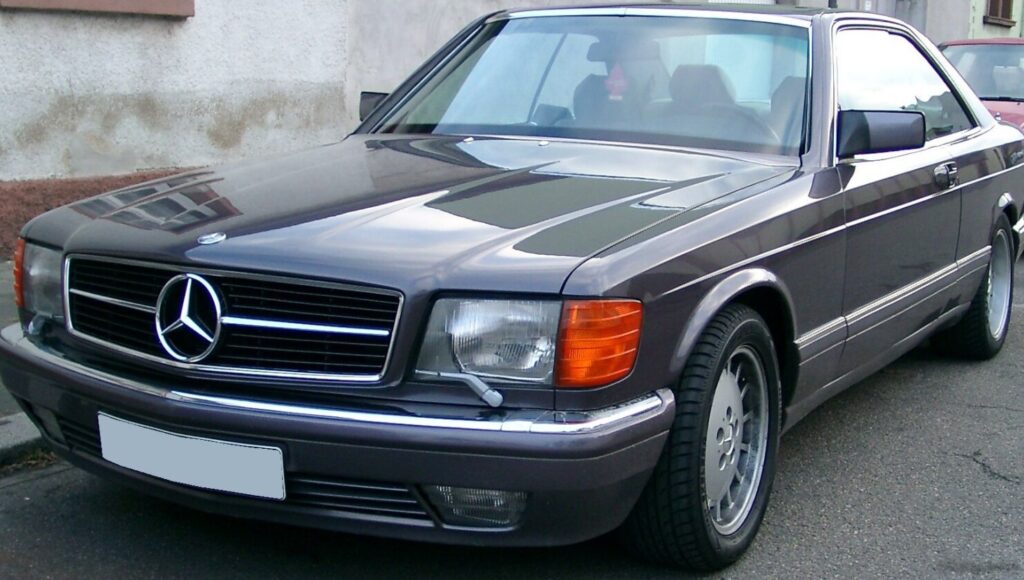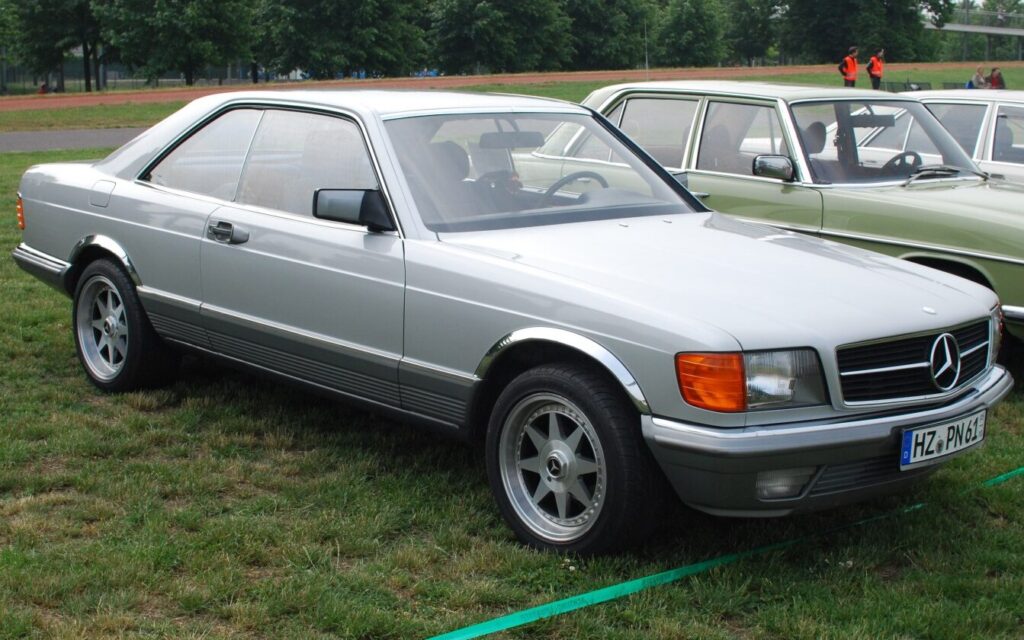
The Mercedes-Benz 500 SEC, part of the C126 S-Class Coupe range produced between July 1980 and September 1985, represented a significant blend of luxury, performance, and engineering prowess. Positioned as the flagship coupe within the S-Class lineup, the 500 SEC offered a more sporting alternative to the traditional sedan while maintaining the renowned Mercedes-Benz commitment to comfort and refinement. It was a key model in establishing the brand’s presence in the growing grand touring coupe market, particularly in North America where it found a substantial customer base. The C126 generation itself was a groundbreaking design, introducing features that would become hallmarks of the S-Class for decades to come.
Technical Specifications
| Brand | Mercedes-Benz |
| Model | S-class |
| Generation | S-class Coupe (C126) |
| Type (Engine) | 500 SEC V8 (231 Hp) Automatic |
| Start of production | July, 1980 |
| End of production | September, 1985 |
| Powertrain Architecture | Internal Combustion engine |
| Body type | Coupe |
| Seats | 4 |
| Doors | 2 |
| Fuel consumption (urban) | 15.2 l/100 km (15.5 US mpg, 18.6 UK mpg, 6.6 km/l) |
| Fuel consumption (extra urban) | 9.1 l/100 km (25.8 US mpg, 31 UK mpg, 11 km/l) |
| Fuel Type | Petrol (Gasoline) |
| Acceleration 0 – 100 km/h | 8.1 sec |
| Acceleration 0 – 62 mph | 8.1 sec |
| Acceleration 0 – 60 mph | 7.7 sec |
| Maximum speed | 225 km/h (139.81 mph) |
| Weight-to-power ratio | 7 kg/Hp, 143.5 Hp/tonne |
| Weight-to-torque ratio | 4 kg/Nm, 251.6 Nm/tonne |
| Power | 231 Hp @ 4750 rpm |
| Power per litre | 46.5 Hp/l |
| Torque | 405 Nm @ 3000 rpm (298.71 lb.-ft. @ 3000 rpm) |
| Engine layout | Front, Longitudinal |
| Engine Model/Code | M 117 E 50 / 117.963 |
| Engine displacement | 4973 cm3 (303.47 cu. in.) |
| Number of cylinders | 8 |
| Engine configuration | V-engine |
| Cylinder Bore | 96.5 mm (3.8 in.) |
| Piston Stroke | 85 mm (3.35 in.) |
| Compression ratio | 9.2:1 |
| Number of valves per cylinder | 2 |
| Fuel injection system | Multi-port manifold injection |
| Engine aspiration | Naturally aspirated engine |
| Valvetrain | SOHC |
| Engine oil capacity | 9 l (9.51 US qt | 7.92 UK qt) |
| Coolant | 13.5 l (14.27 US qt | 11.88 UK qt) |
| Kerb Weight | 1610 kg (3549.44 lbs.) |
| Max. weight | 2130 kg (4695.85 lbs.) |
| Max load | 520 kg (1146.4 lbs.) |
| Fuel tank capacity | 90 l (23.78 US gal | 19.8 UK gal) |
| Length | 4910 mm (193.31 in.) |
| Width | 1828 mm (71.97 in.) |
| Height | 1406 mm (55.35 in.) |
| Wheelbase | 2845 mm (112.01 in.) |
| Front track | 1545 mm (60.83 in.) |
| Rear track | 1517 mm (59.72 in.) |
| Drivetrain Architecture | The Internal combustion engine (ICE) drives the rear wheels of the vehicle. |
| Drive wheel | Rear wheel drive |
| Number of gears and type of gearbox | 4 gears, automatic transmission |
| Front suspension | Double wishbone |
| Rear suspension | Threaded twist beam |
| Front brakes | Ventilated discs |
| Rear brakes | Disc |
| Steering type | Cone worm with recirculation balls |
| Power steering | Hydraulic Steering |
| Tires size | Front wheel tires: 205/70 R14Rear wheel tires: 205/70 R14 |
| Wheel rims size | Front wheel rims: 6.5J x 14Rear wheel rims: 6.5J x 14 |
Powertrain & Engine Architecture
The heart of the 500 SEC was the M117 E 50 engine, a 4.97-liter (303.47 cubic inch) naturally aspirated V8. This engine, designated with code 117.963, was a sophisticated design for its time, featuring a single overhead camshaft (SOHC) per bank and Bosch K-Jetronic multi-port fuel injection. The K-Jetronic system, while complex, provided precise fuel delivery, contributing to both performance and relatively good fuel economy for a V8 of this era. The engine produced 231 horsepower at 4750 rpm and 299 lb-ft of torque at 3000 rpm. The engine’s robust construction and over-engineering were typical of Mercedes-Benz, contributing to its longevity. The 500 SEC exclusively utilized a four-speed automatic transmission, designed to provide smooth and effortless shifting, complementing the car’s luxurious character. This transmission was geared towards comfortable cruising rather than outright performance.
Driving Characteristics
The 500 SEC offered a driving experience that prioritized comfort and refinement over sporty handling. The automatic transmission, while smooth, wasn’t particularly quick to shift, and the gear ratios were optimized for relaxed highway cruising. Acceleration to 60 mph took around 7.7 seconds, respectable for the early 1980s, but noticeably slower than the manual transmission equipped 380 SEC. The V8 engine provided ample torque, making overtaking effortless, but the car’s considerable weight (approximately 3550 lbs) meant it wasn’t a nimble handler. The suspension, tuned for comfort, absorbed bumps well, but body roll was noticeable in corners. Compared to the smaller-engined 380 SEC, the 500 SEC offered a significantly more powerful and refined driving experience, justifying its higher price tag.
Equipment & Trim Levels
The 500 SEC came standard with a high level of equipment, befitting its flagship status. Leather upholstery was standard, as were power windows, power locks, and a sunroof. Air conditioning was also a standard feature. The interior was characterized by its high-quality materials and meticulous craftsmanship. Optional extras included a premium sound system, heated seats, and a self-leveling suspension system. The dashboard layout was typical of Mercedes-Benz of the era, with a clear and functional design. Wood trim was used extensively throughout the interior, adding to the car’s luxurious ambiance.
Chassis & Braking
The C126 coupe utilized a robust chassis with independent double wishbone suspension at the front and a threaded twist beam rear axle. This setup prioritized ride comfort over ultimate handling precision. Braking was provided by ventilated discs at the front and solid discs at the rear. Hydraulic power steering was standard, making the car easy to maneuver at low speeds. The tires were typically 205/70 R14, providing a good balance of grip and ride comfort. The braking system, while effective, lacked the sophistication of more modern systems, such as ABS, which wasn’t available on early C126 models.
Market Reception & Comparison
The 500 SEC was generally well-received by critics, who praised its luxurious interior, smooth ride, and powerful engine. However, some criticized its relatively high price and its lack of sporty handling. Compared to the 380 SEC, the 500 SEC offered significantly more performance and refinement, but at a considerable cost premium. Fuel economy was also a concern, with the 500 SEC consuming approximately 15.2 liters per 100 kilometers in urban driving. The 500 SEC was positioned as a competitor to other high-end grand touring coupes, such as the BMW 6 Series and the Jaguar XJ-S.
Legacy
The Mercedes-Benz 500 SEC has become a sought-after classic car, appreciated for its elegant design, luxurious interior, and robust engineering. The M117 engine, while thirsty by modern standards, is known for its reliability and longevity when properly maintained. Today, well-maintained examples command high prices in the used car market. The C126 generation S-Class Coupe established a benchmark for luxury coupes, and the 500 SEC remains a testament to Mercedes-Benz’s commitment to quality and engineering excellence. Finding parts can sometimes be a challenge, but a dedicated community of enthusiasts ensures that these cars continue to be enjoyed for years to come.