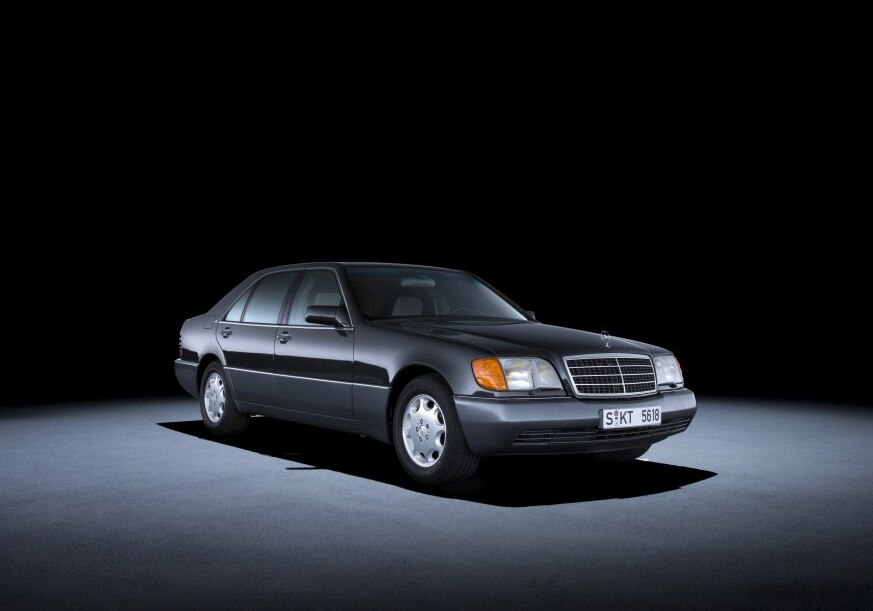
The Mercedes-Benz S-Class Long (V140) 500 SE, produced from 1991 to 1993, represented the pinnacle of luxury and engineering for the German automaker. Positioned as a high-end variant within the W140 generation – the first “full-size” S-Class after the split from the SEC coupe – the 500 SE offered a significantly more powerful engine and extended wheelbase compared to the base models like the 300SE and 400SE. The “Long” designation indicated an extended wheelbase, providing increased rear passenger legroom, catering to a market that valued chauffeur-driven comfort. This model was primarily aimed at the North American and Asian markets, where larger luxury sedans were highly sought after.
Technical Specifications
| Brand | Mercedes-Benz |
| Model | S-class |
| Generation | S-class Long (V140) |
| Type (Engine) | 500 SE (326 Hp) Automatic |
| Start of production | 1991 year |
| End of production | 1993 year |
| Powertrain Architecture | Internal Combustion engine |
| Body type | Sedan |
| Seats | 5 |
| Doors | 4 |
| Fuel consumption (economy) – combined | 13 l/100 km |
| Fuel consumption (economy) – combined | 18.1 US mpg |
| Fuel consumption (economy) – combined | 21.7 UK mpg |
| Fuel consumption (economy) – combined | 7.7 km/l |
| Fuel Type | Petrol (Gasoline) |
| Acceleration 0 – 100 km/h | 6.7 sec |
| Acceleration 0 – 62 mph | 6.7 sec |
| Acceleration 0 – 60 mph | 6.4 sec |
| Maximum speed | 250 km/h |
| Maximum speed | 155.34 mph |
| Weight-to-power ratio | 6.2 kg/Hp |
| Weight-to-power ratio | 162.2 Hp/tonne |
| Weight-to-torque ratio | 4.2 kg/Nm |
| Weight-to-torque ratio | 238.8 Nm/tonne |
| Power | 326 Hp @ 5700 rpm |
| Power per litre | 65.6 Hp/l |
| Torque | 480 Nm @ 3900 rpm |
| Torque | 354.03 lb.-ft. @ 3900 rpm |
| Engine layout | Front, Longitudinal |
| Engine Model/Code | M 119 E 50 |
| Engine displacement | 4973 cm3 |
| Engine displacement | 303.47 cu. in. |
| Number of cylinders | 8 |
| Engine configuration | V-engine |
| Cylinder Bore | 96.5 mm |
| Cylinder Bore | 3.8 in. |
| Piston Stroke | 85 mm |
| Piston Stroke | 3.35 in. |
| Compression ratio | 10:1 |
| Number of valves per cylinder | 4 |
| Fuel injection system | Multi-port manifold injection |
| Engine aspiration | Naturally aspirated engine |
| Valvetrain | DOHC |
| Engine oil capacity | 8 l |
| Engine oil capacity | 8.45 US qt |
| Engine oil capacity | 7.04 UK qt |
| Coolant | 16.5 l |
| Coolant | 17.44 US qt |
| Coolant | 14.52 UK qt |
| Kerb Weight | 2010 kg |
| Kerb Weight | 4431.29 lbs |
| Max. weight | 2530 kg |
| Max. weight | 5577.7 lbs |
| Max load | 520 kg |
| Max load | 1146.4 lbs |
| Trunk (boot) space – minimum | 525 l |
| Trunk (boot) space – minimum | 18.54 cu. ft. |
| Fuel tank capacity | 100 l |
| Fuel tank capacity | 26.42 US gal |
| Fuel tank capacity | 22 UK gal |
| Permitted trailer load with brakes (12%) | 1900 kg |
| Permitted trailer load with brakes (12%) | 4188.78 lbs |
| Permitted trailer load without brakes | 750 kg |
| Permitted trailer load without brakes | 1653.47 lbs |
| Length | 5213 mm |
| Length | 205.24 in |
| Width | 1886 mm |
| Width | 74.25 in |
| Height | 1495 mm |
| Height | 58.86 in |
| Wheelbase | 3140 mm |
| Wheelbase | 123.62 in |
| Front track | 1602 mm |
| Front track | 63.07 in |
| Rear (Back) track | 1574 mm |
| Rear (Back) track | 61.97 in |
| Minimum turning circle | 12.51 m |
| Minimum turning circle | 41.04 ft |
| Drivetrain Architecture | The Internal combustion engine (ICE) drives the rear wheels of the vehicle. |
| Drive wheel | Rear wheel drive |
| Number of gears and type of gearbox | 4 gears, automatic transmission |
| Front suspension | Double wishbone |
| Rear suspension | Independent multi-link spring suspension with stabilizer |
| Front brakes | Ventilated discs |
| Rear brakes | Ventilated discs |
| Assisting systems | ABS (Anti-lock braking system) |
| Steering type | Worm-reduction unit |
| Power steering | Hydraulic Steering |
| Tires size | 235/60 R16 |
| Wheel rims size | 7.5J x 16 |
Powertrain & Engine Architecture
The heart of the 500 SE was the M119 E 50 5.0-liter V8 engine. This engine, a naturally aspirated powerplant, was a significant upgrade over the smaller engines offered in other S-Class variants. It featured a cast-iron block and aluminum cylinder heads, incorporating dual overhead camshafts (DOHC) and four valves per cylinder. The M119 utilized Bosch Motronic fuel injection and electronic ignition, contributing to smooth power delivery and relatively good fuel efficiency for its displacement. The engine produced 326 horsepower at 5700 rpm and 354 lb-ft of torque at 3900 rpm. This power was channeled through a four-speed automatic transmission, a common pairing for luxury vehicles of the era, prioritizing comfort over outright performance. The transmission was electronically controlled, offering adaptive shift patterns based on driving conditions.
Driving Characteristics
The 500 SE offered a refined and powerful driving experience. While not a sports sedan, the V8 engine provided ample acceleration, achieving 0-60 mph in approximately 6.4 seconds. The four-speed automatic transmission, while smooth, wasn’t particularly quick-shifting by modern standards. The gear ratios were tuned for comfortable cruising and effortless highway passing. Compared to the 400SE, the 500 SE offered a noticeable increase in performance, particularly in mid-range acceleration. The extended wheelbase of the “Long” version contributed to a more stable and comfortable ride, especially on long journeys. However, the added length did slightly reduce maneuverability in tight urban environments.
Equipment & Trim Levels
The 500 SE came standard with a comprehensive list of luxury features. Leather upholstery was standard, along with power-adjustable front seats with memory function. Wood trim adorned the interior, enhancing the sense of opulence. Other standard features included automatic climate control, a premium sound system, power windows, and central locking. Optional extras included a sunroof, rear climate control, and upgraded leather options. The extended wheelbase models often featured power-adjustable rear seats and a rear entertainment system, further emphasizing the car’s chauffeur-driven appeal.
Chassis & Braking
The V140 S-Class featured a robust chassis with double wishbone suspension at the front and an independent multi-link suspension with a stabilizer bar at the rear. This setup provided a comfortable ride while maintaining good handling characteristics. The 500 SE was equipped with ventilated disc brakes on all four wheels, providing ample stopping power. Anti-lock braking system (ABS) was standard, enhancing safety. The steering was a hydraulic power-assisted worm-reduction unit, offering a relatively light and precise feel.
Market Reception & Comparison
The 500 SE was well-received by automotive critics, who praised its powerful engine, luxurious interior, and comfortable ride. It was often compared favorably to its rivals, such as the BMW 750iL and the Jaguar XJ12. Fuel economy, however, was a common criticism, with the 5.0-liter V8 consuming a significant amount of gasoline. Compared to the 400SE, the 500 SE commanded a substantial price premium, reflecting its increased performance and exclusivity. The 500 SE offered a more engaging driving experience than the diesel-powered 300SD, but lacked the fuel efficiency of the smaller, turbocharged engines.
Legacy
The M119 engine, found in the 500 SE, is generally considered to be a robust and reliable powerplant when properly maintained. However, like all older luxury vehicles, the 500 SE requires regular maintenance to prevent costly repairs. Common issues include vacuum leaks, electrical gremlins, and wear and tear on suspension components. Today, the V140 S-Class, including the 500 SE, is gaining popularity among collectors and enthusiasts. Well-maintained examples command a premium in the used car market, representing a piece of automotive history and a testament to Mercedes-Benz’s engineering prowess.