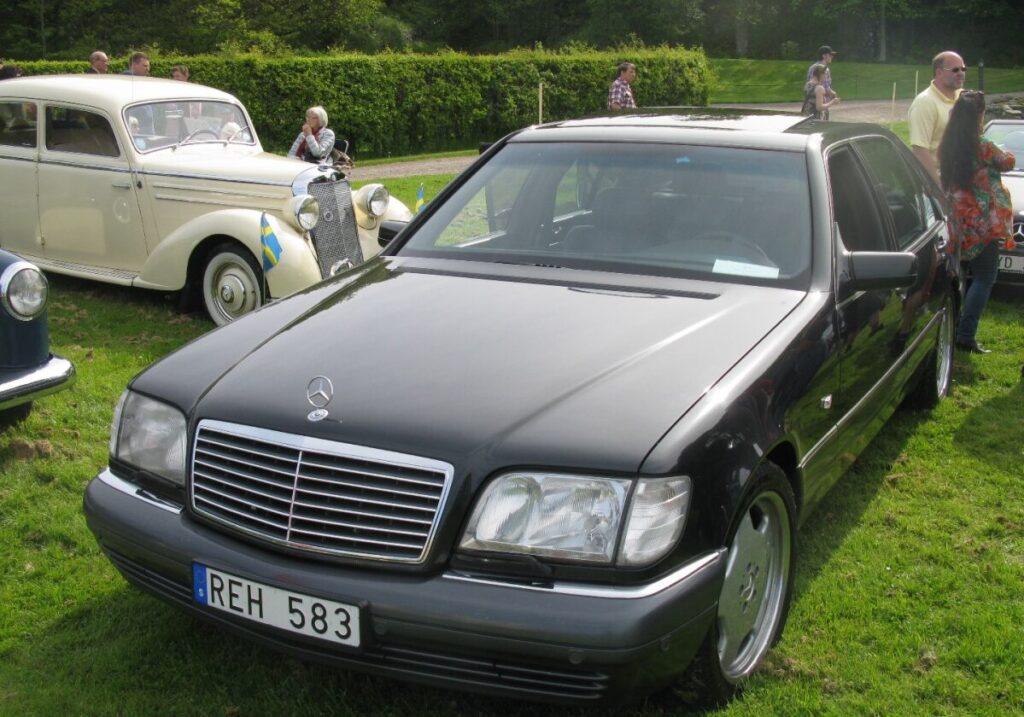
The Mercedes-Benz S 500 V8 (320 hp) with the 4G-TRONIC automatic transmission, produced between March 1994 and August 1995, represents a significant iteration of the W140 S-Class “Long” wheelbase model. This facelifted version of the W140, introduced in 1994, addressed some criticisms of the initial 1991 launch, refining the design and improving overall refinement. Positioned as a high-end luxury sedan, the S 500 V8 occupied a premium slot within the S-Class range, offering a substantial step up in performance and features compared to the six-cylinder models, but remaining below the flagship S 600 V12. It was a key model for Mercedes-Benz in the North American and European markets, embodying the brand’s commitment to engineering excellence and opulent comfort.
Technical Specifications
| Brand | Mercedes-Benz |
| Model | S-class |
| Generation | S-class Long (V140, facelift 1994) |
| Type (Engine) | S 500 V8 (320 Hp) 4G-TRONIC |
| Start of production | March, 1994 |
| End of production | August, 1995 |
| Powertrain Architecture | Internal Combustion engine |
| Body type | Sedan |
| Seats | 5 |
| Doors | 4 |
| Fuel consumption (economy) – urban | 17.2 l/100 km (13.7 US mpg, 16.4 UK mpg, 5.8 km/l) |
| Fuel consumption (economy) – extra urban | 10-11.9 l/100 km (23.5 – 19.8 US mpg, 28.2 – 23.7 UK mpg, 10 – 8.4 km/l) |
| Fuel Type | Petrol (Gasoline) |
| Acceleration 0 – 100 km/h | 7.3 sec |
| Acceleration 0 – 62 mph | 7.3 sec |
| Acceleration 0 – 60 mph | 6.9 sec |
| Maximum speed | 250 km/h (155.34 mph), Electronically limited |
| Weight-to-power ratio | 6.3 kg/Hp, 159.2 Hp/tonne |
| Weight-to-torque ratio | 4.3 kg/Nm, 233.8 Nm/tonne |
| Power | 320 Hp @ 5600 rpm |
| Power per litre | 64.3 Hp/l |
| Torque | 470 Nm @ 3900 rpm (346.65 lb.-ft. @ 3900 rpm) |
| Engine layout | Front, Longitudinal |
| Engine Model/Code | M 119.970 |
| Engine displacement | 4973 cm3 (303.47 cu. in.) |
| Number of cylinders | 8 |
| Engine configuration | V-engine |
| Cylinder Bore | 96.5 mm (3.8 in.) |
| Piston Stroke | 85 mm (3.35 in.) |
| Compression ratio | 10:1 |
| Number of valves per cylinder | 4 |
| Fuel injection system | Multi-port manifold injection |
| Engine aspiration | Naturally aspirated engine |
| Valvetrain | DOHC |
| Engine oil capacity | 8 l (8.45 US qt | 7.04 UK qt) |
| Coolant | 16.5 l (17.44 US qt | 14.52 UK qt) |
| Kerb Weight | 2010 kg (4431.29 lbs.) |
| Max. weight | 2660 kg (5864.3 lbs.) |
| Max load | 650 kg (1433 lbs.) |
| Trunk (boot) space – minimum | 525 l (18.54 cu. ft.) |
| Fuel tank capacity | 100 l (26.42 US gal | 22 UK gal) |
| Length | 5213 mm (205.24 in.) |
| Width | 1886 mm (74.25 in.) |
| Height | 1486 mm (58.5 in.) |
| Wheelbase | 3140 mm (123.62 in.) |
| Front track | 1606 mm (63.23 in.) |
| Rear (Back) track | 1579 mm (62.17 in.) |
| Minimum turning circle | 12.51 m (41.04 ft.) |
| Drivetrain Architecture | The Internal combustion engine (ICE) drives the rear wheels of the vehicle. |
| Drive wheel | Rear wheel drive |
| Number of gears and type of gearbox | 4 gears, automatic transmission G-TRONIC |
| Front suspension | Coil spring, Double wishbone, Transverse stabilizer |
| Rear suspension | Independent multi-link suspension, Transverse stabilizer, Coil spring |
| Front brakes | Ventilated discs |
| Rear brakes | Ventilated discs |
| Assisting systems | ABS (Anti-lock braking system) |
| Steering type | Cone worm with recirculation balls |
| Power steering | Hydraulic Steering |
| Tires size | 235/60 R16 |
| Wheel rims size | 7.5J x 16 |
Powertrain & Engine Architecture
The heart of the S 500 V8 is the M119.970 engine, a 4.973-liter (303.47 cubic inches) naturally aspirated V8. This engine is a cornerstone of Mercedes-Benz engineering from the era, known for its smoothness and durability. It features a cast-iron block and aluminum cylinder heads, employing a double overhead camshaft (DOHC) valvetrain with four valves per cylinder. Fuel delivery is managed by a Bosch multi-port fuel injection system, providing precise control over the air-fuel mixture. The engine produces 320 horsepower at 5600 rpm and 470 Nm (346.65 lb-ft) of torque at 3900 rpm. Paired with the engine is the 4G-TRONIC four-speed automatic transmission. This transmission, while not as sophisticated as modern automatics, was renowned for its smooth shifts and reliability. It featured electronic control for optimized gear selection based on driving conditions.
Driving Characteristics
The S 500 V8 offered a distinctly grand touring experience. While not overtly sporty, the 320 hp engine provided ample power for effortless cruising and confident overtaking. The 4G-TRONIC transmission, while lacking the responsiveness of a manual or more modern automatic, was well-suited to the engine’s torque curve, delivering smooth and predictable acceleration. Compared to the six-cylinder S-Class models, the V8 offered a significant performance advantage, reducing the 0-60 mph time to around 6.9 seconds. However, it wasn’t as nimble as some of its European rivals. The long wheelbase and substantial weight contributed to a more relaxed, composed ride rather than sharp handling. The gear ratios were optimized for comfortable highway driving, prioritizing smoothness over outright acceleration.
Equipment & Trim Levels
The S 500 V8 came standard with a comprehensive array of luxury features. Leather upholstery was standard, along with power-adjustable front seats with memory function. Wood trim adorned the interior, enhancing the sense of opulence. Standard equipment also included automatic climate control, a premium sound system, and power windows and locks. Optional extras included a rear seat entertainment system, a sunroof, and upgraded leather options. The “Long” wheelbase provided significantly more rear legroom, making it a popular choice for chauffeur-driven executives.
Chassis & Braking
The W140 S-Class featured a robust chassis designed for comfort and safety. The front suspension utilized coil springs and a double wishbone setup with a transverse stabilizer bar. The rear suspension employed an independent multi-link design, also with coil springs and a stabilizer bar. This configuration provided a smooth and controlled ride, even over uneven surfaces. Braking duties were handled by ventilated disc brakes on all four wheels, assisted by an Anti-lock Braking System (ABS). The braking system was effective, providing confident stopping power, although it lacked the advanced features found on more modern vehicles.
Market Reception & Comparison
The S 500 V8 was generally well-received by automotive critics. It was praised for its luxurious interior, smooth ride, and powerful engine. However, some critics noted its size and weight, as well as the relatively conservative styling. Compared to the six-cylinder S-Class models, the S 500 V8 offered a significant performance upgrade, but at a higher price point. Fuel economy was a concern, with combined fuel consumption averaging around 14.6 mpg. Compared to the range-topping S 600 V12, the S 500 V8 offered a more balanced combination of performance and fuel efficiency, appealing to buyers who didn’t require the ultimate in luxury and power.
Legacy
The M119 engine, found in the S 500 V8, is considered one of Mercedes-Benz’s most reliable V8 engines. With proper maintenance, these engines can accumulate high mileage without major issues. The 4G-TRONIC transmission is also generally durable, although it may require occasional servicing. Today, the W140 S-Class, including the S 500 V8, is gaining popularity among classic car enthusiasts. Its combination of luxury, engineering, and relative affordability makes it an attractive alternative to more expensive vintage Mercedes-Benz models. Well-maintained examples are becoming increasingly collectible, representing a high point in German automotive engineering.