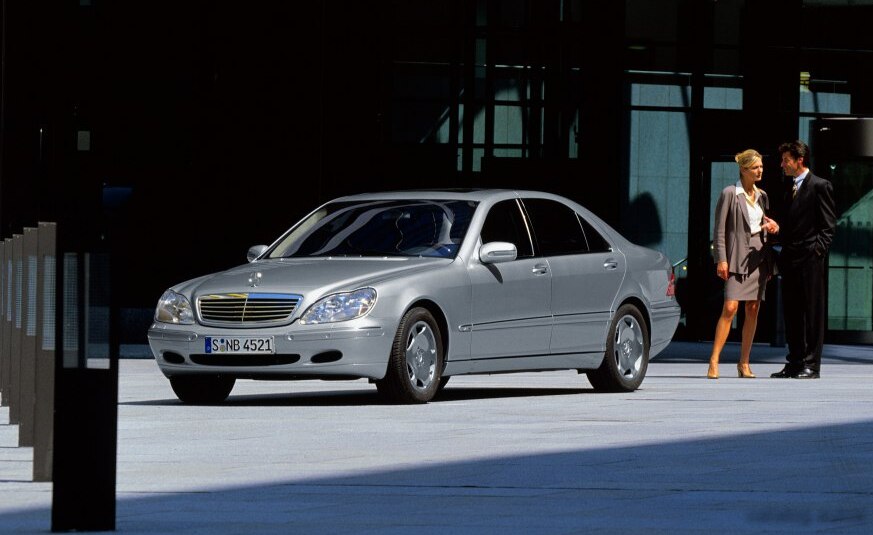
The Mercedes-Benz S-Class Long (V220) AMG S 55, produced from 2001 to 2002, represented a high-performance variant of the already luxurious W220 S-Class. Positioned as a flagship sedan, the AMG S 55 offered a significant increase in power and performance compared to the standard S-Class models, targeting buyers who desired both opulent comfort and exhilarating driving dynamics. The “Long” designation indicates an extended wheelbase, providing increased rear passenger legroom, a feature particularly popular in markets outside of North America where chauffeur-driven luxury was common. This model occupied the top tier of the V220 range, sitting above the S430 and S500 in terms of both price and performance.
Technical Specifications
| Brand | Mercedes-Benz |
| Model | S-Class |
| Generation | S-Class Long (V220) |
| Type | AMG S 55 V8 (360 Hp) 5G-TRONIC |
| Start of production | 2001 |
| End of production | 2002 |
| Powertrain Architecture | Internal Combustion engine |
| Body type | Sedan |
| Seats | 5 |
| Doors | 4 |
| Fuel consumption (urban) | 19.6 l/100 km (12 US mpg, 14.4 UK mpg, 5.1 km/l) |
| Fuel consumption (extra urban) | 9.2 l/100 km (25.6 US mpg, 30.7 UK mpg, 10.9 km/l) |
| Fuel consumption (combined) | 13 l/100 km (18.1 US mpg, 21.7 UK mpg, 7.7 km/l) |
| CO2 emissions | 310 g/km |
| Fuel Type | Petrol (Gasoline) |
| Acceleration 0 – 100 km/h | 6 sec |
| Acceleration 0 – 62 mph | 6 sec |
| Acceleration 0 – 60 mph | 5.7 sec |
| Maximum speed | 250 km/h (155.34 mph) |
| Weight-to-power ratio | 5.2 kg/Hp, 192 Hp/tonne |
| Weight-to-torque ratio | 3.5 kg/Nm, 282.7 Nm/tonne |
| Power | 360 Hp @ 5500 rpm |
| Power per litre | 66.2 Hp/l |
| Torque | 530 Nm @ 3150 rpm (390.91 lb.-ft. @ 3150 rpm) |
| Engine layout | Front, Longitudinal |
| Engine Model/Code | M 113 E 55/113.986 |
| Engine displacement | 5439 cm3 (331.91 cu. in.) |
| Number of cylinders | 8 |
| Engine configuration | V-engine |
| Cylinder Bore | 97 mm (3.82 in.) |
| Piston Stroke | 92 mm (3.62 in.) |
| Compression ratio | 10:1 |
| Number of valves per cylinder | 3 |
| Fuel injection system | Multi-port manifold injection |
| Engine aspiration | Naturally aspirated engine |
| Engine oil capacity | 7.5 l (7.93 US qt | 6.6 UK qt) |
| Coolant | 13.5 l (14.27 US qt | 11.88 UK qt) |
| Kerb Weight | 1875 kg (4133.67 lbs.) |
| Max. weight | 2400 kg (5291.09 lbs.) |
| Max load | 525 kg (1157.43 lbs.) |
| Trunk (boot) space – minimum | 500 l (17.66 cu. ft.) |
| Fuel tank capacity | 88 l (23.25 US gal | 19.36 UK gal) |
| Length | 5158 mm (203.07 in.) |
| Width | 1855 mm (73.03 in.) |
| Width including mirrors | 2092 mm (82.36 in.) |
| Height | 1444 mm (56.85 in.) |
| Wheelbase | 3085 mm (121.46 in.) |
| Front track | 1575 mm (62.01 in.) |
| Rear (Back) track | 1570 mm (61.81 in.) |
| Front overhang | 867 mm (34.13 in.) |
| Rear overhang | 1206 mm (47.48 in.) |
| Drag coefficient (Cd) | 0.29 |
| Minimum turning circle (turning diameter) | 12.1 m (39.7 ft.) |
| Drivetrain Architecture | Rear wheel drive |
| Drive wheel | Rear wheel drive |
| Number of gears and type of gearbox | 5 gears, automatic transmission G-TRONIC |
| Front brakes | Ventilated discs |
| Rear brakes | Ventilated discs |
| Assisting systems | ABS (Anti-lock braking system) |
| Steering type | Steering rack and pinion |
| Power steering | Hydraulic Steering |
Powertrain & Engine Architecture
The heart of the AMG S 55 was the M113 E 55, a 5.4-liter naturally aspirated V8 engine. This engine was a significant departure from the standard S-Class engines, featuring a larger displacement and a more aggressive camshaft profile. The M113 utilized a three-valve per cylinder design (two intake, one exhaust) and a multi-port fuel injection system. The engine’s robust construction and relatively simple design (for its performance level) contributed to its long-term reliability. Power was transmitted to the rear wheels via the 5G-TRONIC automatic transmission, a five-speed unit known for its smooth shifts and adaptability. This transmission was specifically tuned by AMG to handle the increased torque output of the V8 engine. The 5G-TRONIC offered a manual shift mode, allowing drivers some control over gear selection, though it wasn’t as responsive as later, more advanced automatic transmissions.
Driving Characteristics
The AMG S 55 delivered a markedly different driving experience compared to the standard S-Class models. The increased horsepower and torque resulted in significantly quicker acceleration – 0 to 60 mph in approximately 5.7 seconds and a governed top speed of 155 mph. While not a dedicated sports car, the AMG S 55 offered a compelling blend of performance and comfort. The 5G-TRONIC transmission, while smooth, could feel slightly hesitant during quick downshifts. The suspension was tuned to provide a firmer ride than the standard S-Class, improving handling and body control, but without sacrificing too much in terms of overall comfort. The long wheelbase contributed to a stable and planted feel, especially at highway speeds.
Equipment & Trim Levels
The AMG S 55 came standard with a comprehensive list of luxury features, befitting its flagship status. Interior appointments included premium leather upholstery, wood trim, and power-adjustable heated and ventilated front seats. Standard equipment also included a premium sound system, automatic climate control, and a sunroof. Optional extras included rear seat entertainment, massaging seats, and a variety of exterior styling enhancements, such as AMG-specific wheels and body styling elements. The extended wheelbase “Long” version offered significantly more rear legroom, making it a popular choice for those who frequently traveled with passengers or were chauffeured.
Chassis & Braking
The chassis of the AMG S 55 was largely similar to that of the standard S-Class, featuring a fully independent suspension with multi-link front and rear designs. However, the AMG variant benefited from stiffer springs and dampers, as well as a larger stabilizer bar, to improve handling and reduce body roll. Braking duties were handled by ventilated disc brakes on all four wheels, coupled with an Anti-lock Braking System (ABS). The braking system was upgraded compared to the standard S-Class to cope with the increased performance and weight of the AMG model.
Market Reception & Comparison
The AMG S 55 was generally well-received by automotive critics, who praised its powerful engine, luxurious interior, and comfortable ride. However, some reviewers noted that the 5G-TRONIC transmission could feel a bit dated compared to newer automatic transmissions. Compared to the standard S430 and S500 models, the AMG S 55 offered a substantial performance upgrade, but at a significant price premium. Fuel economy was also considerably lower, reflecting the larger engine and increased power output. The AMG S 55 competed with other high-performance luxury sedans, such as the BMW 750iL and the Jaguar XJ Super V8.
Legacy
The M113 engine, found in the AMG S 55, is known for its durability and relatively straightforward maintenance. While not immune to age-related issues, these engines generally hold up well with proper care. Today, the AMG S 55 represents a compelling value in the used luxury car market, offering a significant amount of performance and luxury for the price. However, potential buyers should be aware of the higher maintenance costs associated with a high-performance vehicle of this age, including potential issues with the air suspension system and electronic components. The AMG S 55 remains a desirable and respected example of early 2000s German engineering, representing a sweet spot between classic luxury and modern performance.