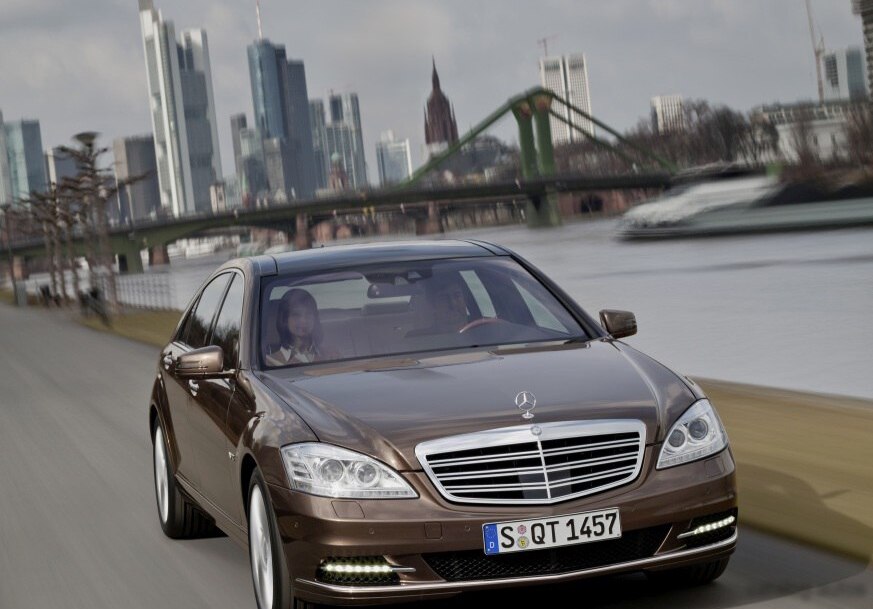
The Mercedes-Benz S 400 Hybrid, introduced as part of the V221 facelift in June 2009 and continuing through May 2013, represented a significant step towards fuel efficiency within the flagship S-Class range. Positioned as a technologically advanced option, it combined a 3.5-liter V6 gasoline engine with a mild hybrid system. This variant aimed to deliver S-Class luxury and performance with reduced emissions and improved fuel economy compared to its conventionally powered siblings. The “Long” designation indicates an extended wheelbase, offering increased rear passenger legroom, a popular feature in markets prioritizing chauffeur-driven luxury.
Technical Specifications
| Brand | Mercedes-Benz |
| Model | S-Class |
| Generation | S-Class Long (V221, facelift 2009) |
| Type (Engine) | S 400 V6 (299 Hp) HYBRID 7G-TRONIC |
| Start of production | June, 2009 |
| End of production | May, 2013 |
| Powertrain Architecture | MHEV (Mild Hybrid Electric Vehicle) |
| Body type | Sedan |
| Seats | 4-5 |
| Doors | 4 |
| Fuel consumption (urban) | 10.8-11 l/100 km (21.8 – 21.4 US mpg) |
| Fuel consumption (extra urban) | 6.4-6.6 l/100 km (36.8 – 35.6 US mpg) |
| Fuel consumption (combined) | 8-8.2 l/100 km (29.4 – 28.7 US mpg) |
| CO2 emissions | 188-191 g/km |
| Fuel Type | Petrol (Gasoline) |
| Acceleration 0 – 100 km/h | 7.2 sec |
| Acceleration 0 – 62 mph | 7.2 sec |
| Acceleration 0 – 60 mph | 6.8 sec |
| Maximum speed | 250 km/h (155.34 mph) |
| Emission standard | Euro 5 |
| Weight-to-power ratio | 6.5 kg/Hp |
| Weight-to-torque ratio | 5.1 kg/Nm |
| Battery voltage | 120 V |
| Battery technology | Lithium-ion (Li-Ion) |
| Battery location | Under the front hood |
| Electric motor power | 20 Hp |
| Electric motor location | Between the combustion engine and the transmission |
| Electric motor type | Synchronous |
| System power | 299 Hp |
| Engine Power | 279 Hp @ 6000 rpm |
| Engine Torque | 385 Nm @ 2400-5000 rpm (283.96 lb.-ft.) |
| Engine layout | Front, Longitudinal |
| Engine Model/Code | M 272.974 |
| Engine displacement | 3498 cm3 (213.46 cu. in.) |
| Number of cylinders | 6 |
| Engine configuration | V-engine |
| Cylinder Bore | 92.9 mm (3.66 in.) |
| Piston Stroke | 86 mm (3.39 in.) |
| Compression ratio | 11.7:1 |
| Number of valves per cylinder | 4 |
| Fuel injection system | Multi-port manifold injection |
| Engine aspiration | Naturally aspirated |
| Valvetrain | DOHC |
| Engine oil capacity | 8 l (8.45 US qt | 7.04 UK qt) |
| Kerb Weight | 1945 kg (4287.99 lbs.) |
| Max. weight | 2600 kg (5732.02 lbs.) |
| Max load | 655 kg (1444.03 lbs.) |
| Trunk (boot) space | 560 l (19.78 cu. ft.) |
| Fuel tank capacity | 90 l (23.78 US gal | 19.8 UK gal) |
| Length | 5226 mm (205.75 in.) |
| Width | 1871 mm (73.66 in.) |
| Width including mirrors | 2120 mm (83.46 in.) |
| Height | 1479 mm (58.23 in.) |
| Wheelbase | 3165 mm (124.61 in.) |
| Front track | 1600 mm (62.99 in.) |
| Rear track | 1606 mm (63.23 in.) |
| Front overhang | 888 mm (34.96 in.) |
| Rear overhang | 1173 mm (46.18 in.) |
| Drag coefficient (Cd) | 0.27 |
| Minimum turning circle | 12.2 m (40.03 ft.) |
| Drivetrain Architecture | RWD, MHEV |
| Drive wheel | Rear wheel drive |
| Number of gears | 7 |
| Gearbox type | Automatic transmission G-TRONIC |
| Front suspension | Independent multi-link, Air suspension |
| Rear suspension | Independent multi-link, Air suspension |
| Front brakes | Ventilated discs |
| Rear brakes | Disc |
INTRODUCTION
The S 400 Hybrid, launched in 2009, was a key component of Mercedes-Benz’s efforts to improve the fuel efficiency of its luxury vehicles without sacrificing the comfort and performance expected of the S-Class. Built on the V221 platform – the fourth generation of the S-Class – the facelifted model incorporated updated styling and, crucially, this new hybrid powertrain. The S 400 Hybrid was primarily aimed at markets where fuel costs were high and environmental regulations were becoming stricter, though it was also available in the United States. It occupied a middle ground in the S-Class lineup, offering a more economical alternative to the V8-powered S 550 and S 600 models, while providing more power and a more sophisticated driving experience than the entry-level S 350.
Powertrain & Engine Architecture
At the heart of the S 400 Hybrid lies the M272.974 3.5-liter naturally aspirated V6 engine. This engine, a mainstay of the Mercedes-Benz lineup, produces 279 horsepower at 6000 rpm and 385 Nm (283.96 lb.-ft.) of torque between 2400 and 5000 rpm. It utilizes a multi-port fuel injection system and a double overhead camshaft (DOHC) valvetrain. The key innovation, however, is the integration of a 20 horsepower electric motor sandwiched between the engine and the 7G-TRONIC seven-speed automatic transmission. This mild hybrid system doesn’t allow for purely electric driving; instead, the electric motor provides assistance during acceleration, regenerative braking to recapture energy, and enables an auto start/stop function to reduce idling fuel consumption. The system operates at a 120V level and utilizes a lithium-ion battery pack located under the front hood. The 7G-TRONIC transmission is specifically tuned to work seamlessly with the hybrid system, optimizing gear changes for both efficiency and performance.
Driving Characteristics
The S 400 Hybrid delivers a refined and comfortable driving experience, typical of the S-Class. The electric motor’s assistance provides a noticeable boost during initial acceleration, resulting in a 0-60 mph time of around 6.8 seconds. While not as overtly powerful as the V8 models, the S 400 Hybrid offers ample power for everyday driving and highway cruising. The 7G-TRONIC transmission shifts smoothly and efficiently, and the hybrid system’s regenerative braking is virtually imperceptible. Compared to the S 550, the S 400 Hybrid feels less urgent in its acceleration, but the trade-off is significantly improved fuel economy. The steering is light and precise, and the air suspension provides a plush and controlled ride. The hybrid system’s start/stop function can occasionally feel slightly abrupt, but it contributes significantly to reducing fuel consumption in urban environments.
Equipment & Trim Levels
The S 400 Hybrid typically came well-equipped, reflecting its position as a luxury vehicle. Standard features included leather upholstery, wood trim, a premium sound system, dual-zone automatic climate control, and a host of safety features such as ABS, stability control, and multiple airbags. The “Long” wheelbase version prioritized rear passenger comfort, offering increased legroom and often including features like rear seat entertainment options. Optional extras included a panoramic sunroof, massaging seats, a more advanced navigation system, and various driver assistance technologies. Interior color schemes were customizable, allowing buyers to personalize their vehicle. The dashboard layout was consistent with other V221 S-Class models, featuring a blend of traditional luxury and modern technology.
Chassis & Braking
The S 400 Hybrid utilizes a sophisticated chassis design focused on ride comfort and handling. It features an independent multi-link suspension at both the front and rear, complemented by an air suspension system that automatically adjusts to road conditions and driving style. This air suspension provides a remarkably smooth ride, even on uneven surfaces. The braking system consists of ventilated discs at the front and solid discs at the rear, providing ample stopping power. Anti-lock braking system (ABS) and electronic stability control are standard features, enhancing safety and control. The S 400 Hybrid’s weight (approximately 1945 kg or 4288 lbs) is comparable to other S-Class models, and the suspension is tuned to handle this weight effectively.
Market Reception & Comparison
The S 400 Hybrid was generally well-received by automotive critics, who praised its fuel efficiency and comfortable ride. However, some reviewers noted that the hybrid system didn’t deliver the dramatic fuel economy improvements seen in some other hybrid vehicles. Compared to the S 350, the S 400 Hybrid offered a more refined driving experience and slightly better performance, albeit at a higher price. Against the S 550, it provided a more economical alternative without sacrificing too much in terms of luxury or comfort. Reliability reports suggest that the hybrid system itself is generally robust, but owners should be mindful of maintaining the battery pack and associated components.
Legacy
The Mercedes-Benz S 400 Hybrid represents an important step in the evolution of the S-Class, demonstrating Mercedes-Benz’s commitment to improving fuel efficiency in its flagship models. While it wasn’t a revolutionary hybrid in terms of fuel savings, it paved the way for more advanced hybrid and plug-in hybrid S-Class variants in subsequent generations. On the used car market, the S 400 Hybrid offers a compelling value proposition for buyers seeking a luxurious and comfortable sedan with reasonable running costs. The M272 engine is known for its durability, and with proper maintenance, these vehicles can provide many years of reliable service. However, potential buyers should be aware of the potential costs associated with maintaining the hybrid system and ensuring the battery pack remains in good condition.