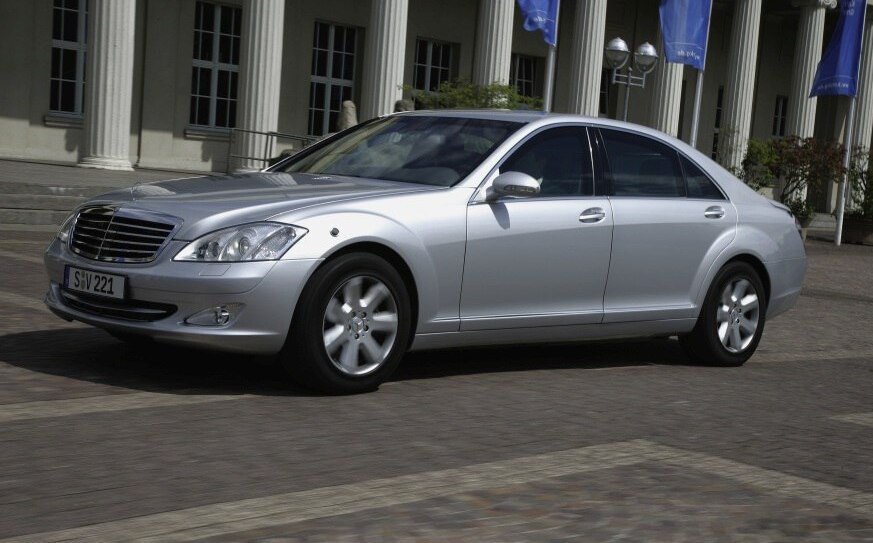
The Mercedes-Benz S-Class Long (V221) S 350, produced from 2005 to 2009, represented a significant iteration of the flagship S-Class sedan. Positioned as a mid-range offering within the extended-wheelbase V221 generation, the S 350 aimed to deliver a luxurious experience with a balance of performance and efficiency. The “Long” designation indicates an extended wheelbase, providing increased rear passenger legroom – a particularly important feature in markets where chauffeur-driven travel was common. This variant was primarily targeted at buyers seeking the prestige of the S-Class without the higher price tag and performance focus of the S 500 or S 600 models.
Technical Specifications
| Brand | Mercedes-Benz |
| Model | S-class |
| Generation | S-class Long (V221) |
| Type (Engine) | S 350 (272 Hp) 7G-TRONIC |
| Start of production | 2005 |
| End of production | 2009 |
| Powertrain Architecture | Internal Combustion engine |
| Body type | Sedan |
| Seats | 5 |
| Doors | 4 |
| Fuel consumption (urban) | 14.5-14.7 l/100 km (16.2 – 16 US mpg, 19.5 – 19.2 UK mpg, 6.9 – 6.8 km/l) |
| Fuel consumption (extra urban) | 7.7-7.9 l/100 km (30.5 – 29.8 US mpg, 36.7 – 35.8 UK mpg, 13 – 12.7 km/l) |
| Fuel consumption (combined) | 10.1-10.3 l/100 km (23.3 – 22.8 US mpg, 28 – 27.4 UK mpg, 9.9 – 9.7 km/l) |
| CO2 emissions | 242-247 g/km |
| Fuel Type | Petrol (Gasoline) |
| Acceleration 0 – 100 km/h | 7.3 sec |
| Acceleration 0 – 62 mph | 7.3 sec |
| Acceleration 0 – 60 mph | 6.9 sec |
| Maximum speed | 250 km/h (155.34 mph) |
| Weight-to-power ratio | 6.8 kg/Hp, 147 Hp/tonne |
| Weight-to-torque ratio | 5.3 kg/Nm, 189.2 Nm/tonne |
| Power | 272 Hp @ 6000 rpm |
| Power per litre | 77.8 Hp/l |
| Torque | 350 Nm @ 2400-5000 rpm (258.15 lb.-ft. @ 2400-5000 rpm) |
| Engine layout | Front, Longitudinal |
| Engine Model/Code | M 272.965 |
| Engine displacement | 3498 cm3 (213.46 cu. in.) |
| Number of cylinders | 6 |
| Engine configuration | V-engine |
| Cylinder Bore | 92.9 mm (3.66 in.) |
| Piston Stroke | 86 mm (3.39 in.) |
| Compression ratio | 10.7:1 |
| Number of valves per cylinder | 4 |
| Fuel injection system | Multi-port manifold injection |
| Engine aspiration | Naturally aspirated engine |
| Valvetrain | DOHC |
| Engine oil capacity | 8 l (8.45 US qt | 7.04 UK qt) |
| Coolant | 8 l (8.45 US qt | 7.04 UK qt) |
| Kerb Weight | 1850 kg (4078.55 lbs.) |
| Max. weight | 2505 kg (5522.58 lbs.) |
| Max load | 655 kg (1444.03 lbs.) |
| Trunk (boot) space – maximum | 560 l (19.78 cu. ft.) |
| Fuel tank capacity | 90 l (23.78 US gal | 19.8 UK gal) |
| Length | 5209 mm (205.08 in.) |
| Width | 1872 mm (73.7 in.) |
| Width including mirrors | 2115 mm (83.27 in.) |
| Height | 1473 mm (57.99 in.) |
| Wheelbase | 3165 mm (124.61 in.) |
| Front track | 1604 mm (63.15 in.) |
| Rear (Back) track | 1606 mm (63.23 in.) |
| Front overhang | 871 mm (34.29 in.) |
| Rear overhang | 1173 mm (46.18 in.) |
| Drivetrain Architecture | Rear wheel drive |
| Drive wheel | Rear wheel drive |
| Number of gears and type of gearbox | 7 gears, automatic transmission G-TRONIC |
| Front brakes | Disc |
| Rear brakes | Disc |
| Assisting systems | ABS (Anti-lock braking system) |
| Steering type | Steering rack and pinion |
| Tires size | 235/55 R17 |
| Wheel rims size | 17 |
Powertrain & Engine Architecture
The S 350 was powered by the M272.965 3.5-liter naturally aspirated V6 engine. This engine, a cornerstone of Mercedes-Benz’s mid-2000s lineup, featured a 60-degree V-angle and utilized a three-valve-per-cylinder (two intake, one exhaust) design with double overhead camshafts (DOHC). The engine employed multi-port fuel injection and a relatively high 10.7:1 compression ratio to maximize efficiency and power output. The 7G-TRONIC seven-speed automatic transmission was standard, offering smooth and relatively quick shifts. This transmission was a significant advancement over previous five-speed automatics, contributing to improved fuel economy and more refined driving experience. The 7G-TRONIC featured a torque converter lock-up clutch that engaged in multiple gears, further enhancing efficiency.
Driving Characteristics
The S 350, with its 272 horsepower and 350 Nm (258 lb-ft) of torque, provided a comfortable and composed driving experience. Acceleration from 0 to 60 mph took approximately 6.9 seconds, which was respectable for a large luxury sedan of that era, but noticeably slower than the more powerful S 500. The 7G-TRONIC transmission was well-matched to the engine, providing adequate responsiveness for everyday driving. However, the engine could feel somewhat strained when pushed hard, particularly during overtaking maneuvers. The gear ratios were tuned for comfort and fuel economy rather than outright performance. Compared to the V8-powered S 500, the S 350 offered a more relaxed and fuel-efficient driving experience, but at the expense of outright speed and responsiveness.
Equipment & Trim Levels
The S 350 Long came standard with a comprehensive array of luxury features, befitting its flagship status. These included leather upholstery, wood trim, automatic climate control, a premium sound system, and power-adjustable front seats with memory function. Rear passengers benefited from the extended wheelbase, offering generous legroom and available features like rear seat entertainment and individual climate control. Optional extras included a panoramic sunroof, upgraded leather packages, massaging seats, and advanced driver-assistance systems such as Distronic adaptive cruise control and Parktronic parking assist. The interior design emphasized elegance and sophistication, with a focus on high-quality materials and meticulous craftsmanship.
Chassis & Braking
The V221 S-Class featured an independent suspension system all around, utilizing air suspension with Adaptive Damping System (ADS) to provide a smooth and controlled ride. The S 350 typically came equipped with disc brakes on all four wheels, coupled with ABS (Anti-lock Braking System), Electronic Stability Program (ESP), and Brake Assist. The suspension was tuned to prioritize comfort, effectively isolating passengers from road imperfections. The steering was precise and well-weighted, providing a confident feel at highway speeds. The standard tire size was 235/55 R17, mounted on 17-inch alloy wheels.
Market Reception & Comparison
The S 350 Long was generally well-received by automotive critics, who praised its luxurious interior, comfortable ride, and refined driving experience. However, some reviewers noted that the engine lacked the punch of the V8 models. Fuel economy was considered reasonable for a vehicle of its size and class, averaging around 23-28 mpg in combined driving. Compared to the S 500, the S 350 offered a more affordable entry point into the S-Class range, appealing to buyers who prioritized comfort and efficiency over outright performance. The S 350 also offered a compelling alternative to other luxury sedans, such as the BMW 7 Series and Audi A8.
Legacy
The M272 engine, while generally reliable, is known to be susceptible to certain issues, including oil leaks from the valve cover gaskets and potential problems with the balance shaft. The 7G-TRONIC transmission is also relatively robust, but may require fluid changes and occasional maintenance to ensure smooth operation. Today, the V221 S 350 Long represents a relatively affordable way to experience the luxury and prestige of the S-Class. Well-maintained examples can still provide years of comfortable and reliable service, but prospective buyers should be aware of the potential maintenance costs associated with a vehicle of this age and complexity.