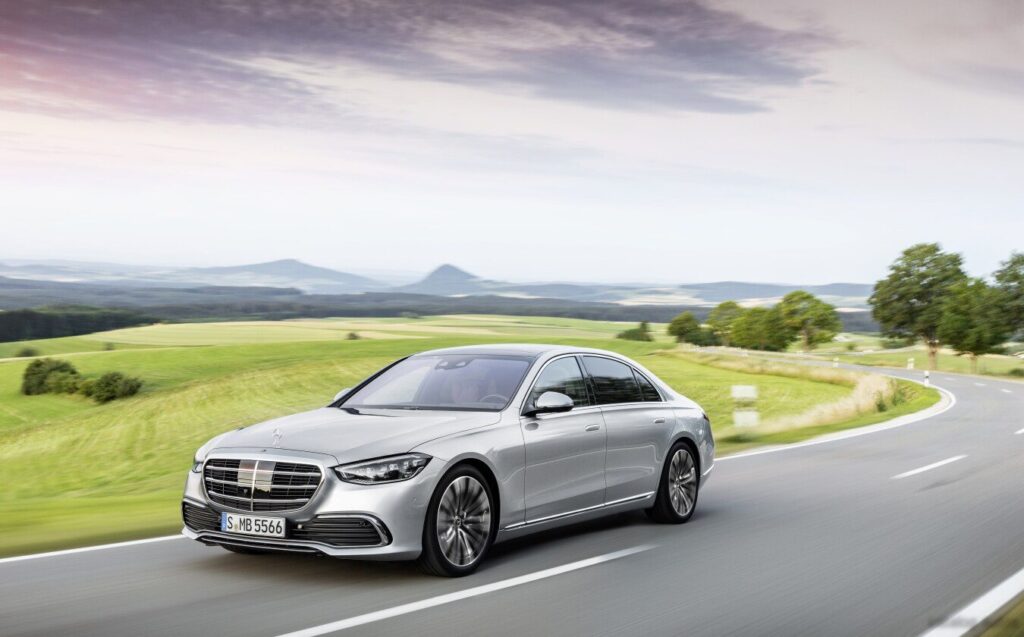
The Mercedes-Benz S-Class Long (V223) S 350d EQ Boost 9G-TRONIC, launched in May 2023, represents the latest iteration of the flagship S-Class sedan, specifically tailored for markets prioritizing rear passenger space. This variant, positioned as a mid-range offering within the V223 lineup, combines a potent diesel engine with mild-hybrid technology and a sophisticated nine-speed automatic transmission. Production is expected to continue through 2026. The “Long” designation indicates an extended wheelbase, adding approximately 109mm (4.3 inches) to the standard S-Class, primarily benefiting rear legroom. This model is a key component of Mercedes-Benz’s strategy to offer luxury and efficiency in a full-size executive sedan.
Technical Specifications
| Brand | Mercedes-Benz |
| Model | S-class |
| Generation | S-class Long (V223) |
| Type (Engine) | S 350d (313 Hp) EQ Boost 9G-TRONIC |
| Start of production | May, 2023 |
| End of production | 2026 |
| Powertrain Architecture | MHEV (Mild Hybrid Electric Vehicle) |
| Body type | Sedan |
| Seats | 4-5 |
| Doors | 4 |
| Combined fuel consumption (WLTP) | 5.9-6.8 l/100 km (39.9 – 34.6 US mpg, 47.9 – 41.5 UK mpg, 16.9 – 14.7 km/l) |
| CO2 emissions (WLTP) | 155-180 g/km |
| Fuel Type | Diesel |
| Acceleration 0 – 100 km/h | 5.6 sec |
| Acceleration 0 – 62 mph | 5.6 sec |
| Acceleration 0 – 60 mph | 5.3 sec |
| Maximum speed | 250 km/h (155.34 mph) |
| Emission standard | Euro 6e |
| Weight-to-power ratio | 6.5 kg/Hp, 153.8 Hp/tonne |
| Weight-to-torque ratio | 3.1 kg/Nm, 319.4 Nm/tonne |
| Gross battery capacity | 0.9 kWh |
| Battery voltage | 48 V |
| Battery technology | Lithium-ion (Li-Ion) |
| Electric motor power | 23 Hp |
| Electric motor Torque | 250 Nm (184.39 lb.-ft.) |
| Electric motor location | Between the combustion engine and the transmission |
| Power | 313 Hp @ 3600-4800 rpm |
| Power per litre | 104.7 Hp/l |
| Torque | 650 Nm @ 1200-3200 rpm (479.42 lb.-ft. @ 1200-3200 rpm) |
| Engine layout | Front, Longitudinal |
| Engine Model/Code | OM 656.830 |
| Engine displacement | 2989 cm3 (182.4 cu. in.) |
| Number of cylinders | 6 |
| Engine configuration | Inline |
| Compression ratio | 15.5:1 |
| Number of valves per cylinder | 4 |
| Fuel injection system | Diesel Commonrail |
| Engine aspiration | BiTurbo, Intercooler |
| Valvetrain | DOHC |
| Engine oil capacity | 9 l (9.51 US qt | 7.92 UK qt) |
| Coolant | 12 l (12.68 US qt | 10.56 UK qt) |
| Kerb Weight | 2035 kg (4486.41 lbs.) |
| Max. weight | 2765 kg (6095.78 lbs.) |
| Max load | 730 kg (1609.37 lbs.) |
| Trunk (boot) space – minimum | 540 l (19.07 cu. ft.) |
| Fuel tank capacity | 65 l (17.17 US gal | 14.3 UK gal) |
| AdBlue tank | 25 l (6.6 US gal | 5.5 UK gal) |
| Max. roof load | 100 kg (220.46 lbs.) |
| Permitted trailer load with brakes (12%) | 2100 kg (4629.71 lbs.) |
| Permitted trailer load without brakes | 750 kg (1653.47 lbs.) |
| Permitted towbar download | 85 kg (187.39 lbs.) |
| Length | 5289 mm (208.23 in.) |
| Width | 1954 mm (76.93 in.) |
| Width including mirrors | 2109 mm (83.03 in.) |
| Height | 1503 mm (59.17 in.) |
| Wheelbase | 3216 mm (126.61 in.) |
| Front track | 1655 mm (65.16 in.) |
| Rear (Back) track | 1651 mm (65 in.) |
| Front overhang | 877 mm (34.53 in.) |
| Rear overhang | 1196 mm (47.09 in.) |
| Ride height (ground clearance) | 130 mm (5.12 in.) |
| Minimum turning circle (turning diameter) | 10.8 m (35.43 ft.) |
| Drivetrain Architecture | Rear wheel drive. MHEV. ICE and electric motor drive rear wheels. |
| Number of gears and type of gearbox | 9 gears, automatic transmission G-TRONIC |
| Front suspension | Independent multi-link suspension, Air suspension |
| Rear suspension | Independent multi-link suspension, Air suspension |
| Front brakes | Ventilated discs |
| Rear brakes | Ventilated discs |
| Tires size (Front) | 235/55 R18; 255/45 R19; 255/40 R20; 255/35 R21 |
| Tires size (Rear) | 235/55 R18; 255/45 R19; 285/40 R19; 255/40 R20; 285/35 R20; 285/30 R21 |
Powertrain & Engine Architecture
The S 350d EQ Boost utilizes the OM 656.830, a 3.0-liter inline-six cylinder diesel engine. This engine is a hallmark of modern Mercedes-Benz diesel technology, featuring a sophisticated bi-turbocharger system with variable turbine geometry and intercooling. The engine employs a diesel commonrail direct injection system, delivering fuel at extremely high pressures for optimized combustion. The EQ Boost system adds a 48-volt mild-hybrid component, integrating a 23 horsepower electric motor and a 0.9 kWh lithium-ion battery. This system enables functions like extended coasting, smoother start/stop operation, and a small power boost during acceleration. The engine produces 313 horsepower at 3600-4800 rpm and a substantial 650 Nm (479.42 lb-ft) of torque between 1200-3200 rpm. The 9G-TRONIC nine-speed automatic transmission is standard, offering smooth and efficient gear changes. The transmission is specifically tuned to complement the engine’s torque characteristics, providing responsive acceleration and relaxed cruising.
Driving Characteristics
The S 350d EQ Boost delivers a refined and powerful driving experience. The combination of the diesel engine and mild-hybrid system provides ample torque from low engine speeds, resulting in strong acceleration. The 0-60 mph sprint takes approximately 5.3 seconds. While not as overtly sporty as some of the gasoline-powered S-Class variants, the S 350d offers a more than adequate level of performance for most drivers. The 9G-TRONIC transmission contributes to a smooth and seamless driving experience, with well-chosen gear ratios. The EQ Boost system subtly enhances responsiveness, particularly during overtaking maneuvers. Compared to higher-output S-Class models, the S 350d prioritizes fuel efficiency and relaxed cruising over outright performance.
Equipment & Trim Levels
The S 350d EQ Boost Long typically comes standard with a high level of equipment, befitting its flagship status. Standard features include Mercedes-Benz’s MBUX infotainment system with a large touchscreen display, premium leather upholstery, heated and ventilated front seats with massage functions, a panoramic sunroof, and a comprehensive suite of driver-assistance systems. Optional extras include advanced suspension systems (like E-Active Body Control), upgraded audio systems (Burmester), and various interior trim options. The long wheelbase provides significantly more rear legroom than the standard S-Class, making it particularly appealing to chauffeur-driven executives.
Chassis & Braking
The S-Class Long utilizes an independent multi-link suspension system at both the front and rear, often paired with Mercedes-Benz’s AIRMATIC air suspension. This provides a comfortable and controlled ride, even on uneven surfaces. The air suspension allows for adjustable ride height and damping settings. Braking is handled by ventilated discs on all four wheels, providing ample stopping power. Standard safety features include ABS, electronic stability control, and a suite of advanced driver-assistance systems, including lane-keeping assist, adaptive cruise control, and automatic emergency braking.
Market Reception & Comparison
The S 350d EQ Boost has been generally well-received by automotive critics. It’s praised for its refined driving experience, luxurious interior, and impressive fuel economy. The diesel engine offers a good balance of performance and efficiency, and the mild-hybrid system further enhances fuel savings. Compared to the S 450 or S 580 models, the S 350d offers a more affordable entry point into the S-Class range, while still providing a high level of luxury and technology. However, some critics note that the diesel engine can be slightly noisier than the gasoline alternatives. Fuel economy figures range from 5.9 to 6.8 liters per 100 kilometers (39.9 to 34.6 US mpg), making it a relatively efficient option in the luxury sedan segment.
Legacy
The OM 656 engine family, including the OM 656.830 found in the S 350d, has proven to be a reliable and durable powertrain. While long-term reliability data for the V223 generation is still emerging, the engine’s robust construction and advanced technology suggest it will be a dependable unit. On the used car market, the S 350d EQ Boost is expected to hold its value well, due to its desirable combination of luxury, efficiency, and performance. The integration of mild-hybrid technology positions this variant as a transitional model, bridging the gap between traditional internal combustion engines and fully electric vehicles.