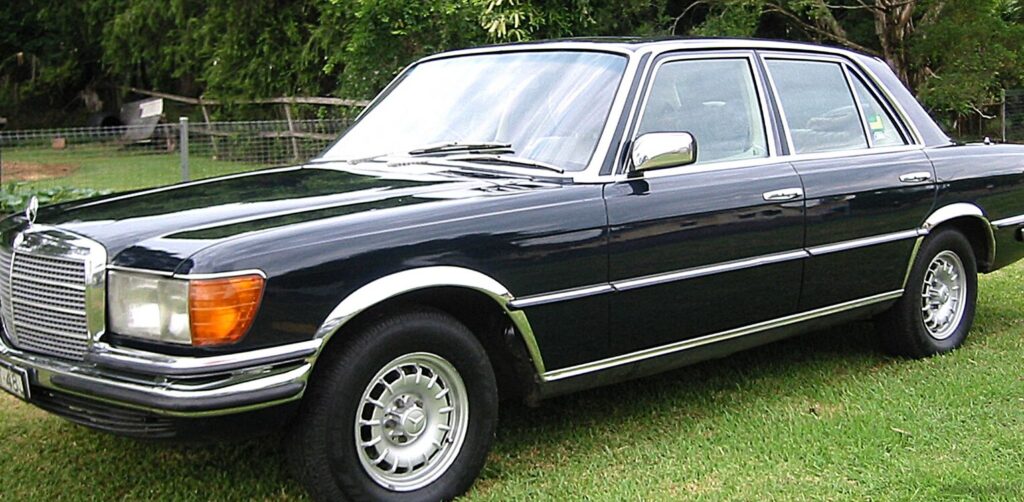
The Mercedes-Benz W116 series, produced from 1972 to 1980, represented a significant leap forward in luxury and safety for the German automaker. The 280 S, introduced in January 1976 and continuing through July 1980, occupied a middle ground within the W116 lineup. Positioned above the 280 SE but below the more powerful 350 SE/SEL and 450 SE/SEL models, the 280 S offered a balance of refinement, performance, and fuel economy that appealed to a broad segment of the luxury car market. It was a key model in establishing the S-Class as the benchmark for full-size luxury sedans.
Technical Specifications
| Brand | Mercedes-Benz |
| Model | S-class |
| Generation | S-class SE (W116) |
| Type (Engine) | 280 S (156 Hp) |
| Start of production | January, 1976 |
| End of production | July, 1980 |
| Powertrain Architecture | Internal Combustion engine |
| Body type | Sedan |
| Seats | 5 |
| Doors | 4 |
| Fuel consumption (urban) | 14 l/100 km (16.8 US mpg, 20.2 UK mpg, 7.1 km/l) |
| Fuel consumption (extra urban) | 10 l/100 km (23.5 US mpg, 28.2 UK mpg, 10 km/l) |
| Fuel consumption (combined) | 11 l/100 km (21.4 US mpg, 25.7 UK mpg, 9.1 km/l) |
| Fuel Type | Petrol (Gasoline) |
| Acceleration 0 – 100 km/h | 11.5 sec |
| Acceleration 0 – 62 mph | 11.5 sec |
| Acceleration 0 – 60 mph | 10.9 sec |
| Maximum speed | 190 km/h (118.06 mph) |
| Weight-to-power ratio | 10.3 kg/Hp, 96.9 Hp/tonne |
| Weight-to-torque ratio | 7.2 kg/Nm, 138.5 Nm/tonne |
| Power | 156 Hp @ 5500 rpm |
| Power per litre | 56.8 Hp/l |
| Torque | 223 Nm @ 4000 rpm (164.48 lb.-ft. @ 4000 rpm) |
| Engine layout | Front, Longitudinal |
| Engine Model/Code | M 110 V 28 / 110.922 |
| Engine displacement | 2746 cm3 (167.57 cu. in.) |
| Number of cylinders | 6 |
| Engine configuration | Inline |
| Cylinder Bore | 86 mm (3.39 in.) |
| Piston Stroke | 78.8 mm (3.1 in.) |
| Compression ratio | 8.7:1 |
| Number of valves per cylinder | 2 |
| Fuel injection system | Carburettor |
| Engine aspiration | Naturally aspirated engine |
| Valvetrain | DOHC |
| Engine oil capacity | 7 l (7.4 US qt | 6.16 UK qt) |
| Coolant | 10.5 l (11.1 US qt | 9.24 UK qt) |
| Kerb Weight | 1610 kg (3549.44 lbs.) |
| Max. weight | 2130 kg (4695.85 lbs.) |
| Max load | 520 kg (1146.4 lbs.) |
| Trunk (boot) space – minimum | 530 l (18.72 cu. ft.) |
| Fuel tank capacity | 96 l (25.36 US gal | 21.12 UK gal) |
| Length | 4960 mm (195.28 in.) |
| Width | 1870 mm (73.62 in.) |
| Height | 1425 mm (56.1 in.) |
| Wheelbase | 2860 mm (112.6 in.) |
| Front track | 1521 mm (59.88 in.) |
| Rear (Back) track | 1505 mm (59.25 in.) |
| Drivetrain Architecture | The Internal combustion engine (ICE) drives the rear wheels of the vehicle. |
| Drive wheel | Rear wheel drive |
| Number of gears and type of gearbox | 4 gears, manual transmission |
| Front suspension | Double wishbone |
| Rear suspension | Trailing arm |
| Front brakes | Ventilated discs |
| Rear brakes | Disc |
| Steering type | Cone worm with recirculation balls |
| Power steering | Hydraulic Steering |
| Tires size | Front wheel tires: 195/75 R14Rear wheel tires: 195/75 R14 |
| Wheel rims size | Front wheel rims: 6J x 14Rear wheel rims: 6J x 14 |
Powertrain & Engine Architecture
The heart of the 280 S was the M110 V28 engine, a 2.8-liter inline-six cylinder powerplant. This engine, a descendant of Mercedes-Benz’s long-standing six-cylinder tradition, featured a cast-iron block and an aluminum cylinder head. It utilized a single overhead camshaft (SOHC) design, operating two valves per cylinder. Unlike later Mercedes engines, the 280 S employed a Solex carburetor for fuel delivery, a system that, while reliable, was less efficient and offered less precise control than fuel injection. The engine produced 156 horsepower at 5,500 rpm and 223 Nm (164.48 lb-ft) of torque at 4,000 rpm. The engine’s longitudinal mounting and rear-wheel drive configuration were standard for Mercedes-Benz at the time. The standard transmission was a four-speed manual, though an optional four-speed automatic transmission was frequently selected by buyers prioritizing comfort.
Driving Characteristics
The 280 S with the manual transmission offered a reasonably engaging driving experience, though it wasn’t a sports car. Acceleration to 60 mph took around 10.9 seconds, and top speed was approximately 118 mph. The automatic transmission, while providing smoother shifts, noticeably dulled acceleration. The gear ratios were geared towards comfortable cruising rather than spirited performance. The 280 S excelled in providing a refined and quiet ride, typical of the W116 generation. The suspension, tuned for comfort, absorbed bumps effectively, and the steering, while not particularly direct, offered a reassuring feel at highway speeds.
Equipment & Trim Levels
The 280 S came standard with a respectable array of features for its era. These included power-assisted steering, power-assisted disc brakes on all four wheels, central locking, and a high-quality radio. The interior was typically upholstered in either cloth or leather, with wood trim adorning the dashboard and door panels. Optional extras included air conditioning, a sunroof, and upgraded audio systems. The 280 S generally featured a more restrained interior trim compared to the higher-spec SE/SEL models, focusing on durable materials and understated elegance.
Chassis & Braking
The W116 chassis featured independent suspension all around. The front suspension utilized double wishbones, while the rear employed a trailing arm setup. This configuration provided a comfortable ride and good handling characteristics. The 280 S was equipped with ventilated disc brakes on all four wheels, offering ample stopping power. The braking system was hydraulically assisted, providing a firm and progressive pedal feel. Stabilizer bars were fitted to both the front and rear axles to reduce body roll during cornering.
Market Reception & Comparison
The 280 S was well-received by automotive critics as a comfortable, reliable, and well-built luxury sedan. It was often praised for its ride quality and spacious interior. Compared to the 280 SE, the 280 S offered a slightly more economical engine, making it appealing to buyers concerned about fuel costs. However, the 280 SE’s larger engine provided noticeably more performance. The higher-end 350 SE/SEL and 450 SE/SEL models offered even greater levels of luxury and performance, but at a significantly higher price point. The 280 S struck a balance between these extremes, making it a popular choice for those seeking a refined and capable luxury car without the expense of the top-tier models.
Legacy
The Mercedes-Benz W116 280 S has proven to be a remarkably durable and reliable vehicle. The M110 engine, while not the most powerful of its time, is known for its longevity and relatively simple maintenance requirements. Today, well-maintained examples are sought after by classic car enthusiasts. Parts availability is generally good, although some specific trim pieces can be difficult to find. The 280 S represents a high point in Mercedes-Benz engineering and design, and it continues to offer a comfortable and elegant driving experience for those who appreciate classic luxury.