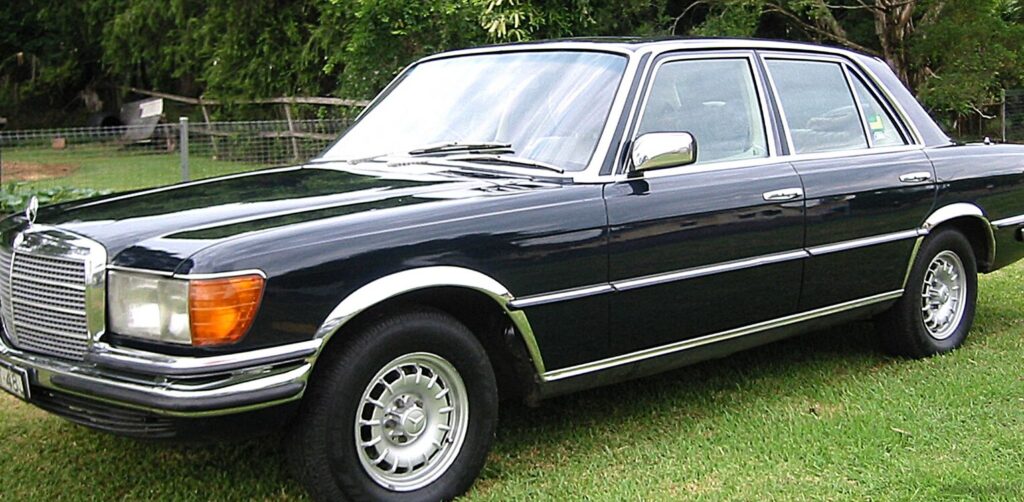
The Mercedes-Benz W116 series, produced from August 1972 to July 1980, represented a significant leap forward in luxury and safety for the German automaker. The 280 S, powered by the M110 V28 engine producing 160 horsepower, occupied a middle ground within the W116 lineup, positioned above the entry-level 280 but below the more powerful and expensive 350 and 450 models. It was designed to offer a balance of performance, refinement, and fuel economy for the discerning buyer. The W116 was the successor to the W108/W109 series and established many of the design cues and technological advancements that would define the S-Class for decades to come.
Technical Specifications
| Brand | Mercedes-Benz |
| Model | S-class |
| Generation | S-class SE (W116) |
| Type (Engine) | 280 S (160 Hp) |
| Start of production | August, 1972 |
| End of production | July, 1980 |
| Powertrain Architecture | Internal Combustion engine |
| Body type | Sedan |
| Seats | 5 |
| Doors | 4 |
| Fuel consumption (combined) | 12.5 l/100 km (18.8 US mpg, 22.6 UK mpg, 8 km/l) |
| Fuel Type | Petrol (Gasoline) |
| Acceleration 0 – 100 km/h | 11.5 sec |
| Acceleration 0 – 62 mph | 11.5 sec |
| Acceleration 0 – 60 mph | 10.9 sec |
| Maximum speed | 190 km/h (118.06 mph) |
| Weight-to-power ratio | 10.1 kg/Hp, 99.4 Hp/tonne |
| Weight-to-torque ratio | 7.1 kg/Nm, 140.4 Nm/tonne |
| Power | 160 Hp @ 5500 rpm |
| Power per litre | 58.3 Hp/l |
| Torque | 226 Nm @ 4000 rpm (166.69 lb.-ft. @ 4000 rpm) |
| Engine layout | Front, Longitudinal |
| Engine Model/Code | M 110 V 28 / 110.922 |
| Engine displacement | 2746 cm3 (167.57 cu. in.) |
| Number of cylinders | 6 |
| Engine configuration | Inline |
| Cylinder Bore | 86 mm (3.39 in.) |
| Piston Stroke | 78.8 mm (3.1 in.) |
| Compression ratio | 9:1 |
| Number of valves per cylinder | 2 |
| Fuel injection system | Carburettor |
| Engine aspiration | Naturally aspirated engine |
| Valvetrain | DOHC |
| Engine oil capacity | 7 l (7.4 US qt | 6.16 UK qt) |
| Coolant | 10.5 l (11.1 US qt | 9.24 UK qt) |
| Kerb Weight | 1610 kg (3549.44 lbs.) |
| Max. weight | 2130 kg (4695.85 lbs.) |
| Max load | 520 kg (1146.4 lbs.) |
| Trunk (boot) space – minimum | 530 l (18.72 cu. ft.) |
| Fuel tank capacity | 96 l (25.36 US gal | 21.12 UK gal) |
| Length | 4960 mm (195.28 in.) |
| Width | 1870 mm (73.62 in.) |
| Height | 1425 mm (56.1 in.) |
| Wheelbase | 2860 mm (112.6 in.) |
| Front track | 1521 mm (59.88 in.) |
| Rear (Back) track | 1505 mm (59.25 in.) |
| Drivetrain Architecture | The Internal combustion engine (ICE) drives the rear wheels of the vehicle. |
| Drive wheel | Rear wheel drive |
| Number of gears and type of gearbox | 4 gears, manual transmission |
| Front suspension | Double wishbone |
| Rear suspension | Trailing arm |
| Front brakes | Ventilated discs |
| Rear brakes | Disc |
| Steering type | Cone worm with recirculation balls |
| Power steering | Hydraulic Steering |
| Tires size | Front wheel tires: 195/75 R14Rear wheel tires: 195/75 R14 |
| Wheel rims size | Front wheel rims: 6J x 14Rear wheel rims: 6J x 14 |
Powertrain & Engine Architecture
The heart of the 280 S was the M110 V28 2.8-liter inline-six engine. This engine, a descendant of Mercedes-Benz’s long-standing six-cylinder tradition, featured a cast-iron block and an aluminum cylinder head. It utilized a single overhead camshaft (SOHC) design, operating two valves per cylinder. Fuel delivery was handled by a Solex 35/40 PHH carburetor, a relatively simple system for the time but providing adequate performance for the intended market. The engine code 110.922 specifically denotes this configuration. The M110 was known for its smoothness and durability, though it lacked the outright power of the V8 engines offered in higher-spec W116 models. The four-speed manual transmission was standard, offering a direct connection to the rear wheels.
Driving Characteristics
The 280 S with the manual transmission provided a reasonably engaging driving experience, though it wasn’t a sports car. Acceleration to 60 mph took around 10.9 seconds, which was respectable for the era but noticeably slower than the 350 or 450 S. The engine delivered its peak torque at 4000 rpm, requiring drivers to utilize the gearbox to maintain momentum, especially when overtaking. The gear ratios were spaced to prioritize fuel economy and cruising comfort over outright performance. Compared to the automatic versions, the manual offered more control and a slightly more responsive feel. The W116’s suspension, featuring double wishbones at the front and a trailing arm setup at the rear, provided a comfortable and controlled ride, absorbing bumps effectively while maintaining stability.
Equipment & Trim Levels
The 280 S came standard with a generous array of features for its time, including power-assisted steering, disc brakes on all four wheels, and comfortable cloth upholstery. Leather upholstery, air conditioning, a sunroof, and power windows were available as optional extras. The interior was characterized by its elegant design and high-quality materials. The dashboard featured wood trim and a comprehensive instrument cluster. The 280 S was generally positioned as a more affordable entry point into the S-Class range, appealing to buyers who prioritized comfort and reliability over outright performance and luxury.
Chassis & Braking
The W116 chassis was a robust and well-engineered structure, providing a solid foundation for the car’s luxurious appointments. The front suspension utilized double wishbones with coil springs and shock absorbers, while the rear employed a trailing arm setup, also with coil springs and shocks. The braking system consisted of ventilated disc brakes on all four wheels, providing ample stopping power. The steering was a recirculating ball system with hydraulic assistance, offering a good balance of feel and ease of use. Stabilizer bars were fitted to both the front and rear axles to reduce body roll during cornering.
Market Reception & Comparison
The 280 S was generally well-received by automotive critics, who praised its comfortable ride, refined interior, and solid build quality. However, some reviewers noted that its performance was somewhat underwhelming compared to the larger-engined models. Fuel economy was a concern, averaging around 18.8 US mpg, which was typical for a large luxury sedan of the era. Compared to the 350 S, the 280 S offered a more affordable price point but sacrificed performance. The 280 S also provided a more economical alternative to the 450 S, which was significantly more expensive and complex.
Legacy
The M110 engine, while not the most powerful in the W116 lineup, proved to be remarkably durable and reliable. Many examples are still on the road today, testament to the quality of its engineering. The 280 S, in particular, is often considered a good value in the used car market, offering a classic Mercedes-Benz experience at a relatively affordable price. Parts availability is generally good, although some specific components can be difficult to find. The W116 series as a whole is regarded as a landmark achievement in automotive engineering, setting the standard for luxury sedans for years to come. The 280 S represents a compelling entry point into the world of classic Mercedes-Benz ownership, offering a blend of style, comfort, and reliability.