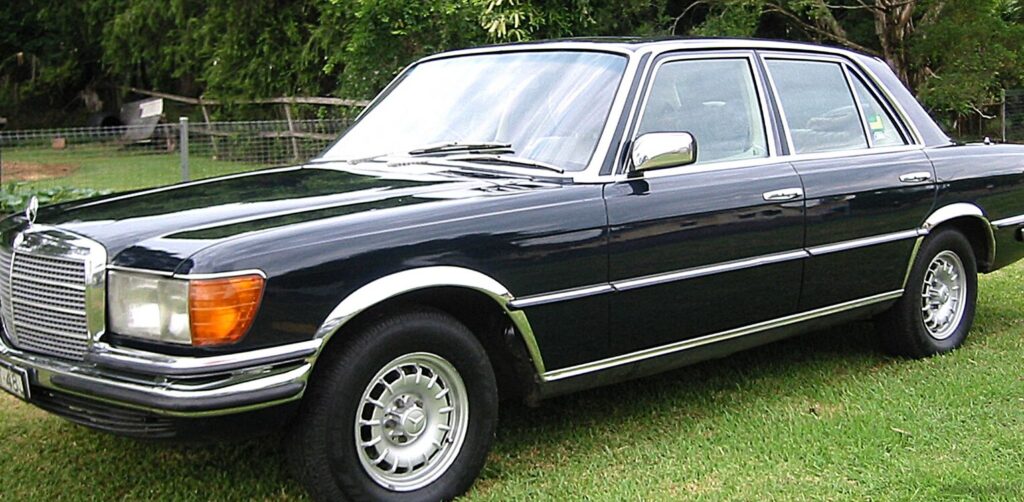
The Mercedes-Benz W116 series, produced from 1972 to 1980, represented a significant leap forward in luxury and engineering for the German automaker. The 280 SE, introduced in October 1973 and continuing through May 1980, occupied a crucial middle ground within the W116 lineup. Positioned above the entry-level 280 S and below the flagship 350 SE/SEL, the 280 SE offered a compelling blend of performance, refinement, and relative affordability. It was designed to appeal to buyers seeking the prestige of an S-Class without the higher price tag of the larger-displacement models. The W116 platform itself was revolutionary for its time, incorporating advanced safety features and a sophisticated independent suspension system.
Technical Specifications
| Brand | Mercedes-Benz |
| Model | S-class |
| Generation | S-class SE (W116) |
| Type (Engine) | 280 SE (185 Hp) |
| Start of production | October, 1973 |
| End of production | May, 1980 |
| Powertrain Architecture | Internal Combustion engine |
| Body type | Sedan |
| Seats | 5 |
| Doors | 4 |
| Fuel consumption (combined) | 12.5 l/100 km (18.8 US mpg, 22.6 UK mpg, 8 km/l) |
| Fuel Type | Petrol (Gasoline) |
| Acceleration 0 – 100 km/h | 10.5 sec |
| Acceleration 0 – 62 mph | 10.5 sec |
| Acceleration 0 – 60 mph | 10 sec |
| Maximum speed | 200 km/h (124.27 mph) |
| Weight-to-power ratio | 8.9 kg/Hp, 112.5 Hp/tonne |
| Weight-to-torque ratio | 6.9 kg/Nm, 144.7 Nm/tonne |
| Power | 185 Hp @ 6000 rpm |
| Power per litre | 67.4 Hp/l |
| Torque | 238 Nm @ 4500 rpm (175.54 lb.-ft. @ 4500 rpm) |
| Engine layout | Front, Longitudinal |
| Engine Model/Code | M 110 E 28 / 110.983 |
| Engine displacement | 2746 cm3 (167.57 cu. in.) |
| Number of cylinders | 6 |
| Engine configuration | Inline |
| Cylinder Bore | 86 mm (3.39 in.) |
| Piston Stroke | 78.8 mm (3.1 in.) |
| Compression ratio | 9:1 |
| Number of valves per cylinder | 2 |
| Fuel injection system | Multi-port manifold injection |
| Engine aspiration | Naturally aspirated engine |
| Valvetrain | DOHC |
| Engine oil capacity | 7.5 l (7.93 US qt | 6.6 UK qt) |
| Coolant | 11 l (11.62 US qt | 9.68 UK qt) |
| Kerb Weight | 1645 kg (3626.6 lbs.) |
| Max. weight | 2165 kg (4773.01 lbs.) |
| Max load | 520 kg (1146.4 lbs.) |
| Trunk (boot) space – minimum | 530 l (18.72 cu. ft.) |
| Fuel tank capacity | 96 l (25.36 US gal | 21.12 UK gal) |
| Length | 4960 mm (195.28 in.) |
| Width | 1870 mm (73.62 in.) |
| Height | 1425 mm (56.1 in.) |
| Wheelbase | 2860 mm (112.6 in.) |
| Front track | 1521 mm (59.88 in.) |
| Rear (Back) track | 1505 mm (59.25 in.) |
| Drivetrain Architecture | The Internal combustion engine (ICE) drives the rear wheels of the vehicle. |
| Drive wheel | Rear wheel drive |
| Number of gears and type of gearbox | 4 gears, manual transmission |
| Front suspension | Double wishbone |
| Rear suspension | Trailing arm |
| Front brakes | Ventilated discs |
| Rear brakes | Disc |
| Steering type | Cone worm with recirculation balls |
| Power steering | Hydraulic Steering |
| Tires size | Front wheel tires: 195/75 R14Rear wheel tires: 195/75 R14 |
| Wheel rims size | Front wheel rims: 6J x 14Rear wheel rims: 6J x 14 |
Powertrain & Engine Architecture
The 280 SE was powered by the M110 E 28 engine, a 2.8-liter inline-six cylinder powerplant. This engine, a descendant of Mercedes-Benz’s long-running M110 family, featured a cast-iron block and an aluminum cylinder head. It utilized a Bosch K-Jetronic fuel injection system, a mechanical continuous injection system known for its precision and reliability. The engine boasted a double overhead camshaft (DOHC) valvetrain, operating two valves per cylinder. The 9:1 compression ratio contributed to a respectable 185 horsepower at 6000 rpm and 238 Nm (175.54 lb-ft) of torque at 4500 rpm. The engine was mounted longitudinally in the front of the vehicle, driving the rear wheels. The standard transmission was a four-speed manual, though an optional four-speed automatic transmission was also available, and quite popular with buyers prioritizing comfort.
Driving Characteristics
The 280 SE with the manual transmission offered a reasonably engaging driving experience for its time. While not overtly sporty, the engine provided adequate power for comfortable highway cruising and passing maneuvers. The four-speed manual gearbox allowed for precise control, though the shift linkage wasn’t particularly short-throw. The automatic transmission, while smoother, noticeably dulled acceleration. Zero to 60 mph took around 10 seconds, and top speed was approximately 124 mph. The W116’s independent suspension – double wishbones at the front and a trailing arm setup at the rear – provided a comfortable and controlled ride, absorbing bumps effectively. Steering was via a recirculating ball system with hydraulic assistance, offering a good balance of feel and ease of use.
Equipment & Trim Levels
The 280 SE came standard with a generous array of features for the era, including power-assisted steering and brakes, central locking, and a high-quality radio. The interior was typically trimmed with cloth upholstery, though leather was available as an option. Dashboard layout was characterized by its elegant simplicity, with wood veneer accents and clearly marked gauges. Optional extras included air conditioning, sunroof, power windows, and upgraded sound systems. The 280 SE generally featured a more restrained level of trim compared to the 350 SE/SEL, focusing on understated luxury rather than ostentatious displays.
Chassis & Braking
The W116 chassis was a robust monocoque construction, prioritizing safety and rigidity. The 280 SE utilized ventilated disc brakes at the front and solid discs at the rear, providing ample stopping power. The suspension system was designed to provide a comfortable ride while maintaining good handling characteristics. Stabilizer bars were fitted to both the front and rear axles to reduce body roll during cornering. The relatively lighter weight of the 280 SE compared to the larger-engined models contributed to slightly more agile handling.
Market Reception & Comparison
The 280 SE was well-received by automotive critics as a balanced and refined luxury sedan. It offered a compelling alternative to the more expensive 350 SE/SEL, providing a similar level of comfort and prestige at a lower price point. Compared to the 280 S, the 280 SE’s larger engine provided noticeably improved performance. Fuel economy, however, was a concern, averaging around 18.8 US mpg. Reliability was generally good, though the K-Jetronic fuel injection system could require specialized maintenance. The 280 SE appealed to buyers who valued a smooth ride, comfortable interior, and the prestige of the Mercedes-Benz brand.
Legacy
The W116 280 SE remains a sought-after classic Mercedes-Benz today. The M110 engine, when properly maintained, is known for its durability and longevity. While parts availability can be a challenge, a dedicated community of enthusiasts ensures that spares are still obtainable. The 280 SE represents a high point in Mercedes-Benz engineering and design, offering a unique blend of classic styling, luxurious comfort, and robust mechanicals. Well-preserved examples command respectable prices in the used car market, appealing to collectors and enthusiasts alike. The W116 series, and the 280 SE in particular, laid the foundation for the modern S-Class, cementing Mercedes-Benz’s reputation as a leader in luxury automotive engineering.