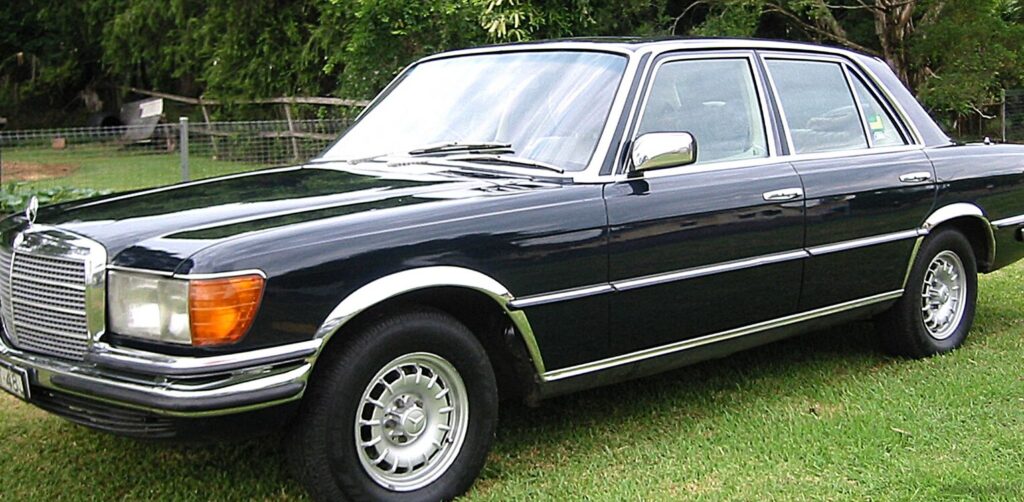
The Mercedes-Benz W116 series, produced from 1972 to 1979, represented a significant leap forward in luxury and safety for the German automaker. The 350 SE V8, introduced in March 1972 and continuing through January 1976, was a cornerstone of the initial W116 lineup. Positioned as a mid-range offering, it bridged the gap between the entry-level 280 SE and the flagship 450 SE, offering a compelling blend of performance, refinement, and advanced features for the era. The W116 was the successor to the W108/W109 series and established many of the design cues and technological advancements that would define the S-Class for decades to come.
Technical Specifications
| Brand | Mercedes-Benz |
| Model | S-class |
| Generation | S-class SE (W116) |
| Type (Engine) | 350 SE V8 (195 Hp) |
| Start of production | March, 1972 |
| End of production | January, 1976 |
| Powertrain Architecture | Internal Combustion engine |
| Body type | Sedan |
| Seats | 5 |
| Doors | 4 |
| Fuel consumption (combined) | 13 l/100 km (18.1 US mpg, 21.7 UK mpg, 7.7 km/l) |
| Fuel Type | Petrol (Gasoline) |
| Acceleration 0 – 100 km/h | 9.5 sec |
| Acceleration 0 – 62 mph | 9.5 sec |
| Acceleration 0 – 60 mph | 9 sec |
| Maximum speed | 205 km/h (127.38 mph) |
| Weight-to-power ratio | 8.6 kg/Hp, 116.4 Hp/tonne |
| Weight-to-torque ratio | 6.1 kg/Nm, 164.2 Nm/tonne |
| Power | 195 Hp @ 5500 rpm |
| Power per litre | 55.7 Hp/l |
| Torque | 275 Nm @ 4000 rpm (202.83 lb.-ft. @ 4000 rpm) |
| Engine layout | Front, Longitudinal |
| Engine Model/Code | M 116 E 35 / 116.985 |
| Engine displacement | 3499 cm3 (213.52 cu. in.) |
| Number of cylinders | 8 |
| Engine configuration | V-engine |
| Cylinder Bore | 92 mm (3.62 in.) |
| Piston Stroke | 65.8 mm (2.59 in.) |
| Compression ratio | 9:1 |
| Number of valves per cylinder | 2 |
| Fuel injection system | Multi-port manifold injection |
| Engine aspiration | Naturally aspirated engine |
| Valvetrain | SOHC |
| Engine oil capacity | 8 l (8.45 US qt | 7.04 UK qt) |
| Coolant capacity | 8 l (8.45 US qt | 7.04 UK qt) |
| Kerb Weight | 1675 kg (3692.74 lbs.) |
| Max. weight | 2195 kg (4839.15 lbs.) |
| Max load | 520 kg (1146.4 lbs.) |
| Trunk (boot) space – minimum | 530 l (18.72 cu. ft.) |
| Fuel tank capacity | 96 l (25.36 US gal | 21.12 UK gal) |
| Length | 4960 mm (195.28 in.) |
| Width | 1870 mm (73.62 in.) |
| Height | 1425 mm (56.1 in.) |
| Wheelbase | 2860 mm (112.6 in.) |
| Front track | 1521 mm (59.88 in.) |
| Rear (Back) track | 1505 mm (59.25 in.) |
| Drivetrain Architecture | The Internal combustion engine (ICE) drives the rear wheels of the vehicle. |
| Drive wheel | Rear wheel drive |
| Number of gears and type of gearbox | 4 gears, manual transmission |
| Front suspension | Double wishbone |
| Rear suspension | Trailing arm |
| Front brakes | Ventilated discs |
| Rear brakes | Disc |
| Steering type | Cone worm with recirculation balls |
| Power steering | Hydraulic Steering |
| Tires size | Front wheel tires: 205/70 R14 Rear wheel tires: 205/70 R14 |
| Wheel rims size | Front wheel rims: 6.5J x 14 Rear wheel rims: 6.5J x 14 |
Powertrain & Engine Architecture
The heart of the 350 SE V8 was the M116 E 35 engine, a 3.5-liter naturally aspirated V8. This engine featured a single overhead camshaft (SOHC) design, two valves per cylinder, and a compression ratio of 9:1. Crucially, it employed Bosch K-Jetronic multi-port fuel injection, a sophisticated system for its time that improved fuel efficiency and reduced emissions compared to carbureted engines. The M116 was known for its smooth power delivery and relatively quiet operation. The engine produced 195 horsepower at 5,500 rpm and 275 Nm (202.83 lb-ft) of torque at 4,000 rpm. The 350 SE was typically equipped with a 4-speed manual transmission, though an optional 3-speed automatic transmission was also available, impacting the driving experience.
Driving Characteristics
The 350 SE V8 offered a refined and comfortable driving experience. With the manual transmission, acceleration to 60 mph took around 9 seconds, and it could reach a top speed of 127.38 mph. The automatic transmission, while providing convenience, slightly dulled performance. The V8 engine provided ample torque for effortless cruising, and the suspension, featuring double wishbones at the front and a trailing arm setup at the rear, delivered a smooth ride. Steering was via a cone worm and recirculation ball system with hydraulic power assistance, offering a good balance of feel and ease of use. Compared to the 280 SE, the 350 SE offered noticeably more power and a more relaxed highway cruising experience. However, it lacked the outright performance of the larger-engined 450 SE.
Equipment & Trim Levels
The 350 SE V8 came standard with a high level of equipment for the early 1970s. This included power-assisted steering, power-assisted disc brakes on all four wheels, central locking, and a high-quality interior with cloth upholstery. Leather upholstery, air conditioning, a sunroof, and a self-leveling suspension were available as optional extras. The dashboard featured wood trim and a comprehensive array of gauges. The interior was designed for comfort and luxury, reflecting Mercedes-Benz’s commitment to providing a premium experience.
Chassis & Braking
The W116 chassis was a robust and well-engineered platform. The 350 SE utilized ventilated disc brakes at the front and solid discs at the rear, providing effective stopping power. The suspension system was designed to prioritize ride comfort, with anti-roll bars helping to minimize body roll during cornering. The steering system, as mentioned, was a recirculating ball setup with hydraulic assistance. Tire size was typically 205/70 R14 all around, mounted on 6.5J x 14 inch wheels.
Market Reception & Comparison
The 350 SE V8 was well-received by automotive critics and buyers alike. It was praised for its smooth engine, comfortable ride, and high level of refinement. Compared to the 280 SE, the 350 SE offered a significant performance upgrade without the higher price tag of the 450 SE. Fuel economy, at 18.1 US mpg, was reasonable for a V8-powered luxury car of the era. Reliability was generally good, although the K-Jetronic fuel injection system could require specialized maintenance. The 350 SE V8 was seen as a sweet spot in the W116 range, offering a compelling combination of luxury, performance, and value.
Legacy
The M116 engine proved to be a durable and reliable powerplant, and many 350 SE V8s remain on the road today. While the K-Jetronic fuel injection system can require specialized knowledge for maintenance, parts availability is generally good. The W116 series, and the 350 SE V8 in particular, is now considered a classic Mercedes-Benz, appreciated by enthusiasts for its elegant styling, comfortable ride, and robust engineering. In the used car market, well-maintained examples command a premium, reflecting their enduring appeal and historical significance. The W116 laid the foundation for the modern S-Class, establishing a benchmark for luxury and innovation that continues to this day.