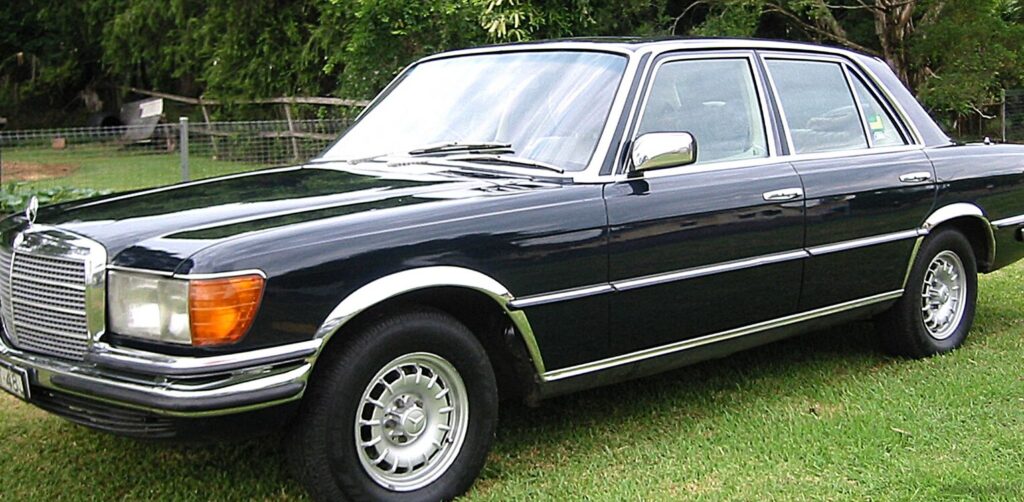
The Mercedes-Benz W116 series, produced from 1972 to 1979, represented a significant leap forward in luxury and safety for the German automaker. Within this generation, the 350 SE V8 Automatic, manufactured between March 1972 and January 1976, occupied a crucial position as a mid-range offering, blending performance with the renowned Mercedes-Benz comfort. It served as a stepping stone between the entry-level 280 SE and the flagship 450 SE, appealing to buyers seeking a powerful yet refined grand touring experience. The W116 was the successor to the W108/W109 series and established many of the design cues and engineering principles that would define the S-Class for decades to come.
Technical Specifications
| Brand | Mercedes-Benz |
| Model | S-class |
| Generation | S-class SE (W116) |
| Type (Engine) | 350 SE V8 (195 Hp) Automatic |
| Start of production | March, 1972 |
| End of production | January, 1976 |
| Powertrain Architecture | Internal Combustion engine |
| Body type | Sedan |
| Seats | 5 |
| Doors | 4 |
| Fuel consumption (combined) | 13 l/100 km (18.1 US mpg, 21.7 UK mpg, 7.7 km/l) |
| Fuel Type | Petrol (Gasoline) |
| Acceleration 0 – 100 km/h | 10.3 sec |
| Acceleration 0 – 62 mph | 10.3 sec |
| Acceleration 0 – 60 mph | 9.8 sec |
| Maximum speed | 200 km/h (124.27 mph) |
| Weight-to-power ratio | 8.6 kg/Hp, 116.4 Hp/tonne |
| Weight-to-torque ratio | 6.1 kg/Nm, 164.2 Nm/tonne |
| Power | 195 Hp @ 5500 rpm |
| Power per litre | 55.7 Hp/l |
| Torque | 275 Nm @ 4000 rpm (202.83 lb.-ft. @ 4000 rpm) |
| Engine layout | Front, Longitudinal |
| Engine Model/Code | M 116 E 35 / 116.985 |
| Engine displacement | 3499 cm3 (213.52 cu. in.) |
| Number of cylinders | 8 |
| Engine configuration | V-engine |
| Cylinder Bore | 92 mm (3.62 in.) |
| Piston Stroke | 65.8 mm (2.59 in.) |
| Compression ratio | 9:1 |
| Number of valves per cylinder | 2 |
| Fuel injection system | Multi-port manifold injection |
| Engine aspiration | Naturally aspirated engine |
| Valvetrain | SOHC |
| Engine oil capacity | 8 l (8.45 US qt | 7.04 UK qt) |
| Coolant | 8 l (8.45 US qt | 7.04 UK qt) |
| Kerb Weight | 1675 kg (3692.74 lbs.) |
| Max. weight | 2195 kg (4839.15 lbs.) |
| Max load | 520 kg (1146.4 lbs.) |
| Trunk (boot) space – minimum | 530 l (18.72 cu. ft.) |
| Fuel tank capacity | 96 l (25.36 US gal | 21.12 UK gal) |
| Length | 4960 mm (195.28 in.) |
| Width | 1870 mm (73.62 in.) |
| Height | 1425 mm (56.1 in.) |
| Wheelbase | 2860 mm (112.6 in.) |
| Front track | 1521 mm (59.88 in.) |
| Rear (Back) track | 1505 mm (59.25 in.) |
| Drivetrain Architecture | The Internal combustion engine (ICE) drives the rear wheels of the vehicle. |
| Drive wheel | Rear wheel drive |
| Number of gears and type of gearbox | 3 gears, automatic transmission |
| Front suspension | Double wishbone |
| Rear suspension | Trailing arm |
| Front brakes | Ventilated discs |
| Rear brakes | Disc |
| Steering type | Cone worm with recirculation balls |
| Power steering | Hydraulic Steering |
| Tires size | Front wheel tires: 205/70 R14 Rear wheel tires: 205/70 R14 |
| Wheel rims size | Front wheel rims: 6.5J x 14 Rear wheel rims: 6.5J x 14 |
Powertrain & Engine Architecture
The heart of the 350 SE was the M116 E 35 engine, a 3.5-liter naturally aspirated V8. This engine featured a cast iron block and aluminum cylinder heads, a design choice that helped to reduce weight and improve heat dissipation. It employed a single overhead camshaft (SOHC) valvetrain operating two valves per cylinder. Crucially, the M116 utilized Bosch K-Jetronic multi-port fuel injection, a sophisticated system for its time that contributed to smooth power delivery and relatively good fuel economy. The engine produced 195 horsepower at 5,500 rpm and 275 Nm (202.83 lb-ft) of torque at 4,000 rpm. Paired with this engine was a three-speed automatic transmission, providing a comfortable and effortless driving experience. This transmission was known for its smoothness, but lacked the responsiveness of a manual gearbox.
Driving Characteristics
The 350 SE Automatic prioritized comfort and refinement over outright performance. While the 195 hp engine provided adequate power for highway cruising and passing maneuvers, acceleration was not particularly brisk, taking around 10.3 seconds to reach 60 mph. The automatic transmission, while smooth, contributed to a slight disconnect between throttle input and wheel speed. Compared to the 280 SE, the 350 SE offered a noticeable increase in power and torque, resulting in more relaxed performance. However, it couldn’t match the responsiveness of the later 450 SE models with their larger displacement engines. The gear ratios were optimized for cruising, making it a superb long-distance vehicle, but less engaging on twisty roads.
Equipment & Trim Levels
The 350 SE came standard with a high level of equipment, befitting its luxury status. This included power-assisted steering, power-assisted disc brakes on all four wheels, central locking, and electric windows. The interior was typically upholstered in high-quality leather, with wood trim adorning the dashboard and door panels. Air conditioning was a common option, as were electric sunroofs and upgraded audio systems. The 350 SE offered a more luxurious experience than the base 280 SE, but lacked some of the more exclusive features found on the 450 SE, such as automatic climate control and more extensive leather trim.
Chassis & Braking
The W116 chassis featured independent suspension all around, with double wishbones at the front and a trailing arm setup at the rear. This configuration provided a comfortable ride and good handling characteristics. The 350 SE utilized ventilated disc brakes on all four wheels, offering excellent stopping power. Power steering was standard, making the car easy to maneuver at low speeds. The rear brakes were discs, a step up from the drums found on some earlier Mercedes-Benz models. Stabilizer bars were fitted front and rear to reduce body roll during cornering.
Market Reception & Comparison
The 350 SE V8 Automatic was well-received by critics and buyers alike. It was praised for its comfortable ride, refined interior, and powerful engine. Fuel economy, at 13 liters per 100 kilometers (18.1 US mpg), was reasonable for a car of its size and performance. Compared to the 280 SE, the 350 SE offered a significant performance upgrade, while remaining more affordable than the 450 SE. Reliability was generally good, although the K-Jetronic fuel injection system could require specialized maintenance. The 350 SE struck a sweet spot in the W116 lineup, offering a compelling blend of luxury, performance, and value.
Legacy
The M116 engine proved to be a durable and reliable powerplant, with many examples still running today. The W116 series as a whole is considered a classic Mercedes-Benz, and the 350 SE V8 Automatic remains a desirable model among collectors and enthusiasts. While maintenance costs can be higher than for more modern vehicles, the 350 SE offers a unique driving experience and a timeless sense of style. The K-Jetronic fuel injection system can be a point of concern for potential buyers, requiring a mechanic familiar with this technology. However, with proper care and maintenance, the 350 SE V8 Automatic can provide many years of enjoyable motoring.