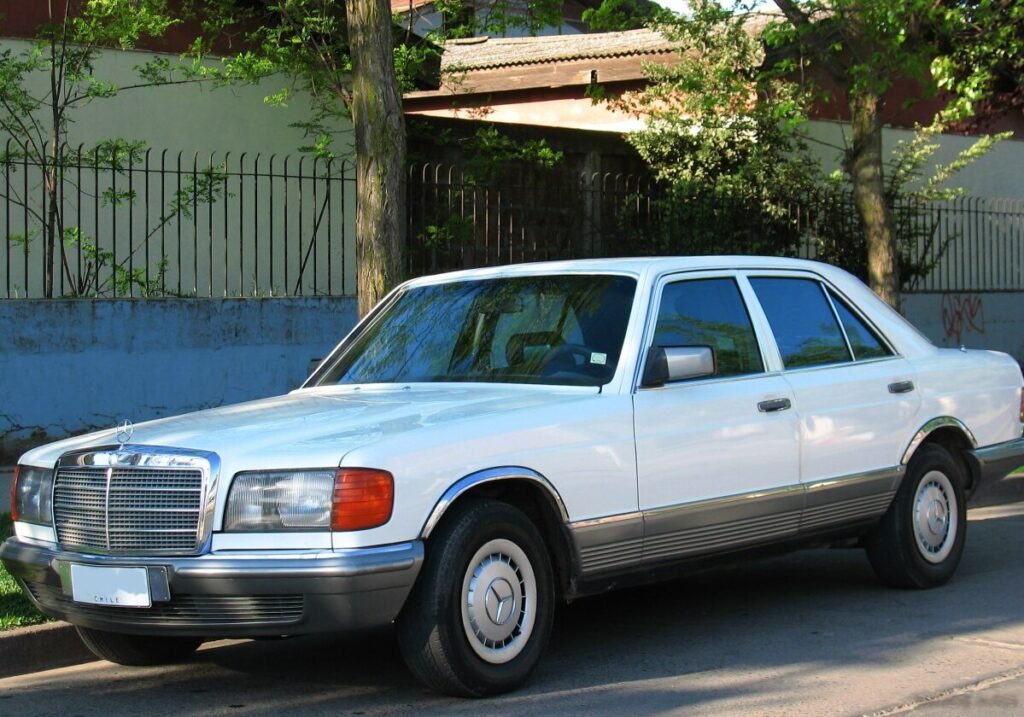
The Mercedes-Benz W126 S-Class, manufactured between 1979 and 1991, marked a substantial advancement in automotive luxury and safety standards. Within this generation, the 300 SD Turbodiesel Automatic, produced from October 1982 to August 1985, held a distinctive position. It combined the prestige and comfort associated with the S-Class with the fuel efficiency and renowned durability of a turbocharged diesel engine, coupled with the convenience of an automatic transmission. This variant specifically catered to buyers who prioritized long-distance comfort and economy over outright performance, finding particular favor in European markets where diesel fuel was more accessible and cost-effective.
Technical Specifications
| Brand | Mercedes-Benz |
| Model | S-class |
| Generation | S-class SE (W126) |
| Type (Engine) | 300 SD Turbodiesel (125 Hp) Automatic |
| Start of production | October, 1982 |
| End of production | August, 1985 |
| Powertrain Architecture | Internal Combustion engine |
| Body type | Sedan |
| Seats | 5 |
| Doors | 4 |
| Fuel Type | Diesel |
| Acceleration 0 – 100 km/h | 15.2 sec |
| Acceleration 0 – 62 mph | 15.2 sec |
| Acceleration 0 – 60 mph | 14.4 sec |
| Maximum speed | 175 km/h (108.74 mph) |
| Weight-to-power ratio | 13.6 kg/Hp, 73.7 Hp/tonne |
| Weight-to-torque ratio | 6.8 kg/Nm, 147.5 Nm/tonne |
| Power | 125 Hp @ 4350 rpm |
| Power per litre | 41.7 Hp/l |
| Torque | 250 Nm @ 2400 rpm (184.39 lb.-ft. @ 2400 rpm) |
| Engine layout | Front, Longitudinal |
| Engine Model/Code | OM 617 D 30 A / 617.951 |
| Engine displacement | 2998 cm3 (182.95 cu. in.) |
| Number of cylinders | 5 |
| Engine configuration | Inline |
| Cylinder Bore | 90.9 mm (3.58 in.) |
| Piston Stroke | 92.4 mm (3.64 in.) |
| Compression ratio | 21.5:1 |
| Number of valves per cylinder | 2 |
| Fuel injection system | Multi-port manifold injection |
| Engine aspiration | Turbocharger |
| Valvetrain | SOHC |
| Engine oil capacity | 9.5 l (10.04 US qt | 8.36 UK qt) |
| Coolant | 12.5 l (13.21 US qt | 11 UK qt) |
| Kerb Weight | 1695-1705 kg (3736.84 – 3758.88 lbs.) |
| Max. weight | 2170 kg (4784.03 lbs.) |
| Max load | 465-475 kg (1025.15 – 1047.2 lbs.) |
| Trunk (boot) space – minimum | 505 l (17.83 cu. ft.) |
| Fuel tank capacity | 77 l (20.34 US gal | 16.94 UK gal) |
| Length | 5145 mm (202.56 in.) |
| Width | 1820 mm (71.65 in.) |
| Height | 1430 mm (56.3 in.) |
| Wheelbase | 2930 mm (115.35 in.) |
| Front track | 1545 mm (60.83 in.) |
| Rear (Back) track | 1517 mm (59.72 in.) |
| Drivetrain Architecture | The Internal combustion engine (ICE) drives the rear wheels of the vehicle. |
| Drive wheel | Rear wheel drive |
| Number of gears and type of gearbox | 4 gears, automatic transmission |
| Front suspension | Double wishbone |
| Rear suspension | Trailing arm |
| Front brakes | Ventilated discs |
| Rear brakes | Disc |
| Steering type | Cone worm with recirculation balls |
| Power steering | Hydraulic Steering |
| Tires size | Front wheel tires: 195/70 R14Rear wheel tires: 195/70 R14 |
| Wheel rims size | Front wheel rims: 6J x 14Rear wheel rims: 6J x 14 |
Powertrain & Engine Architecture
The 300 SD’s powertrain revolved around the OM617.951, a 3.0-liter inline five-cylinder diesel engine. This engine was a mainstay of Mercedes-Benz diesel technology for many years, celebrated for its inherent robustness and long service life. The ‘D 30 A’ designation signified the engine’s displacement and the inclusion of a turbocharger. The turbocharger substantially increased power output compared to naturally aspirated versions, achieving 125 horsepower and 184 lb-ft of torque. Fuel delivery was managed by a multi-port manifold injection system, a relatively sophisticated system for its era, contributing to enhanced combustion efficiency and reduced emissions. The engine incorporated a single overhead camshaft (SOHC) valvetrain operating two valves per cylinder. The automatic transmission was a four-speed unit, engineered to provide smooth and comfortable gear changes, complementing the diesel engine’s torque characteristics.
Driving Characteristics
The 300 SD Turbodiesel Automatic wasn’t engineered for rapid acceleration. Its 0-60 mph time of approximately 14.4 seconds demonstrates this. However, the engine’s considerable torque, readily available from low engine speeds, provided sufficient power for comfortable cruising and effortless highway overtaking. The automatic transmission, while smooth, wasn’t particularly quick to downshift, requiring drivers to anticipate acceleration needs. Compared to the manual transmission versions, the automatic offered greater convenience but at the cost of some responsiveness. In contrast to the more powerful gasoline-powered S-Class models (such as the 380SE), the 300 SD prioritized fuel economy and long-term reliability over outright performance. The gear ratios were optimized for fuel efficiency and relaxed cruising, rather than aggressive acceleration.
Equipment & Trim Levels
The 300 SD Turbodiesel Automatic came standard with a comprehensive range of features expected of its S-Class designation. These included power windows, central locking, a sunroof, and climate control. Interior upholstery was typically a high-quality cloth, with leather upholstery available as an optional upgrade. The dashboard layout was a classic Mercedes-Benz design, featuring wood trim and analog gauges. Optional extras encompassed a premium sound system, heated seats, and a self-leveling suspension system. The trim level remained largely consistent across the 300 SD models, with optional extras providing the primary means of personalization.
Chassis & Braking
The W126 S-Class boasted a sturdy chassis with independent suspension on all four wheels. The front suspension utilized a double wishbone design, while the rear employed a trailing arm setup. This configuration delivered a comfortable ride and commendable handling characteristics. Braking was achieved through ventilated discs at the front and solid discs at the rear. Hydraulic power steering was standard, simplifying maneuvering the large sedan. Stabilizer bars were fitted to both the front and rear axles to minimize body roll during cornering. The suspension was tuned for comfort, prioritizing a smooth ride over sporty handling dynamics.
Market Reception & Comparison
The 300 SD Turbodiesel Automatic was well-received in Europe, where diesel fuel was more affordable and widely available. Reviewers lauded its fuel efficiency and comfortable ride quality. However, some critics noted its comparatively slow acceleration when measured against its gasoline-powered counterparts. In the US market, the 300 SD was less popular, as gasoline prices were lower and diesel engines were often perceived as noisy and underpowered. Compared to the 300SE (gasoline), the SD offered significantly improved fuel economy but less performance. When contrasted with the later 300SDL (estate/wagon) version, the sedan offered a more traditional luxury experience, while the SDL provided enhanced practicality.
Legacy
The OM617 engine, powering the 300 SD, is celebrated for its exceptional durability and has earned a reputation for exceeding 300,000 miles with diligent maintenance. Today, the W126 S-Class, including the 300 SD, is a highly sought-after classic automobile. The diesel variant, while not as frequently collected as some of the gasoline models, is appreciated by enthusiasts for its unique character and fuel efficiency. Parts availability is generally good, although certain diesel-specific components can be more challenging to locate. The 300 SD Turbodiesel Automatic represents a unique combination of luxury, durability, and fuel economy, making it an appealing choice for classic Mercedes-Benz collectors and enthusiasts.