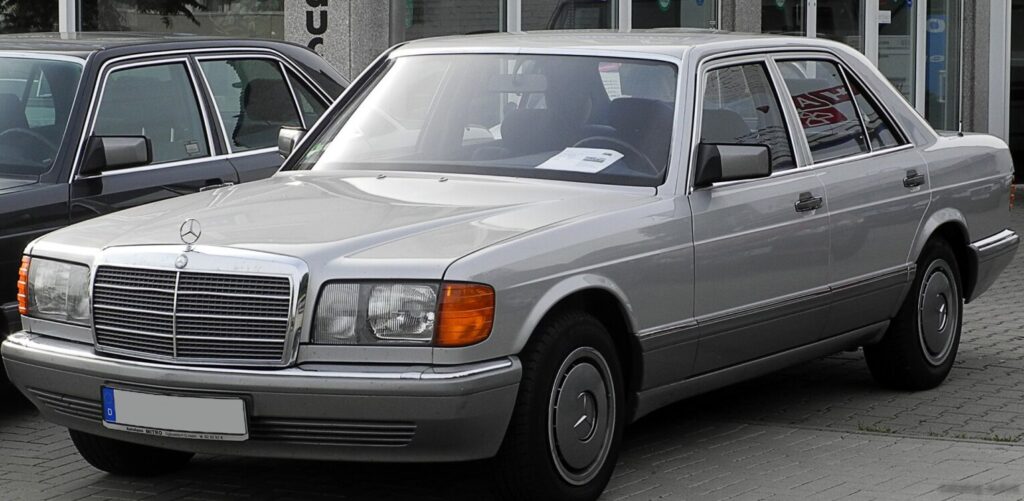
The Mercedes-Benz 420 SE, part of the W126 S-Class range produced from 1985 to 1987, represented a significant evolution of the flagship sedan. This facelifted version of the W126, introduced in 1985, offered a blend of luxury, performance, and advanced technology for its time. The 420 SE specifically denoted a model equipped with a 4.2-liter V8 engine, catalytic converter (“CAT”), and an automatic transmission. It occupied a mid-to-upper position within the S-Class lineup, offering a step up in performance and refinement from the six-cylinder 280 SE and 300 SE models, while remaining more accessible than the range-topping 560 SE.
Technical Specifications
| Brand | Mercedes-Benz |
| Model | S-class |
| Generation | S-class SE (W126, facelift 1985) |
| Type (Engine) | 420 SE V8 CAT (204 Hp) Automatic |
| Start of production | June, 1985 |
| End of production | September, 1987 |
| Powertrain Architecture | Internal Combustion engine |
| Body type | Sedan |
| Seats | 5 |
| Doors | 4 |
| Fuel consumption (urban) | 14.9 l/100 km (15.8 US mpg / 19 UK mpg) |
| Fuel consumption (extra urban) | 9.3 l/100 km (25.3 US mpg / 30.4 UK mpg) |
| Fuel Type | Petrol (Gasoline) |
| Acceleration 0 – 100 km/h | 8.7 sec |
| Acceleration 0 – 62 mph | 8.7 sec |
| Acceleration 0 – 60 mph | 8.3 sec |
| Maximum speed | 210 km/h (130.49 mph) |
| Weight-to-power ratio | 7.8 kg/Hp |
| Weight-to-torque ratio | 5.2 kg/Nm |
| Power | 204 Hp @ 5200 rpm |
| Torque | 310 Nm @ 3600 rpm (228.64 lb.-ft. @ 3600 rpm) |
| Engine layout | Front, Longitudinal |
| Engine Model/Code | M 116 E 42 / 116.965 |
| Engine displacement | 4196 cm3 (256.06 cu. in.) |
| Number of cylinders | 8 |
| Engine configuration | V-engine |
| Cylinder Bore | 92 mm (3.62 in.) |
| Piston Stroke | 78.9 mm (3.11 in.) |
| Compression ratio | 9:1 |
| Number of valves per cylinder | 2 |
| Fuel injection system | Multi-port manifold injection |
| Engine aspiration | Naturally aspirated engine |
| Valvetrain | SOHC |
| Engine oil capacity | 8 l (8.45 US qt | 7.04 UK qt) |
| Coolant capacity | 12.5 l (13.21 US qt | 11 UK qt) |
| Kerb Weight | 1600 kg (3527.4 lbs.) |
| Max. weight | 2120 kg (4673.8 lbs.) |
| Max load | 520 kg (1146.4 lbs.) |
| Fuel tank capacity | 90 l (23.78 US gal | 19.8 UK gal) |
| Length | 5020 mm (197.64 in.) |
| Width | 1820 mm (71.65 in.) |
| Height | 1437 mm (56.57 in.) |
| Wheelbase | 2930 mm (115.35 in.) |
| Front track | 1555 mm (61.22 in.) |
| Rear track | 1527 mm (60.12 in.) |
| Drivetrain Architecture | Rear wheel drive |
| Number of gears | 4 |
| Gearbox type | Automatic transmission |
| Front suspension | Double wishbone |
| Rear suspension | Trailing arm |
| Front brakes | Ventilated discs |
| Rear brakes | Disc |
| Assisting systems | ABS (Anti-lock braking system) |
| Steering type | Cone worm with recirculation balls |
| Power steering | Hydraulic |
| Tires size | 205/65 R15 |
| Wheel rims size | 7J x 15 |
Powertrain & Engine Architecture
The heart of the 420 SE was the M116 E 42 engine, a 4.2-liter (4196 cc) naturally aspirated V8. This engine featured a single overhead camshaft (SOHC) design with two valves per cylinder. The M116 series was known for its robust construction and smooth operation. Fuel delivery was handled by a Bosch K-Jetronic multi-port fuel injection system, a mechanical system known for its reliability but less precise than later electronic systems. The catalytic converter, denoted by the “CAT” in the model name, was a crucial component for meeting increasingly stringent emissions regulations. The engine produced 204 horsepower at 5200 rpm and 310 Nm (228.64 lb-ft) of torque at 3600 rpm. The automatic transmission was a four-speed unit, designed to provide smooth and comfortable shifts, prioritizing luxury over outright performance.
Driving Characteristics
The 420 SE with the automatic transmission offered a refined and comfortable driving experience. While not as sporty as the manual transmission equipped models or the higher-output 560 SE, it provided ample power for effortless cruising and confident overtaking. The automatic transmission, while smooth, did result in some power loss compared to the manual options. The gear ratios were tuned for relaxed acceleration rather than rapid sprints. The 0-60 mph time of around 8.3 seconds was respectable for the era, but noticeably slower than the manual versions. The focus was on providing a serene and luxurious ride, absorbing bumps and imperfections in the road with ease.
Equipment & Trim Levels
The 420 SE came standard with a comprehensive list of features befitting a luxury sedan of its time. This included power windows, power locks, a sunroof, leather upholstery, and climate control. Wood trim adorned the interior, adding to the sense of opulence. Optional extras included a premium sound system, heated seats, and a self-leveling suspension system. The interior layout was classic Mercedes-Benz, emphasizing functionality and understated elegance. The dashboard featured a comprehensive array of gauges, providing the driver with essential information.
Chassis & Braking
The W126 S-Class featured a robust chassis with independent suspension all around. The front suspension utilized a double wishbone design, while the rear employed a trailing arm setup. This configuration provided a comfortable ride and good handling characteristics. The 420 SE was equipped with ventilated disc brakes at the front and solid disc brakes at the rear. An Anti-lock Braking System (ABS) was standard, enhancing safety by preventing wheel lockup during hard braking. The steering was a recirculating ball system with hydraulic power assistance, providing a comfortable and manageable driving experience.
Market Reception & Comparison
The 420 SE was generally well-received by automotive critics. It was praised for its comfortable ride, refined interior, and powerful engine. However, some critics noted that the automatic transmission dulled the engine’s performance somewhat. Compared to the 280 SE and 300 SE, the 420 SE offered a significant performance upgrade. Compared to the 560 SE, it provided a similar level of luxury but with slightly less power and a lower price tag. Fuel economy, while not a primary concern for S-Class buyers, was reasonable for a V8 engine of that era, averaging around 15.8 mpg in the city and 25.3 mpg on the highway.
Legacy
The W126 S-Class, including the 420 SE, is widely regarded as one of the best Mercedes-Benz sedans ever produced. The M116 engine is known for its durability and longevity, and well-maintained examples can still provide reliable service today. The 420 SE, in particular, strikes a good balance between performance, luxury, and affordability in the used car market. While maintenance can be expensive due to the car’s age and complexity, the W126 S-Class remains a popular choice for enthusiasts and collectors who appreciate its classic design, engineering, and driving experience. Parts availability is generally good, although some specific components may be difficult to find. The 420 SE represents a high point in Mercedes-Benz engineering and a testament to the brand’s commitment to quality and luxury.