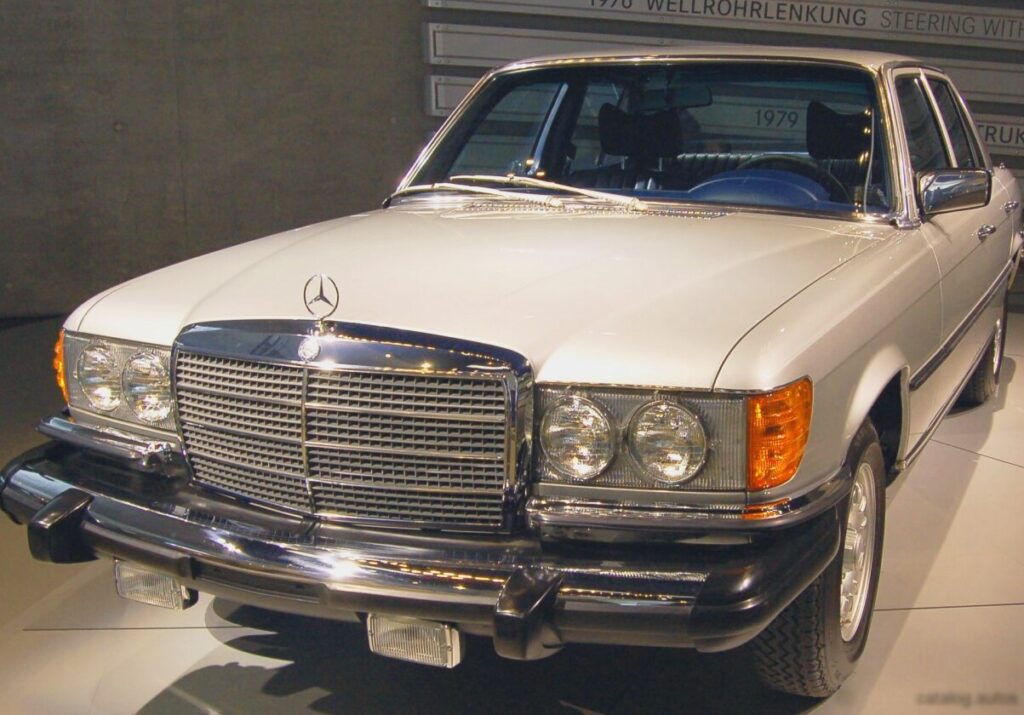
The Mercedes-Benz W116 series, produced from 1972 to 1979, represented a significant leap forward in luxury and safety for the German automaker. Within this generation, the 280 SEL, specifically the variant equipped with the M110 E 28 engine and automatic transmission, occupied a middle ground in the lineup. Production of this specific configuration ran from February 1976 to April 1978. It offered a balance of performance and refinement, appealing to buyers who desired the prestige of an S-Class but didn’t require the outright power of the larger displacement models like the 450 SEL 6.9. The W116 established many of the safety features that would become standard in luxury cars for decades to come, and the 280 SEL automatic was a popular choice for discerning customers.
Technical Specifications
| Brand | Mercedes-Benz |
| Model | S-class |
| Generation | S-class SEL (V116) |
| Type (Engine) | 280 SEL (177 Hp) Automatic |
| Start of production | February, 1976 |
| End of production | April, 1978 |
| Powertrain Architecture | Internal Combustion engine |
| Body type | Sedan |
| Seats | 5 |
| Doors | 4 |
| Fuel consumption (combined) | 12.5 l/100 km (18.8 US mpg, 22.6 UK mpg, 8 km/l) |
| Fuel Type | Petrol (Gasoline) |
| Acceleration 0 – 100 km/h | 11.3 sec |
| Acceleration 0 – 62 mph | 11.3 sec |
| Acceleration 0 – 60 mph | 10.7 sec |
| Maximum speed | 195 km/h (121.17 mph) |
| Weight-to-power ratio | 9.3 kg/Hp, 107.6 Hp/tonne |
| Weight-to-torque ratio | 7.1 kg/Nm, 141.6 Nm/tonne |
| Power | 177 Hp @ 6000 rpm |
| Power per litre | 64.5 Hp/l |
| Torque | 233 Nm @ 4500 rpm (171.85 lb.-ft. @ 4500 rpm) |
| Engine layout | Front, Longitudinal |
| Engine Model/Code | M 110 E 28 / 110.985 |
| Engine displacement | 2746 cm3 (167.57 cu. in.) |
| Number of cylinders | 6 |
| Engine configuration | Inline |
| Cylinder Bore | 86 mm (3.39 in.) |
| Piston Stroke | 78.8 mm (3.1 in.) |
| Compression ratio | 9:1 |
| Number of valves per cylinder | 4 |
| Fuel injection system | Multi-port manifold injection |
| Engine aspiration | Naturally aspirated engine |
| Valvetrain | DOHC |
| Engine oil capacity | 7.5 l (7.93 US qt | 6.6 UK qt) |
| Coolant | 11 l (11.62 US qt | 9.68 UK qt) |
| Kerb Weight | 1645 kg (3626.6 lbs.) |
| Max. weight | 2165 kg (4773.01 lbs.) |
| Max load | 520 kg (1146.4 lbs.) |
| Trunk (boot) space – minimum | 530 l (18.72 cu. ft.) |
| Fuel tank capacity | 96 l (25.36 US gal | 21.12 UK gal) |
| Length | 5060 mm (199.21 in.) |
| Width | 1870 mm (73.62 in.) |
| Height | 1430 mm (56.3 in.) |
| Wheelbase | 2960 mm (116.54 in.) |
| Front track | 1521 mm (59.88 in.) |
| Rear (Back) track | 1505 mm (59.25 in.) |
| Drivetrain Architecture | The Internal combustion engine (ICE) drives the rear wheels of the vehicle. |
| Drive wheel | Rear wheel drive |
| Number of gears and type of gearbox | 4 gears, automatic transmission |
| Front suspension | Double wishbone |
| Rear suspension | Trailing arm |
| Front brakes | Ventilated discs |
| Rear brakes | Disc |
| Steering type | Cone worm with recirculation balls |
| Power steering | Hydraulic Steering |
| Tires size | Front wheel tires: 195/75 R14Rear wheel tires: 195/75 R14 |
| Wheel rims size | Front wheel rims: 6J x 14Rear wheel rims: 6J x 14 |
Powertrain & Engine Architecture
The heart of the 280 SEL was the M110 E 28 engine, a 2.8-liter inline-six cylinder powerplant. This engine was a development of the earlier M110 series, known for its smoothness and durability. It featured a cast iron block and aluminum cylinder head, employing a dual overhead camshaft (DOHC) valvetrain. Fuel delivery was handled by Bosch K-Jetronic multi-port fuel injection, a sophisticated system for its time that improved fuel efficiency and reduced emissions compared to carburetors. The engine produced 177 horsepower at 6000 rpm and 233 Nm (171.85 lb-ft) of torque at 4500 rpm. The automatic transmission was a four-speed unit, providing smooth and relatively quick shifts. While not a performance-oriented transmission, it was well-suited to the engine’s characteristics and the car’s intended role as a comfortable cruiser.
Driving Characteristics
The 280 SEL automatic offered a refined and comfortable driving experience. Acceleration was adequate, with a 0-60 mph time of around 10.7 seconds, but it wasn’t particularly quick compared to other S-Class variants or contemporary sports sedans. The automatic transmission’s gear ratios were geared towards relaxed cruising, prioritizing smoothness over outright performance. The inline-six engine delivered its power in a linear fashion, making it easy to modulate and providing ample torque for everyday driving. Compared to the manual transmission versions, the automatic offered less driver involvement but greater convenience. Against the more powerful 450 SEL, the 280 SEL felt noticeably less potent, but it also offered better fuel economy and a lighter feel.
Equipment & Trim Levels
The 280 SEL automatic came standard with a generous array of features for the era. These included power steering, power-assisted disc brakes on all four wheels, central locking, and a high-quality radio. The interior was typically upholstered in leather or high-quality cloth, with wood trim adorning the dashboard and door panels. Optional extras included air conditioning, a sunroof, and upgraded audio systems. The level of equipment reflected the S-Class’s position as Mercedes-Benz’s flagship model, offering a luxurious and comfortable environment for both driver and passengers.
Chassis & Braking
The W116 chassis featured independent suspension all around, with double wishbones at the front and a trailing arm setup at the rear. This provided a comfortable ride and good handling characteristics. The 280 SEL typically came equipped with ventilated disc brakes on all four wheels, offering excellent stopping power. Power steering was standard, making the car easy to maneuver at low speeds. The suspension was tuned for comfort, prioritizing a smooth ride over sporty handling, but it still provided a stable and predictable driving experience.
Market Reception & Comparison
The 280 SEL automatic was well-received by critics and buyers alike. It was praised for its comfortable ride, refined engine, and luxurious interior. While some reviewers noted its lack of outright performance compared to other S-Class models, they acknowledged that it offered a good balance of features and affordability. Fuel economy was considered reasonable for a large luxury sedan of the time, averaging around 18.8 US mpg. Compared to the 450 SEL, the 280 SEL was more economical to run and maintain, making it a popular choice for buyers who didn’t need the extra power.
Legacy
The Mercedes-Benz W116 S-Class, including the 280 SEL automatic, is now considered a classic car. The M110 engine is known for its durability and reliability, and many examples are still on the road today. While maintenance can be expensive due to the car’s age and complexity, parts availability is generally good. The 280 SEL automatic remains a desirable model for collectors and enthusiasts, offering a taste of 1970s luxury and engineering excellence. Its robust construction and relatively simple mechanicals, compared to later S-Class generations, contribute to its enduring appeal in the used car market.