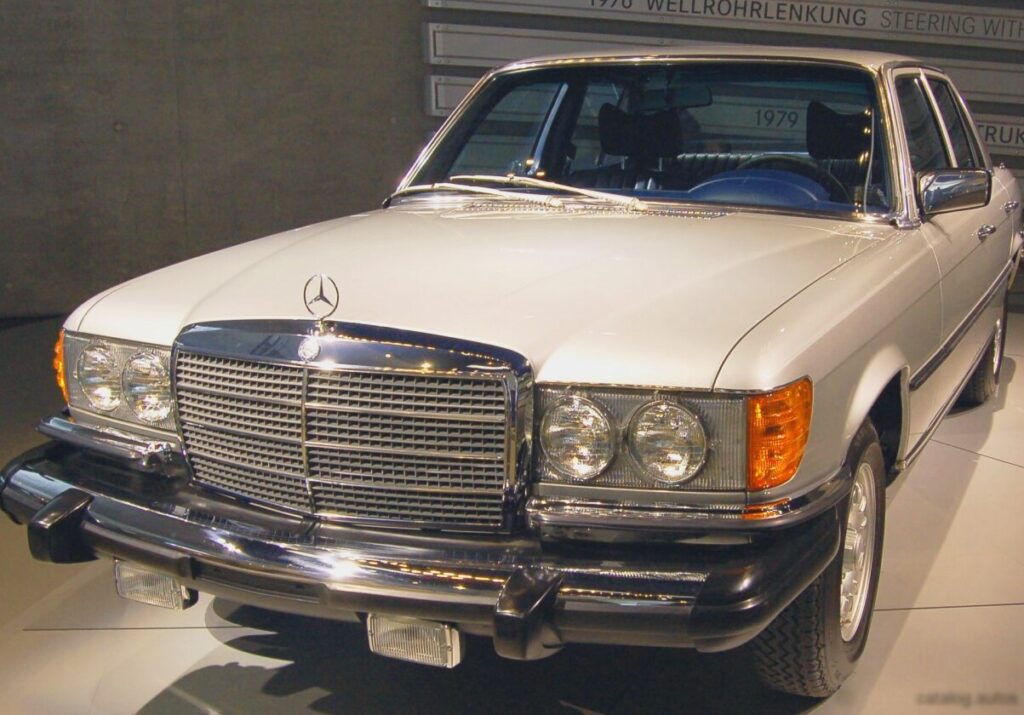
The Mercedes-Benz S-Class SEL (V116) 450 SEL 6.9, produced between September 1975 and May 1980, represented the pinnacle of luxury and performance for the German automaker during that era. Positioned as the flagship variant of the W116 S-Class range, the 6.9 was distinguished by its significantly larger engine and more opulent appointments. It was intended to compete directly with Rolls-Royce and Bentley, offering a blend of German engineering precision and traditional luxury. The “SEL” designation signified the long-wheelbase sedan body style, providing enhanced rear passenger space. This model is particularly notable for its advanced (for the time) hydropneumatic suspension and robust build quality, cementing its status as a collector’s item today.
Technical Specifications
| Brand | Mercedes-Benz |
| Model | S-class |
| Generation | S-class SEL (V116) |
| Type (Engine) | 450 SEL 6.9 (286 Hp) Automatic |
| Start of production | September, 1975 |
| End of production | May, 1980 |
| Powertrain Architecture | Internal Combustion engine |
| Body type | Sedan |
| Seats | 5 |
| Doors | 4 |
| Fuel consumption (combined) | 16 l/100 km |
| Fuel consumption (US mpg) | 14.7 |
| Fuel consumption (UK mpg) | 17.7 |
| Fuel consumption (km/l) | 6.3 |
| Fuel Type | Petrol (Gasoline) |
| Acceleration 0 – 100 km/h | 7.4 sec |
| Acceleration 0 – 62 mph | 7.4 sec |
| Acceleration 0 – 60 mph | 7 sec |
| Maximum speed | 225 km/h (139.81 mph) |
| Weight-to-power ratio | 6.8 kg/Hp |
| Weight-to-torque ratio | 3.5 kg/Nm |
| Power | 286 Hp @ 4250 rpm |
| Power per litre | 41.8 Hp/l |
| Torque | 550 Nm @ 3000 rpm (405.66 lb.-ft. @ 3000 rpm) |
| Engine layout | Front, Longitudinal |
| Engine Model/Code | M 100.985 |
| Engine displacement | 6834 cm3 (417.04 cu. in.) |
| Number of cylinders | 8 |
| Engine configuration | V-engine |
| Cylinder Bore | 107 mm (4.21 in.) |
| Piston Stroke | 95 mm (3.74 in.) |
| Compression ratio | 8.8:1 |
| Number of valves per cylinder | 2 |
| Engine aspiration | Naturally aspirated |
| Valvetrain | SOHC |
| Engine oil capacity | 11 l (11.62 US qt | 9.68 UK qt) |
| Coolant capacity | 16 l (16.91 US qt | 14.08 UK qt) |
| Kerb Weight | 1935 kg (4265.94 lbs.) |
| Max. weight | 2420 kg (5335.19 lbs.) |
| Max load | 485 kg (1069.24 lbs.) |
| Trunk (boot) space – minimum | 530 l (18.72 cu. ft.) |
| Fuel tank capacity | 96 l (25.36 US gal | 21.12 UK gal) |
| Permitted trailer load with brakes (12%) | 1200 kg (2645.55 lbs.) |
| Permitted trailer load without brakes | 750 kg (1653.47 lbs.) |
| Length | 5060 mm (199.21 in.) |
| Width | 1870 mm (73.62 in.) |
| Height | 1410 mm (55.51 in.) |
| Wheelbase | 2960 mm (116.54 in.) |
| Front track | 1521 mm (59.88 in.) |
| Rear track | 1505 mm (59.25 in.) |
| Minimum turning circle | 12.10 m (39.7 ft.) |
| Drivetrain Architecture | Rear wheel drive |
| Number of gears and type of gearbox | 3 gears, automatic transmission |
| Front suspension | Double wishbone, Transverse stabilizer |
| Rear suspension | Hydro-pneumatic element, Threaded twist beam |
| Front brakes | Ventilated discs |
| Rear brakes | Disc |
| Steering type | Cone worm with recirculation balls |
| Power steering | Hydraulic |
| Tires size | 215/70 VR 14 |
| Wheel rims size | 6.5 J x 14 H 2 |
Powertrain & Engine Architecture
The heart of the 450 SEL 6.9 was the M100.985 engine, a 6.8-liter (6834 cc) naturally aspirated V8. This engine was a significant departure from the smaller V8s offered in other W116 models. It featured a single overhead camshaft (SOHC) valvetrain with two valves per cylinder. Fuel delivery was handled by Bosch K-Jetronic mechanical fuel injection, a sophisticated system for its time that provided precise fuel metering. The engine produced 286 horsepower at 4250 rpm and a substantial 405.66 lb-ft of torque at 3000 rpm. The engine’s robust construction and over-engineering contributed to its longevity. The 6.9 was exclusively paired with a three-speed automatic transmission, specifically designed to handle the engine’s considerable output. This transmission was known for its smooth operation, but wasn’t particularly fuel efficient by modern standards.
Driving Characteristics
The 450 SEL 6.9 offered a unique driving experience. While its size and weight (approximately 4,266 lbs) meant it wasn’t a nimble sports sedan, the powerful V8 provided effortless acceleration. Zero to 60 mph could be achieved in around 7 seconds, and top speed was electronically limited to 139.81 mph. The automatic transmission, while smooth, had relatively widely spaced gear ratios, prioritizing comfortable cruising over outright performance. The hydropneumatic suspension, a key feature of the 6.9, provided an exceptionally smooth and controlled ride, absorbing bumps and imperfections in the road with remarkable ease. Compared to the standard 450 SEL or the six-cylinder models, the 6.9 offered a significantly more refined and powerful driving experience, albeit at the cost of fuel economy.
Equipment & Trim Levels
The 450 SEL 6.9 was lavishly equipped as standard. All examples featured leather upholstery, power-adjustable front seats, air conditioning, power windows, and central locking. The interior trim was typically finished in rich wood veneers. The long wheelbase provided ample rear legroom, enhancing the comfort of rear passengers. Optional extras included a sunroof, a premium sound system, and a telephone system – considered cutting-edge technology at the time. The 6.9 also received unique exterior trim details, including a chrome strip along the lower body and distinctive alloy wheels.
Chassis & Braking
The chassis of the 450 SEL 6.9 was based on the standard W116 platform, but with modifications to accommodate the larger engine and more luxurious appointments. The suspension system was a highlight, featuring a double-wishbone setup at the front and a hydro-pneumatic system at the rear. This system automatically adjusted the ride height and damping characteristics to maintain a level ride, regardless of load. Braking was provided by ventilated disc brakes on all four wheels, offering ample stopping power. Power steering was standard, making maneuvering the large sedan relatively easy.
Market Reception & Comparison
The 450 SEL 6.9 was well-received by automotive critics, who praised its luxurious interior, smooth ride, and powerful engine. However, its high price tag – significantly more than other S-Class models – limited its appeal to a relatively small segment of the market. Compared to the standard 450 SEL, the 6.9 offered a substantial performance upgrade and a more refined driving experience. Fuel economy, however, was considerably worse, averaging around 14.7 US mpg. The 6.9 also required more frequent and costly maintenance due to its complex engine and suspension systems.
Legacy
Today, the Mercedes-Benz 450 SEL 6.9 is a highly sought-after classic car. Its rarity, combined with its luxurious features and robust engineering, has made it a favorite among collectors. The M100 engine, while complex, is known for its durability when properly maintained. However, finding parts for the hydropneumatic suspension can be challenging and expensive. Well-preserved examples command high prices in the used car market, reflecting their status as a symbol of 1970s luxury and engineering excellence. The 6.9 remains a testament to Mercedes-Benz’s commitment to building high-quality, long-lasting automobiles.