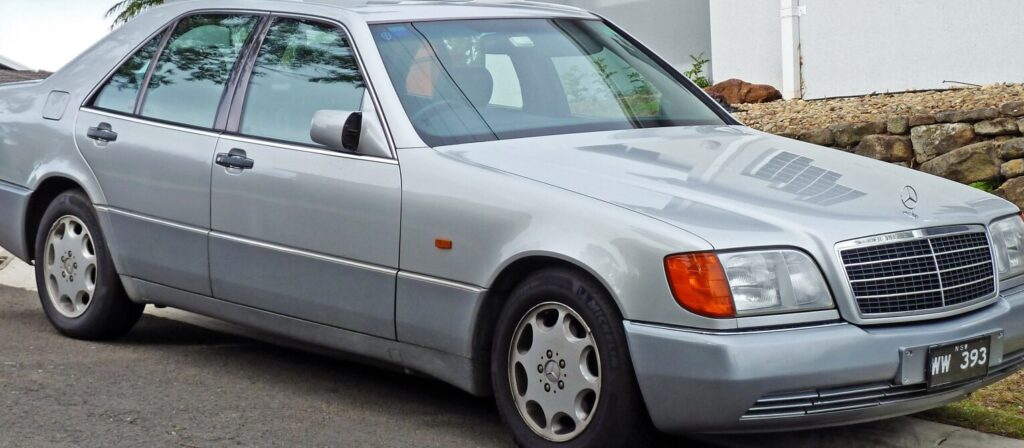
The Mercedes-Benz S-Class (W140) 300 SE, produced from 1991 to 1993, represented a significant step forward in luxury and technology for the German automaker. Positioned as an entry-level offering within the expansive W140 range, the 300 SE aimed to deliver the S-Class experience – renowned comfort, build quality, and advanced features – to a broader clientele. It served as a stepping stone into the flagship model line, offering a balance between performance and affordability compared to the more powerful 320SE, 420SE, and 500SE variants. The W140 generation, replacing the W126, was a radical departure in design and engineering, setting new standards for passive safety and overall refinement.
Technical Specifications
| Brand | Mercedes-Benz |
| Model | S-class |
| Generation | S-class (W140) |
| Type (Engine) | 300 SE (231 Hp) |
| Start of production | 1991 |
| End of production | 1993 |
| Powertrain Architecture | Internal Combustion engine |
| Body type | Sedan |
| Seats | 5 |
| Doors | 4 |
| Fuel consumption (urban) | 17.6 l/100 km (13.4 US mpg, 16.1 UK mpg, 5.7 km/l) |
| Fuel consumption (extra urban) | 9.5 l/100 km (24.8 US mpg, 29.7 UK mpg, 10.5 km/l) |
| Fuel consumption (combined) | 11.6 l/100 km (20.3 US mpg, 24.4 UK mpg, 8.6 km/l) |
| Fuel Type | Petrol (Gasoline) |
| Acceleration 0 – 100 km/h | 8.9 sec |
| Acceleration 0 – 62 mph | 8.9 sec |
| Acceleration 0 – 60 mph | 8.5 sec |
| Maximum speed | 230 km/h (142.92 mph) |
| Weight-to-power ratio | 8.2 kg/Hp, 122.2 Hp/tonne |
| Weight-to-torque ratio | 6.1 kg/Nm, 164 Nm/tonne |
| Power | 231 Hp @ 5800 rpm |
| Power per litre | 72.2 Hp/l |
| Torque | 310 Nm @ 4100 rpm (228.64 lb.-ft. @ 4100 rpm) |
| Engine layout | Front, Longitudinal |
| Engine Model/Code | M 104 E 32/104.990 |
| Engine displacement | 3199 cm3 (195.21 cu. in.) |
| Number of cylinders | 6 |
| Engine configuration | Inline |
| Cylinder Bore | 89.9 mm (3.54 in.) |
| Piston Stroke | 84 mm (3.31 in.) |
| Compression ratio | 10:1 |
| Number of valves per cylinder | 4 |
| Fuel injection system | Multi-port manifold injection |
| Engine aspiration | Naturally aspirated engine |
| Valvetrain | DOHC |
| Engine oil capacity | 7.5 l (7.93 US qt | 6.6 UK qt) |
| Coolant | 14.5 l (15.32 US qt | 12.76 UK qt) |
| Kerb Weight | 1890 kg (4166.74 lbs.) |
| Max. weight | 2410 kg (5313.14 lbs.) |
| Max load | 520 kg (1146.4 lbs.) |
| Trunk (boot) space – minimum | 525 l (18.54 cu. ft.) |
| Fuel tank capacity | 100 l (26.42 US gal | 22 UK gal) |
| Permitted trailer load with brakes (12%) | 1900 kg (4188.78 lbs.) |
| Permitted trailer load without brakes | 750 kg (1653.47 lbs.) |
| Length | 5113 mm (201.3 in.) |
| Width | 1886 mm (74.25 in.) |
| Height | 1492 mm (58.74 in.) |
| Wheelbase | 3040 mm (119.69 in.) |
| Front track | 1602 mm (63.07 in.) |
| Rear (Back) track | 1574 mm (61.97 in.) |
| Minimum turning circle (turning diameter) | 12.18 m (39.96 ft.) |
| Drivetrain Architecture | The Internal combustion engine (ICE) drives the rear wheels of the vehicle. |
| Drive wheel | Rear wheel drive |
| Number of gears and type of gearbox | 5 gears, manual transmission |
| Front suspension | Double wishbone |
| Rear suspension | Independent multi-link suspension |
| Front brakes | Ventilated discs |
| Rear brakes | Disc |
| Assisting systems | ABS (Anti-lock braking system) |
| Steering type | Worm-reduction unit |
| Power steering | Hydraulic Steering |
| Tires size | 235/60 R16 |
| Wheel rims size | 7.5J x 16 |
Powertrain & Engine Architecture
The 300 SE was powered by the M104.990 3.2-liter inline-six engine. This engine, a cornerstone of Mercedes-Benz’s engineering prowess, featured a cast iron block and aluminum cylinder head, incorporating a double overhead camshaft (DOHC) valvetrain with four valves per cylinder. The M104 engine was known for its smoothness and relatively high specific output. Fuel delivery was managed by a Bosch Motronic multi-port fuel injection system, optimizing combustion for both performance and efficiency. The engine produced 231 horsepower at 5800 rpm and 310 Nm (228.64 lb-ft) of torque at 4100 rpm. The 300 SE was typically equipped with a 5-speed manual transmission, although a 4-speed automatic transmission was also available, impacting performance and fuel economy.
Driving Characteristics
The 300 SE, even with the manual transmission, wasn’t designed for outright speed, but rather for effortless cruising and refined comfort. Acceleration from 0 to 60 mph took around 8.5 seconds, and top speed was electronically limited to 230 km/h (143 mph). The inline-six delivered a smooth and linear power delivery, making it easy to drive in various conditions. The automatic transmission, while providing convenience, did slightly diminish acceleration times and responsiveness compared to the manual version. The gear ratios were tuned for relaxed highway driving, prioritizing fuel efficiency over aggressive acceleration. The car felt substantial and planted on the road, thanks to its weight and well-tuned suspension.
Equipment & Trim Levels
The 300 SE came standard with a generous array of features for its time, including power windows, power locks, a sunroof, leather upholstery, and climate control. Wood trim adorned the interior, enhancing the luxurious ambiance. Optional extras included heated seats, a premium sound system, and upgraded leather options. The dashboard layout was typical of the W140, featuring a clean and functional design with easily accessible controls. The 300 SE’s interior, while not as opulent as the higher-spec models, still offered a high level of comfort and refinement.
Chassis & Braking
The W140 S-Class featured a robust chassis with double wishbone suspension at the front and an independent multi-link suspension at the rear, providing a comfortable and controlled ride. The 300 SE was equipped with ventilated disc brakes at the front and solid discs at the rear. Anti-lock braking system (ABS) was standard, enhancing safety and stability during hard braking. The steering was hydraulic power-assisted, providing a light and precise feel. The suspension was tuned to prioritize ride comfort, absorbing bumps and imperfections in the road with ease.
Market Reception & Comparison
The 300 SE was generally well-received by automotive critics, who praised its comfortable ride, refined interior, and robust build quality. However, some critics noted that its performance was not as exhilarating as some of its competitors, particularly the higher-spec S-Class models. Compared to the 320SE, the 300 SE offered a more affordable entry point into the S-Class range, but at the expense of some performance. Fuel economy was reasonable for a luxury sedan of its size, but not exceptional. The 300 SE represented a good value proposition for buyers seeking a luxurious and reliable sedan.
Legacy
The W140 S-Class, including the 300 SE, is now considered a classic car, appreciated for its over-engineered build quality and timeless design. The M104 engine is known for its durability and reliability, and well-maintained examples can still provide years of trouble-free service. However, like all older luxury cars, the W140 S-Class can be expensive to maintain, with parts becoming increasingly difficult to find. The 300 SE, being the entry-level model, is generally more affordable than the higher-spec variants, making it an attractive option for enthusiasts seeking a taste of S-Class luxury without breaking the bank. Today, these cars are sought after by collectors and enthusiasts who appreciate their engineering and historical significance.