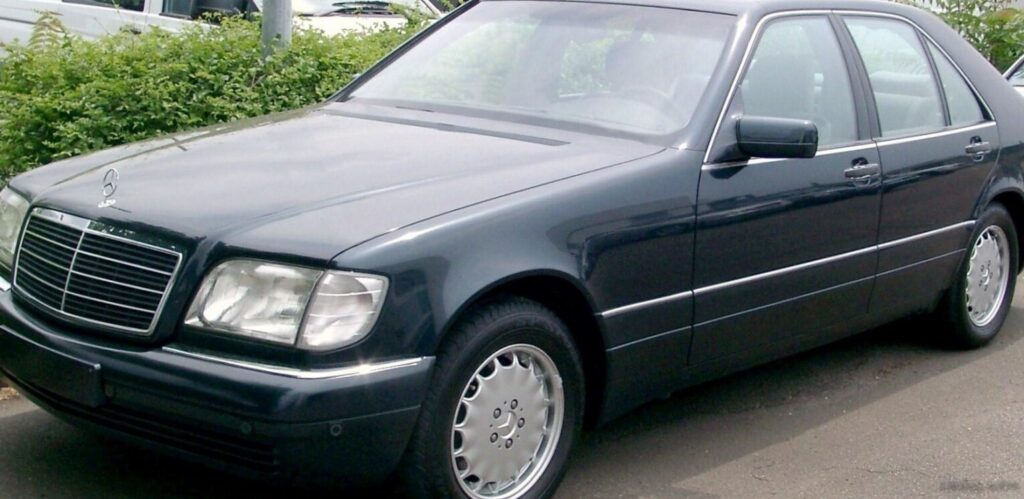
The Mercedes-Benz S 320 (W140 facelift, produced from March 1994 to May 1996) represented a compelling blend of luxury, performance, and technology within the flagship S-Class range. Positioned as a mid-range offering, it slotted between the entry-level S 280 and the high-performance S 420 and S 500 models. The W140 S-Class, introduced in 1991, was a significant leap forward for Mercedes-Benz, establishing new benchmarks for safety, refinement, and innovation. The 1994 facelift brought subtle but important revisions to the exterior and interior, enhancing the car’s appeal and addressing some initial criticisms. The S 320, with its 3.2-liter inline-six engine and four-speed 4G-TRONIC automatic transmission, offered a balanced driving experience geared towards comfortable, effortless cruising.
Technical Specifications
| Brand | Mercedes-Benz |
| Model | S-class |
| Generation | S-class (W140, facelift 1994) |
| Type (Engine) | S 320 (231 Hp) 4G-TRONIC |
| Start of production | March, 1994 |
| End of production | May, 1996 |
| Powertrain Architecture | Internal Combustion engine |
| Body type | Sedan |
| Seats | 5 |
| Doors | 4 |
| Fuel consumption (urban) | 14.5 l/100 km (16.2 US mpg, 19.5 UK mpg, 6.9 km/l) |
| Fuel consumption (extra urban) | 9.6-11.6 l/100 km (24.5 – 20.3 US mpg, 29.4 – 24.4 UK mpg, 10.4 – 8.6 km/l) |
| Fuel Type | Petrol (Gasoline) |
| Acceleration 0 – 100 km/h | 8.9 sec |
| Acceleration 0 – 62 mph | 8.9 sec |
| Acceleration 0 – 60 mph | 8.5 sec |
| Maximum speed | 225 km/h (139.81 mph) |
| Weight-to-power ratio | 8.2 kg/Hp, 122.2 Hp/tonne |
| Weight-to-torque ratio | 6 kg/Nm, 166.7 Nm/tonne |
| Power | 231 Hp @ 5600 rpm |
| Power per litre | 72.2 Hp/l |
| Torque | 315 Nm @ 3750 rpm (232.33 lb.-ft. @ 3750 rpm) |
| Engine layout | Front, Longitudinal |
| Engine Model/Code | M 104.994 |
| Engine displacement | 3199 cm3 (195.21 cu. in.) |
| Number of cylinders | 6 |
| Engine configuration | Inline |
| Cylinder Bore | 89.9 mm (3.54 in.) |
| Piston Stroke | 84 mm (3.31 in.) |
| Compression ratio | 10:1 |
| Number of valves per cylinder | 4 |
| Fuel injection system | Multi-port manifold injection |
| Engine aspiration | Naturally aspirated engine |
| Valvetrain | DOHC |
| Engine oil capacity | 7 l (7.4 US qt | 6.16 UK qt) |
| Coolant | 14.5 l (15.32 US qt | 12.76 UK qt) |
| Kerb Weight | 1890 kg (4166.74 lbs.) |
| Max. weight | 2550 kg (5621.79 lbs.) |
| Max load | 660 kg (1455.05 lbs.) |
| Trunk (boot) space – minimum | 525 l (18.54 cu. ft.) |
| Fuel tank capacity | 100 l (26.42 US gal | 22 UK gal) |
| Length | 5113 mm (201.3 in.) |
| Width | 1886 mm (74.25 in.) |
| Height | 1486 mm (58.5 in.) |
| Wheelbase | 3040 mm (119.69 in.) |
| Front track | 1606 mm (63.23 in.) |
| Rear (Back) track | 1579 mm (62.17 in.) |
| Minimum turning circle | 12.18 m (39.96 ft.) |
| Drivetrain Architecture | Rear wheel drive |
| Number of gears and type of gearbox | 4 gears, automatic transmission G-TRONIC |
| Front suspension | Coil spring, Double wishbone, Transverse stabilizer |
| Rear suspension | Independent multi-link suspension, Transverse stabilizer, Coil spring |
| Front brakes | Ventilated discs |
| Rear brakes | Disc |
| Assisting systems | ABS (Anti-lock braking system) |
| Steering type | Cone worm with recirculation balls |
| Power steering | Hydraulic Steering |
| Tires size | 235/60 R16 |
| Wheel rims size | 7.5J x 16 |
Powertrain & Engine Architecture
The heart of the S 320 was the M104.994 3.2-liter inline-six engine. This engine was a significant development for Mercedes-Benz, representing a move towards more sophisticated engine technology. It featured a cast iron block with an aluminum cylinder head, dual overhead camshafts (DOHC), and four valves per cylinder. The M104 engine was known for its smoothness and refinement, characteristics that perfectly suited the S-Class’s luxury positioning. Fuel delivery was handled by a Bosch Motronic multi-port fuel injection system, optimizing combustion efficiency and power output. The 4G-TRONIC four-speed automatic transmission was a robust and reliable unit, designed for smooth and seamless gear changes. While not as technologically advanced as some contemporary transmissions, it provided a comfortable and predictable driving experience. The transmission was electronically controlled, adapting shift points based on driving conditions and throttle input.
Driving Characteristics
The S 320 offered a distinctly different driving experience compared to its more powerful siblings. With 231 horsepower and 315 Nm (232 lb-ft) of torque, it wasn’t designed for outright acceleration. The 0-60 mph time of around 8.5 seconds was respectable for the era, but the focus was on providing effortless cruising and relaxed performance. The automatic transmission, while smooth, did contribute to a slightly less engaging driving experience than the available manual transmissions in other S-Class models. The gear ratios were optimized for fuel efficiency and comfortable highway driving, rather than aggressive acceleration. Compared to the S 420 or S 500, the S 320 felt less urgent, but it offered a more balanced and manageable driving experience for those prioritizing comfort and refinement.
Equipment & Trim Levels
The S 320 came standard with a comprehensive list of luxury features, befitting its flagship status. This included leather upholstery, power-adjustable front seats with memory function, automatic climate control, a premium sound system, and power windows and locks. Wood trim adorned the interior, adding to the sense of luxury. Optional extras were plentiful, including a sunroof, upgraded sound systems, rear seat entertainment, and various driver assistance systems. The S 320’s interior was designed to provide a serene and comfortable environment for both driver and passengers. The dashboard layout was typically Mercedes-Benz of the era – functional, well-built, and understated.
Chassis & Braking
The W140 S-Class featured a robust chassis designed for comfort and safety. The S 320 utilized a coil spring, double wishbone suspension at the front and an independent multi-link suspension at the rear. This setup provided a smooth and controlled ride, even on uneven surfaces. Anti-roll bars (stabilizer bars) were fitted front and rear to reduce body roll during cornering. The braking system consisted of ventilated discs at the front and solid discs at the rear, coupled with an ABS (Anti-lock Braking System) to enhance stopping power and stability. The steering was a recirculating ball system with hydraulic power assistance, providing a comfortable and precise steering feel.
Market Reception & Comparison
The S 320 was generally well-received by automotive critics. It was praised for its smooth engine, comfortable ride, and luxurious interior. However, some critics noted that it lacked the outright performance of the higher-end S-Class models. In terms of fuel economy, the S 320 offered a slight advantage over the V8-powered variants, but it was still a relatively thirsty vehicle by modern standards. Reliability was generally good, although the W140 S-Class was known for its complex systems, which could be expensive to repair. Compared to the S 280, the S 320 offered a significant performance upgrade, while remaining more affordable than the S 420 or S 500.
Legacy
The W140 S 320 has become a sought-after classic among Mercedes-Benz enthusiasts. The M104 engine is known for its durability and longevity, and well-maintained examples can still provide years of reliable service. While parts availability can be a challenge, the W140 S-Class remains a testament to Mercedes-Benz’s engineering prowess and commitment to luxury. Today, these cars are appreciated for their timeless design, comfortable ride, and solid build quality. The S 320, in particular, represents a sweet spot in the W140 lineup, offering a balance of performance, luxury, and affordability that continues to appeal to collectors and enthusiasts alike.