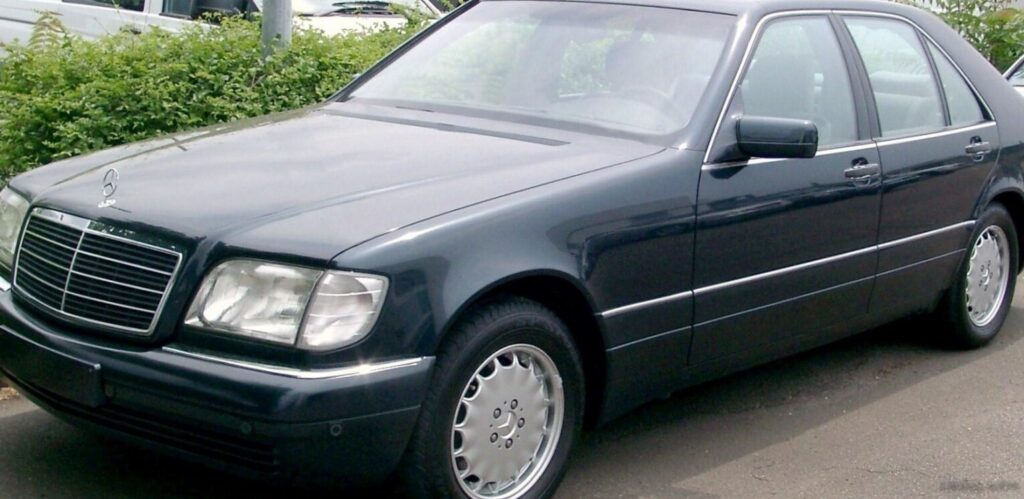
The Mercedes-Benz S 350 Turbodiesel, produced between March 1994 and August 1996, was a variant of the W140 S-Class, representing a significant offering in the flagship luxury sedan range. Positioned as a fuel-efficient alternative to the gasoline-powered models, the S 350 Turbodiesel catered to buyers prioritizing long-distance comfort and economy without sacrificing the S-Class’s renowned luxury. This model arrived with the 1994 facelift of the W140, incorporating updated styling and improved features. It was primarily sold in European markets, where diesel engines held a larger share of the luxury car segment than in the United States.
Technical Specifications
| Brand | Mercedes-Benz |
| Model | S-class |
| Generation | S-class (W140, facelift 1994) |
| Type (Engine) | S 350 Turbodiesel (150 Hp) 4G-TRONIC |
| Start of production | March, 1994 |
| End of production | August, 1996 |
| Powertrain Architecture | Internal Combustion engine |
| Body type | Sedan |
| Seats | 5 |
| Doors | 4 |
| Fuel consumption (urban) | 11.7 l/100 km (20.1 US mpg) |
| Fuel consumption (extra urban) | 7.7-9.7 l/100 km (30.5 – 24.2 US mpg) |
| Fuel Type | Diesel |
| Acceleration 0 – 100 km/h | 13.1 sec |
| Acceleration 0 – 62 mph | 13.1 sec |
| Acceleration 0 – 60 mph | 12.4 sec |
| Maximum speed | 185 km/h (114.95 mph) |
| Weight-to-power ratio | 12.9 kg/Hp |
| Weight-to-torque ratio | 6.3 kg/Nm |
| Power | 150 Hp @ 4000 rpm |
| Torque | 310 Nm @ 2000 rpm (228.64 lb.-ft. @ 2000 rpm) |
| Engine layout | Front, Longitudinal |
| Engine Model/Code | OM 603.971 |
| Engine displacement | 3449 cm3 (210.47 cu. in.) |
| Number of cylinders | 6 |
| Engine configuration | Inline |
| Cylinder Bore | 89 mm (3.5 in.) |
| Piston Stroke | 92.4 mm (3.64 in.) |
| Compression ratio | 22:1 |
| Number of valves per cylinder | 2 |
| Fuel injection system | Precombustion chamber injection |
| Engine aspiration | Turbocharger, Intercooler |
| Valvetrain | SOHC |
| Engine oil capacity | 8 l (8.45 US qt | 7.04 UK qt) |
| Coolant | 10 l (10.57 US qt | 8.8 UK qt) |
| Kerb Weight | 1940 kg (4276.97 lbs.) |
| Max. weight | 2590 kg (5709.97 lbs.) |
| Max load | 650 kg (1433 lbs.) |
| Trunk (boot) space – minimum | 525 l (18.54 cu. ft.) |
| Fuel tank capacity | 100 l (26.42 US gal | 22 UK gal) |
| Length | 5113 mm (201.3 in.) |
| Width | 1886 mm (74.25 in.) |
| Height | 1486 mm (58.5 in.) |
| Wheelbase | 3040 mm (119.69 in.) |
| Front track | 1606 mm (63.23 in.) |
| Rear (Back) track | 1579 mm (62.17 in.) |
| Minimum turning circle | 12.18 m (39.96 ft.) |
| Drivetrain Architecture | Rear wheel drive |
| Number of gears | 4 |
| Gearbox type | automatic transmission G-TRONIC |
| Front suspension | Coil spring, Double wishbone, Transverse stabilizer |
| Rear suspension | Independent multi-link suspension, Transverse stabilizer, Coil spring |
| Front brakes | Ventilated discs |
| Rear brakes | Disc |
| Assisting systems | ABS (Anti-lock braking system) |
| Steering type | Cone worm with recirculation balls |
| Power steering | Hydraulic Steering |
| Tires size | 235/60 R16 |
| Wheel rims size | 7.5J x 16 |
Powertrain & Engine Architecture
The S 350 Turbodiesel was powered by the OM 603.971, a 3.5-liter inline-six cylinder diesel engine. This engine was a cornerstone of Mercedes-Benz’s diesel offerings during the 1990s, known for its durability and refinement. It featured precombustion chamber injection, a system where fuel is partially combusted in a small chamber before entering the main cylinder, promoting more complete combustion and reducing noise. A turbocharger with an intercooler was employed to increase power output to 150 horsepower and 310 Nm (228.64 lb-ft) of torque. The engine utilized a single overhead camshaft (SOHC) valvetrain with two valves per cylinder. The 4G-TRONIC automatic transmission, a four-speed unit, was the sole transmission option. This transmission was electronically controlled, offering smooth shifts and adapting to driving conditions.
Driving Characteristics
The S 350 Turbodiesel offered a distinctly different driving experience compared to its gasoline-powered siblings. While lacking the outright acceleration of the S 420 or S 500, it provided ample torque for relaxed cruising and effortless overtaking. The 0-60 mph time of around 12.4 seconds and a top speed of 185 km/h (114.95 mph) were respectable for the era, but the focus was on refinement and fuel economy. The 4G-TRONIC transmission was tuned for comfort, with relatively long gear ratios prioritizing smooth transitions over sporty responsiveness. Compared to the manual transmission options available on other S-Class models, the automatic offered a more luxurious and less engaging driving experience. However, it perfectly suited the car’s intended purpose as a grand tourer.
Equipment & Trim Levels
The S 350 Turbodiesel came standard with a comprehensive array of luxury features expected of a flagship Mercedes-Benz. This included leather upholstery, power-adjustable front seats with memory function, automatic climate control, a high-end audio system, and power windows and locks. Wood trim adorned the interior, enhancing the sense of opulence. Optional extras included a sunroof, upgraded audio systems, rear seat entertainment, and various driver assistance features. The trim level was generally consistent across the S 350 Turbodiesel models, with customization options primarily revolving around interior color schemes and optional equipment packages.
Chassis & Braking
The W140 S-Class featured a robust chassis designed for comfort and safety. The S 350 Turbodiesel utilized a coil spring, double wishbone suspension at the front and an independent multi-link suspension at the rear, both incorporating a transverse stabilizer bar to reduce body roll. The braking system consisted of ventilated discs at the front and solid discs at the rear, coupled with an Anti-lock Braking System (ABS) for enhanced stopping power and stability. The steering was a recirculating ball system with hydraulic power assistance, providing a smooth and effortless steering experience. The S 350 Turbodiesel’s suspension was tuned to prioritize ride comfort, absorbing bumps and imperfections in the road with ease.
Market Reception & Comparison
The S 350 Turbodiesel was well-received in European markets, where diesel engines were popular for their fuel efficiency and long-distance capabilities. Critics praised the car’s quiet and refined engine, comfortable ride, and luxurious interior. However, some noted the relatively modest performance compared to the gasoline-powered models. Compared to the S 320, the S 350 Turbodiesel offered similar levels of luxury but with significantly better fuel economy. Against the more powerful S 420 and S 500, it represented a more economical choice for buyers who didn’t prioritize outright performance. The diesel engine also offered a longer lifespan and lower maintenance costs compared to the gasoline engines.
Legacy
The OM 603 engine, found in the S 350 Turbodiesel, is renowned for its durability and longevity. Properly maintained examples can accumulate very high mileage with minimal issues. Today, the W140 S 350 Turbodiesel is a sought-after classic car, particularly among enthusiasts who appreciate its robust engineering and understated luxury. While finding well-maintained examples can be challenging, the S 350 Turbodiesel offers a unique blend of comfort, economy, and durability, making it a compelling choice for collectors and drivers alike. The car represents a high point in Mercedes-Benz diesel technology and a testament to the W140 S-Class’s enduring appeal.