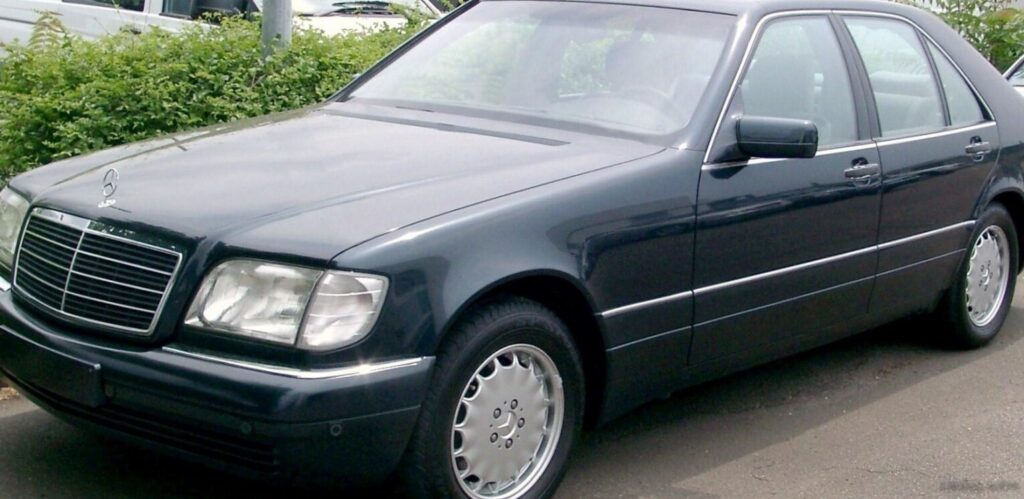
The Mercedes-Benz S 500, part of the W140 generation S-Class produced from 1994 to 1995, represented a significant evolution in luxury automotive engineering. Following the 1994 facelift, this variant occupied a premium position within the S-Class lineup, offering a potent combination of performance and refinement. The W140 S-Class, known for its robust build quality and advanced features for its time, aimed to solidify Mercedes-Benz’s reputation as a leader in the luxury sedan segment. The S 500, with its 5.0-liter V8 engine, was positioned above the S 320 and S 420 models, offering a substantial increase in power and a more exclusive driving experience.
Technical Specifications
| Brand | Mercedes-Benz |
| Model | S-class |
| Generation | S-class (W140, facelift 1994) |
| Type (Engine) | S 500 V8 (320 Hp) 4G-TRONIC |
| Start of production | March, 1994 |
| End of production | August, 1995 |
| Powertrain Architecture | Internal Combustion engine |
| Body type | Sedan |
| Seats | 5 |
| Doors | 4 |
| Fuel consumption (urban) | 17.2 l/100 km (13.7 US mpg) |
| Fuel consumption (extra urban) | 10-11.9 l/100 km (23.5 – 19.8 US mpg) |
| Fuel Type | Petrol (Gasoline) |
| Acceleration 0 – 100 km/h | 7.3 sec |
| Acceleration 0 – 62 mph | 7.3 sec |
| Acceleration 0 – 60 mph | 6.9 sec |
| Maximum speed | 250 km/h (155.34 mph) – Electronically limited |
| Weight-to-power ratio | 6.3 kg/Hp |
| Weight-to-torque ratio | 4.3 kg/Nm |
| Power | 320 Hp @ 5600 rpm |
| Power per litre | 64.3 Hp/l |
| Torque | 470 Nm @ 3900 rpm (346.65 lb.-ft. @ 3900 rpm) |
| Engine layout | Front, Longitudinal |
| Engine Model/Code | M 119.970 |
| Engine displacement | 4973 cm3 (303.47 cu. in.) |
| Number of cylinders | 8 |
| Engine configuration | V-engine |
| Cylinder Bore | 96.5 mm (3.8 in.) |
| Piston Stroke | 85 mm (3.35 in.) |
| Compression ratio | 10:1 |
| Number of valves per cylinder | 4 |
| Fuel injection system | Multi-port manifold injection |
| Engine aspiration | Naturally aspirated engine |
| Valvetrain | DOHC |
| Engine oil capacity | 8 l (8.45 US qt | 7.04 UK qt) |
| Coolant | 16.5 l (17.44 US qt | 14.52 UK qt) |
| Kerb Weight | 2000 kg (4409.25 lbs.) |
| Max. weight | 2650 kg (5842.25 lbs.) |
| Max load | 650 kg (1433 lbs.) |
| Trunk (boot) space – minimum | 525 l (18.54 cu. ft.) |
| Fuel tank capacity | 100 l (26.42 US gal | 22 UK gal) |
| Length | 5113 mm (201.3 in.) |
| Width | 1886 mm (74.25 in.) |
| Height | 1486 mm (58.5 in.) |
| Wheelbase | 3040 mm (119.69 in.) |
| Front track | 1606 mm (63.23 in.) |
| Rear (Back) track | 1579 mm (62.17 in.) |
| Minimum turning circle | 12.18 m (39.96 ft.) |
| Drivetrain Architecture | Rear wheel drive |
| Drive wheel | Rear wheel drive |
| Number of gears and type of gearbox | 4 gears, automatic transmission G-TRONIC |
| Front suspension | Coil spring, Double wishbone, Transverse stabilizer |
| Rear suspension | Independent multi-link suspension, Transverse stabilizer, Coil spring |
| Front brakes | Ventilated discs |
| Rear brakes | Ventilated discs |
| Assisting systems | ABS (Anti-lock braking system) |
| Steering type | Cone worm with recirculation balls |
| Power steering | Hydraulic Steering |
| Tires size | 235/60 R16 |
| Wheel rims size | 7.5J x 16 |
Powertrain & Engine Architecture
The heart of the S 500 was the M119.970 5.0-liter V8 engine. This engine, a naturally aspirated powerplant, featured a cast-iron block and aluminum cylinder heads. It employed multi-port fuel injection and a dual overhead camshaft (DOHC) valvetrain, contributing to its smooth power delivery and relatively high specific output. The engine produced 320 horsepower at 5600 rpm and 470 Nm (346.65 lb-ft) of torque at 3900 rpm. The engine’s design prioritized refinement and durability over outright performance, reflecting the S-Class’s focus on luxurious transportation. Paired with the engine was the 4G-TRONIC four-speed automatic transmission. This transmission, while not as sophisticated as some contemporary offerings, was known for its reliability and smooth shifting characteristics. It was tuned to provide comfortable cruising and adequate acceleration, rather than aggressive downshifts.
Driving Characteristics
The S 500 offered a distinctly different driving experience compared to the lower-powered S 320 or S 420 models. The increased horsepower and torque provided noticeably quicker acceleration, making highway overtaking and merging easier. While not a sports car, the S 500 felt composed and confident on the road. The 4G-TRONIC transmission, while smooth, could sometimes feel a bit sluggish in responding to sudden throttle inputs. The gear ratios were optimized for comfortable cruising, rather than maximizing performance. Compared to a manual transmission equipped S-Class, the automatic version sacrificed some driver engagement but gained in ease of use, particularly in city traffic. The suspension, tuned for comfort, absorbed bumps and imperfections in the road effectively, providing a smooth and isolated ride.
Equipment & Trim Levels
The S 500 came standard with a comprehensive list of features befitting its flagship status. These included leather upholstery, power-adjustable front seats with memory function, automatic climate control, a premium sound system, and a sunroof. Wood trim adorned the interior, adding to the luxurious ambiance. Optional extras included rear seats with massage function, a CD changer, and upgraded leather options. The S 500’s interior was designed to provide a serene and comfortable environment for both driver and passengers. The dashboard layout was relatively straightforward, with clearly labeled controls and a focus on ergonomics.
Chassis & Braking
The W140 S-Class featured a robust chassis with independent suspension at all four wheels. The front suspension utilized coil springs and double wishbones, while the rear employed a multi-link setup. Both ends were equipped with a transverse stabilizer bar to reduce body roll. The S 500 was equipped with ventilated disc brakes on all four wheels, providing ample stopping power. An Anti-lock Braking System (ABS) was standard, enhancing safety and stability during hard braking. The steering system was a cone worm with recirculation balls, offering a balanced feel between precision and comfort.
Market Reception & Comparison
The S 500 was generally well-received by automotive critics, who praised its powerful engine, luxurious interior, and comfortable ride. However, some reviewers noted that the 4G-TRONIC transmission could feel a bit dated compared to newer automatic transmissions. Fuel economy was also a concern, with the S 500 consuming a significant amount of fuel, especially in urban driving. Compared to the S 420, the S 500 offered a substantial performance advantage, but at a higher price point. The S 320, the entry-level model, provided a more fuel-efficient and affordable option, but lacked the S 500’s outright power and prestige.
Legacy
The W140 S 500, while superseded by later generations of the S-Class, remains a highly regarded luxury sedan. The M119 engine is known for its durability and reliability, provided it is properly maintained. Today, well-maintained examples of the S 500 are sought after by collectors and enthusiasts. While maintenance costs can be high due to the car’s age and complexity, the S 500 offers a unique blend of classic luxury and robust engineering. Its solid construction and comfortable ride continue to appeal to those seeking a refined and stately driving experience. The W140 S-Class, and the S 500 in particular, set a high standard for luxury sedans and remains a benchmark for automotive engineering.