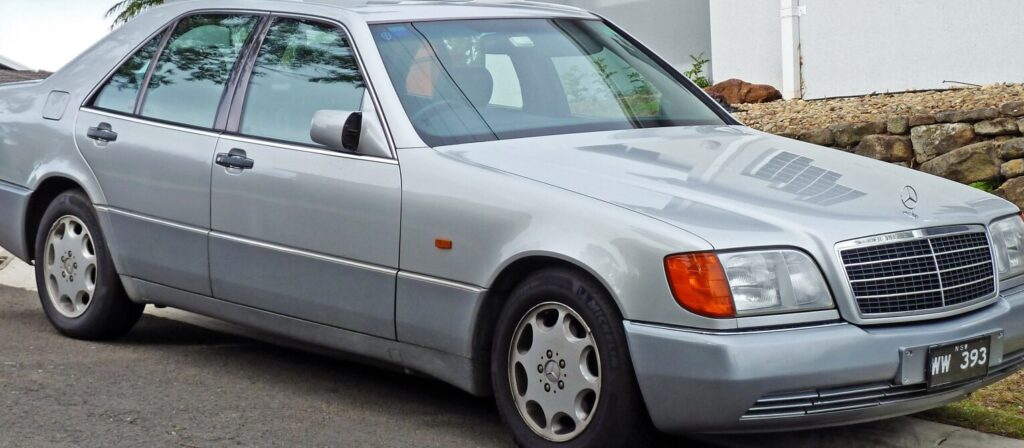
The Mercedes-Benz S 280, produced between 1993 and 1994, was a key variant within the W140 generation of the S-Class. Positioned as a more accessible entry point into the flagship luxury sedan range, the S 280 offered a blend of comfort, refinement, and performance that appealed to buyers seeking prestige without the higher price tag of the V8 or V12 powered models. It represented a significant step up in technology and size compared to its predecessor, the W126, and established many of the features that would become synonymous with the S-Class nameplate. The W140 platform, known for its robust build quality and advanced engineering, provided a solid foundation for the S 280.
Technical Specifications
| Brand | Mercedes-Benz |
| Model | S-class |
| Generation | S-class (W140) |
| Type (Engine) | S 280 (193 Hp) |
| Start of production | 1993 |
| End of production | 1994 |
| Powertrain Architecture | Internal Combustion engine |
| Body type | Sedan |
| Seats | 5 |
| Doors | 4 |
| Fuel consumption (economy) – urban | 15.6 l/100 km (15.1 US mpg, 18.1 UK mpg, 6.4 km/l) |
| Fuel consumption (economy) – extra urban | 8.6 l/100 km (27.4 US mpg, 32.8 UK mpg, 11.6 km/l) |
| Fuel consumption (economy) – combined | 11.6 l/100 km (20.3 US mpg, 24.4 UK mpg, 8.6 km/l) |
| Fuel Type | Petrol (Gasoline) |
| Acceleration 0 – 100 km/h | 10.8 sec |
| Acceleration 0 – 62 mph | 10.8 sec |
| Acceleration 0 – 60 mph | 10.3 sec |
| Maximum speed | 215 km/h (133.59 mph) |
| Weight-to-power ratio | 9.8 kg/Hp, 102.1 Hp/tonne |
| Weight-to-torque ratio | 7 kg/Nm, 142.9 Nm/tonne |
| Power | 193 Hp @ 5500 rpm |
| Power per litre | 69 Hp/l |
| Torque | 270 Nm @ 3750 rpm (199.14 lb.-ft. @ 3750 rpm) |
| Engine layout | Front, Longitudinal |
| Engine Model/Code | M 104 E 28/104.944 |
| Engine displacement | 2799 cm3 (170.81 cu. in.) |
| Number of cylinders | 6 |
| Engine configuration | Inline |
| Cylinder Bore | 89.9 mm (3.54 in.) |
| Piston Stroke | 73.5 mm (2.89 in.) |
| Compression ratio | 10:1 |
| Number of valves per cylinder | 4 |
| Fuel injection system | Multi-port manifold injection |
| Engine aspiration | Naturally aspirated engine |
| Valvetrain | DOHC |
| Engine oil capacity | 7.5 l (7.93 US qt | 6.6 UK qt) |
| Coolant | 14.5 l (15.32 US qt | 12.76 UK qt) |
| Kerb Weight | 1890 kg (4166.74 lbs.) |
| Max. weight | 2550 kg (5621.79 lbs.) |
| Max load | 660 kg (1455.05 lbs.) |
| Trunk (boot) space – minimum | 525 l (18.54 cu. ft.) |
| Fuel tank capacity | 100 l (26.42 US gal | 22 UK gal) |
| Permitted trailer load with brakes (12%) | 1900 kg (4188.78 lbs.) |
| Permitted trailer load without brakes | 750 kg (1653.47 lbs.) |
| Length | 5113 mm (201.3 in.) |
| Width | 1886 mm (74.25 in.) |
| Height | 1486 mm (58.5 in.) |
| Wheelbase | 3040 mm (119.69 in.) |
| Front track | 1606 mm (63.23 in.) |
| Rear (Back) track | 1579 mm (62.17 in.) |
| Minimum turning circle | 12.18 m (39.96 ft.) |
| Drivetrain Architecture | Rear wheel drive |
| Drive wheel | Rear wheel drive |
| Number of gears and type of gearbox | 5 gears, manual transmission |
| Front suspension | Double wishbone |
| Rear suspension | Independent multi-link spring suspension with stabilizer |
| Front brakes | Ventilated discs |
| Rear brakes | Disc |
| Assisting systems | ABS (Anti-lock braking system) |
| Steering type | Worm-reduction unit |
| Power steering | Hydraulic Steering |
| Tires size | 235/60 R16 |
| Wheel rims size | 16 |
Powertrain & Engine Architecture
The S 280 was powered by the M104.944, a 2.8-liter inline-six engine. This engine was a significant departure from the V8s traditionally associated with the S-Class, but it offered a compelling combination of smoothness, efficiency, and adequate power. The M104 featured a cast iron block with an aluminum cylinder head, dual overhead camshafts (DOHC), and four valves per cylinder. Bosch Motronic fuel injection managed the air-fuel mixture, contributing to refined throttle response and relatively low emissions for its time. The engine produced 193 horsepower at 5500 rpm and 270 Nm (199 lb-ft) of torque at 3750 rpm. The five-speed manual transmission was standard, providing drivers with full control over the engine’s power. An optional four-speed automatic transmission was also available, catering to those prioritizing comfort and ease of driving.
Driving Characteristics
The S 280, particularly with the manual transmission, offered a surprisingly engaging driving experience for a large luxury sedan. While not as overtly powerful as the V8 models, the inline-six provided sufficient power for comfortable cruising and confident overtaking. The manual gearbox allowed drivers to exploit the engine’s torque curve, making it feel more responsive than the automatic version. The automatic transmission, while smooth, did diminish the sense of connection to the engine and resulted in slightly slower acceleration times. The W140 chassis, with its double-wishbone front suspension and multi-link rear suspension, provided a comfortable and controlled ride, absorbing bumps and maintaining stability even at higher speeds. The steering, while hydraulically assisted, offered a good degree of feedback.
Equipment & Trim Levels
The S 280 typically came well-equipped, reflecting its status as a luxury vehicle. Standard features included power windows, power locks, central locking, air conditioning, and a high-quality audio system. Interior upholstery was typically cloth, but leather was available as an option. Wood trim adorned the dashboard and door panels, adding to the sense of luxury. Optional extras included a sunroof, heated seats, automatic climate control, and a more advanced audio system. The S 280 occupied the entry-level position in the W140 lineup, making it more accessible than the S 320, S 420, and S 600 models.
Chassis & Braking
The W140 S-Class featured a robust chassis designed for both comfort and safety. The S 280 utilized ventilated disc brakes on all four wheels, providing ample stopping power. Anti-lock braking system (ABS) was standard, enhancing safety in emergency braking situations. The suspension was tuned to prioritize ride comfort, but also offered good handling characteristics. The rear suspension employed a multi-link design, which helped to isolate road imperfections and maintain tire contact with the road surface. Stabilizer bars were fitted to both the front and rear axles to reduce body roll during cornering.
Market Reception & Comparison
The S 280 was generally well-received by automotive critics, who praised its comfortable ride, refined interior, and relatively affordable price. However, some critics noted that the inline-six engine lacked the effortless power of the V8 and V12 options. Compared to the S 320, the S 280 offered a more economical option, but at the expense of performance. The S 280’s fuel economy was respectable for a vehicle of its size and class, but it was still significantly lower than more modern vehicles. Reliability was generally good, although the complex electronics of the W140 could sometimes present challenges.
Legacy
The M104 engine, found in the S 280, proved to be a durable and reliable powerplant. Many examples are still on the road today, testament to its robust construction. The W140 S-Class, as a whole, is now considered a classic, and well-maintained examples are highly sought after by collectors and enthusiasts. The S 280, while not the most powerful or prestigious variant, offers a unique entry point into the world of W140 ownership, providing a taste of Mercedes-Benz luxury and engineering at a more attainable price point. Its relative simplicity compared to the higher-end models can also make it a more straightforward vehicle to maintain and repair.