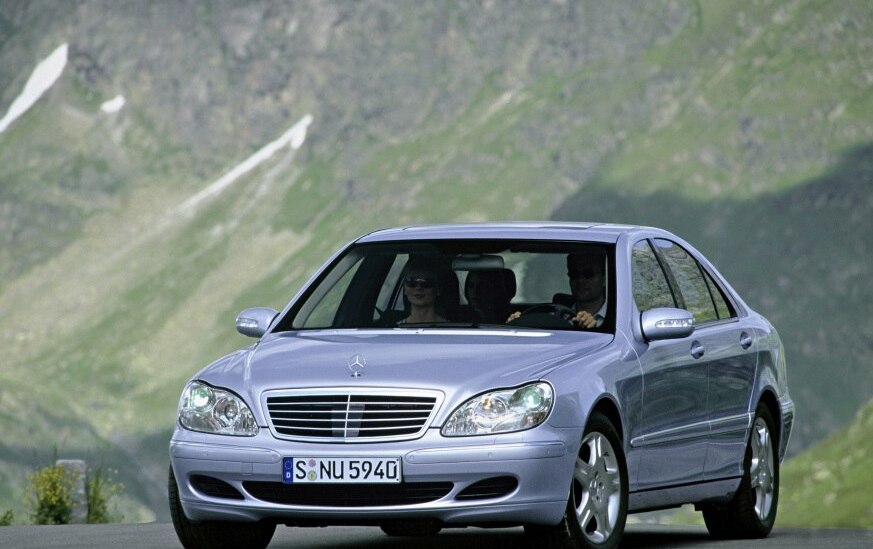
The Mercedes-Benz S 350, produced from 2002 to 2005, was a key variant within the W220 facelifted S-Class range. Representing a mid-range offering in the lineup, it slotted between the entry-level S 320 and the more powerful S 430 and S 500 models. The W220 S-Class, launched in 1998, was a significant vehicle for Mercedes-Benz, introducing numerous technological advancements in safety, comfort, and performance. The 2002 facelift addressed some criticisms of the original W220, refining the styling and improving overall build quality. The S 350, with its 3.7-liter V6 engine and 5G-TRONIC automatic transmission, aimed to provide a balance of luxury, performance, and efficiency for discerning buyers.
The S 350 was powered by the M112 E 37 engine, a 3.7-liter naturally aspirated V6. This engine, internally designated as 112.975, produced 245 horsepower at 5700 rpm and 350 Nm (258.15 lb-ft) of torque at 3000 rpm. The M112 engine family was known for its smooth operation and relatively lightweight construction, utilizing an all-aluminum block and cylinder heads. Fuel delivery was managed by a multi-port manifold injection system. The engine featured three valves per cylinder, contributing to its efficient combustion process. Paired with the engine was the 5G-TRONIC automatic transmission, a five-speed unit that offered smooth and responsive gear changes. This transmission was a significant upgrade over previous Mercedes-Benz automatic transmissions, providing improved fuel economy and a more refined driving experience.
In real-world driving, the S 350 offered a comfortable and composed experience. Acceleration from 0 to 60 mph was achieved in approximately 6.9 seconds, while 0-100 km/h took 7.3 seconds. Top speed was electronically limited to 152.86 mph (246 km/h). While not as overtly sporty as the V8-powered S 430 or S 500, the S 350 provided ample power for effortless cruising and overtaking. The 5G-TRONIC transmission was well-matched to the engine’s characteristics, offering seamless shifts and contributing to a relaxed driving experience. The gear ratios were tuned for a balance of acceleration and fuel efficiency, prioritizing comfort over outright performance. Compared to the S 320, the S 350 offered a noticeable increase in power and torque, resulting in improved responsiveness.
The S 350 came standard with a comprehensive array of luxury features. Interior appointments typically included leather upholstery, wood trim, and automatic climate control. Standard equipment also included power-adjustable front seats with memory function, a premium sound system, and a multi-function steering wheel. Optional extras included a sunroof, upgraded leather options, rear seat entertainment, and advanced driver-assistance systems such as Distronic adaptive cruise control. The dashboard layout was typical of the W220 S-Class, featuring a clean and elegant design with intuitive controls. The overall ambiance was one of understated luxury and refinement.
The S 350 utilized a sophisticated chassis and braking system. The suspension consisted of independent suspension all around, with multi-link setups at both the front and rear. This provided a comfortable ride while maintaining good handling characteristics. Disc brakes were fitted on all four wheels, providing ample stopping power. Anti-lock braking system (ABS) was standard, enhancing safety and stability during emergency braking. The S 350’s curb weight of 1735 kg (3825.02 lbs) was relatively moderate for a full-size luxury sedan, contributing to its balanced handling. Tire size was typically 225/60 R16, mounted on 16-inch alloy wheels.
Critics generally praised the S 350 for its comfortable ride, refined interior, and smooth powertrain. While some noted that it lacked the outright performance of the V8 models, it was considered a compelling option for buyers prioritizing luxury and efficiency. Fuel economy was rated at 11.1 l/100 km (21.2 US mpg) combined, which was respectable for a vehicle of its size and class. Reliability was generally good, although, like all W220 S-Class models, the S 350 was susceptible to certain age-related issues, such as air suspension problems and electrical glitches. Compared to the S 430, the S 350 offered a lower purchase price and slightly better fuel economy, making it an attractive alternative for budget-conscious buyers.
| Engine Model/Code | M 112 E 37/112.975 |
| Engine displacement | 3724 cm3 (227.25 cu. in.) |
| Number of cylinders | 6 |
| Engine configuration | V-engine |
| Cylinder Bore | 97 mm (3.82 in.) |
| Piston Stroke | 84 mm (3.31 in.) |
| Compression ratio | 10:1 |
| Number of valves per cylinder | 3 |
| Fuel injection system | Multi-port manifold injection |
| Power | 245 Hp @ 5700 rpm |
| Torque | 350 Nm @ 3000 rpm (258.15 lb.-ft. @ 3000 rpm) |
| Fuel Type | Petrol (Gasoline) |
| Acceleration 0 – 100 km/h | 7.3 sec |
| Acceleration 0 – 60 mph | 6.9 sec |
| Maximum speed | 246 km/h (152.86 mph) |
| Kerb Weight | 1735 kg (3825.02 lbs.) |
| Fuel tank capacity | 88 l (23.25 US gal | 19.36 UK gal) |
| Trunk (boot) space – maximum | 500 l (17.66 cu. ft.) |
| Transmission | 5 gears, automatic transmission G-TRONIC |
Today, the W220 S 350 remains a relatively affordable entry point into the world of Mercedes-Benz luxury. While maintenance costs can be higher than more modern vehicles, the S 350’s robust engine and transmission, when properly maintained, can provide years of reliable service. The M112 engine is generally considered to be a durable and long-lasting unit. However, potential buyers should be aware of the common W220 issues, such as air suspension failures and electrical problems. The S 350’s blend of comfort, luxury, and relative affordability has ensured its continued presence in the used car market, appealing to enthusiasts and those seeking a classic Mercedes-Benz experience.