
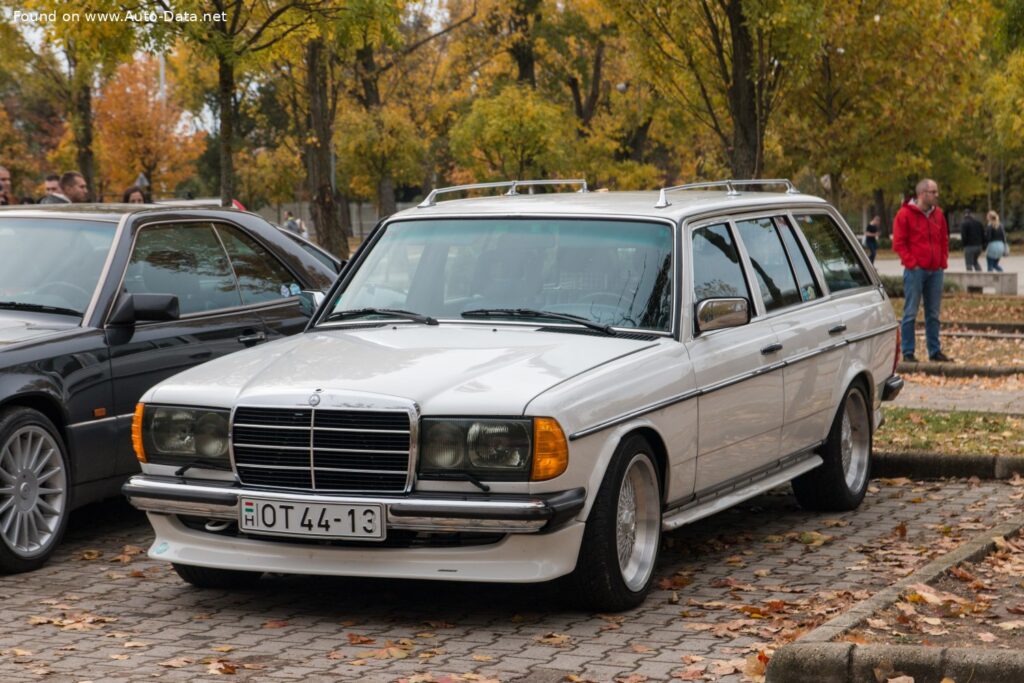
The Mercedes-Benz S123 240 TD, produced from February 1978 to January 1986, was a diesel-powered station wagon (estate) variant of the popular W123 series. Representing a practical and durable option within the W123 lineup, the 240 TD occupied a middle ground, offering a balance between fuel economy, load-carrying capacity, and affordability. It was positioned below the more luxurious gasoline-powered models and above the base-level 200 D, appealing to families and those requiring a robust vehicle for work or leisure. The S123 chassis designation specifically refers to the station wagon body style, distinguishing it from the sedan and coupe versions of the W123.
The 240 TD Within the W123 Family
The W123 series, launched in 1976, was a significant step forward for Mercedes-Benz in terms of engineering and safety. It replaced the W114/W115 models and established a new benchmark for mid-size luxury cars. The 240 TD, with its 72 horsepower diesel engine and four-speed manual transmission, was a key component of the W123’s success. While the gasoline-powered variants (like the 230E, 280E, and 280CE) offered more performance, they came at a higher price point and with increased fuel consumption. The 240 TD, conversely, prioritized efficiency and longevity. Compared to the smaller 200 D, the 240 TD offered noticeably more power and a more relaxed driving experience, making it suitable for longer journeys and heavier loads. It differed significantly from the later 300 TD models, which featured a five-cylinder diesel engine and offered substantially more power, but also a higher purchase price and potentially more complex maintenance.
Powertrain & Engine Architecture
The heart of the 240 TD is the OM 616 D 24 diesel engine, a 2.4-liter inline-four cylinder unit. This engine, with a displacement of 2399 cm³ (146.4 cu. in.), is renowned for its durability and simplicity. The engine code 616.912 specifically identifies this variant. It utilizes precombustion chamber injection, a system where fuel is injected into a small precombustion chamber connected to the main cylinder, promoting more complete combustion and reducing engine noise. The engine produces 72 horsepower at 4400 rpm and 137 Nm (101.05 lb.-ft.) of torque at 2400 rpm. The compression ratio is a high 21.5:1, typical for diesel engines. The engine features a single overhead camshaft (SOHC) valvetrain with two valves per cylinder.
The 240 TD was primarily equipped with a four-speed manual transmission. This gearbox was designed to handle the diesel engine’s torque characteristics and provide a comfortable driving experience. The transmission’s gear ratios were optimized for fuel efficiency and pulling power, rather than outright acceleration. The drivetrain is rear-wheel drive, a standard configuration for Mercedes-Benz vehicles of this era. The engine is mounted longitudinally in the front of the vehicle.
Fuel Injection System
The Bosch mechanical fuel injection system used in the OM 616 D 24 is a key element of its reliability. Unlike later electronic fuel injection systems, this mechanical system is less susceptible to electronic failures and is relatively straightforward to maintain. The system consists of a fuel injection pump, fuel lines, and the precombustion chambers themselves. The pump delivers fuel at high pressure to the injectors, which spray the fuel into the precombustion chambers.
Driving Characteristics
The driving experience in a 240 TD is characterized by its relaxed and unhurried nature. Acceleration is modest, with a 0-100 km/h (0-62 mph) time of around 25.8 seconds. However, the engine’s strong low-end torque makes it well-suited for everyday driving and hauling loads. The four-speed manual transmission requires deliberate shifting, but it provides good control over the engine’s power. The gear ratios are spaced to maximize fuel efficiency and provide adequate acceleration in most situations. Compared to the more powerful gasoline models, the 240 TD feels significantly slower, but it offers a different kind of driving experience – one focused on practicality and economy. The rear-wheel drive configuration provides a balanced feel, although handling is not as sharp as more modern vehicles.
Equipment & Trim Levels
The 240 TD typically came with a relatively basic level of equipment, reflecting its position as a more affordable option within the W123 range. Standard features included cloth upholstery, a simple dashboard layout, and manual windows and door locks. However, Mercedes-Benz offered a range of optional extras, allowing buyers to customize their vehicles. These options included power windows, central locking, a sunroof, and upgraded audio systems. The interior trim was generally functional and durable, with a focus on practicality rather than luxury. The station wagon body style provided ample cargo space, making it ideal for families and those needing to transport large items.
Chassis & Braking
The S123 240 TD utilizes a robust chassis designed to handle the weight of the vehicle and its occupants, as well as any cargo. The front suspension features a double wishbone design, providing a comfortable ride and good handling. The rear suspension employs a trailing arm setup, which is known for its simplicity and durability. The braking system consists of disc brakes on all four wheels, providing adequate stopping power. The steering is a cone worm with recirculation balls system, offering a relatively direct feel. Power steering was not standard but was available as an option. The vehicle rides on 195/70 R14 tires, mounted on 6J x 14 inch steel wheels.
Market Reception & Comparison
The 240 TD was well-received by critics and buyers alike, praised for its fuel economy, reliability, and practicality. It was considered a sensible and durable choice for those seeking a versatile family vehicle. Fuel consumption figures were impressive for the time, with approximately 9.9 l/100 km (23.8 US mpg) in urban driving and 7.8 l/100 km (30.2 US mpg) on the highway. Compared to the gasoline-powered W123 models, the 240 TD offered significantly better fuel economy. While the 300 TD offered more power, it was also more expensive and potentially more complex to maintain. The 240 TD struck a good balance between performance, economy, and reliability, making it a popular choice in the used car market.
Technical Specifications
| Brand | Mercedes-Benz |
| Model | W123 |
| Generation | S123 |
| Type (Engine) | 240 TD (72 Hp) Manual 4-speed |
| Start of production | February, 1978 |
| End of production | January, 1986 |
| Powertrain Architecture | Internal Combustion engine |
| Body type | Station wagon (estate) |
| Seats | 5 |
| Doors | 5 |
| Fuel consumption (urban) | 9.9 l/100 km (23.8 US mpg) |
| Fuel consumption (extra urban) | 7.8 l/100 km (30.2 US mpg) |
| Fuel Type | Diesel |
| Acceleration 0 – 100 km/h | 25.8 sec |
| Acceleration 0 – 62 mph | 25.8 sec |
| Acceleration 0 – 60 mph | 24.5 sec |
| Maximum speed | 138 km/h (85.75 mph) |
| Power | 72 Hp @ 4400 rpm |
| Torque | 137 Nm @ 2400 rpm (101.05 lb.-ft. @ 2400 rpm) |
| Engine layout | Front, Longitudinal |
| Engine Model/Code | OM 616 D 24 / 616.912 |
| Engine displacement | 2399 cm3 (146.4 cu. in.) |
| Number of cylinders | 4 |
| Cylinder Bore | 90.9 mm (3.58 in.) |
| Piston Stroke | 92.4 mm (3.64 in.) |
| Compression ratio | 21.5:1 |
| Kerb Weight | 1515 kg (3340 lbs.) |
| Max. weight | 2135 kg (4706.87 lbs.) |
| Fuel tank capacity | 70 l (18.49 US gal) |
| Length | 4725 mm (186.02 in.) |
| Width | 1786 mm (70.31 in.) |
| Height | 1470 mm (57.87 in.) |
| Wheelbase | 2795 mm (110.04 in.) |
| Number of gears and type of gearbox | 4 gears, manual transmission |
Legacy
The Mercedes-Benz S123 240 TD has earned a reputation as a remarkably durable and reliable vehicle. Many examples are still on the road today, a testament to the quality of engineering and construction. The OM 616 diesel engine is particularly well-regarded for its longevity, often exceeding 300,000 miles with proper maintenance. In the used car market, the 240 TD remains a popular choice for those seeking a classic Mercedes-Benz that is relatively affordable to maintain. While parts availability can be a concern for some older vehicles, many components are still readily available, and the engine’s simplicity makes it relatively easy to repair. The S123 240 TD represents a golden age of Mercedes-Benz engineering, offering a blend of practicality, durability, and understated elegance.
