
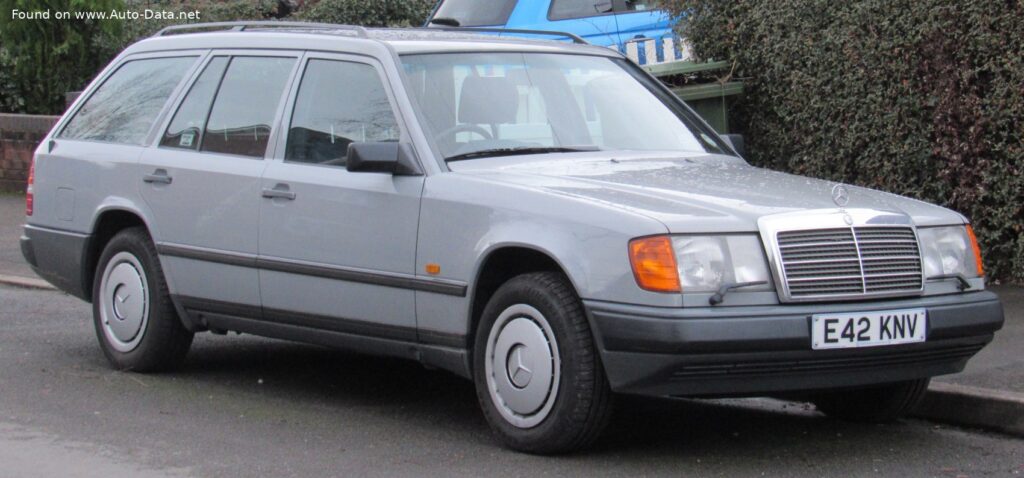
The Mercedes-Benz S124 200 TD (72 Hp) represents a significant chapter in the storied history of the German automaker’s mid-size executive car lineage. Introduced in October 1985 as part of the W124 generation, the S124 designation specifically refers to the station wagon (or estate) variant. This particular model, the 200 TD, was equipped with a naturally aspirated diesel engine, emphasizing Mercedes-Benz’s commitment to durability, fuel efficiency, and practical utility, especially for the discerning European market where diesel power was, and remains, highly valued.
The W124 series, produced from 1984 to 1995, is widely regarded as one of the most robust and “over-engineered” vehicles ever built by Mercedes-Benz, setting new benchmarks for quality, safety, and longevity. The S124 wagon, with its extended wheelbase and versatile cargo capacity, quickly became a favorite among families and professionals alike, offering a blend of luxury, comfort, and uncompromising practicality. While the 200 TD variant, with its modest 72 horsepower, was not designed for blistering performance, it perfectly embodied the W124’s ethos of reliable, economical, and comfortable long-distance travel. Its primary market was undoubtedly Europe, where its diesel powertrain and spacious wagon configuration were highly sought after, contrasting with the more gasoline-centric and sedan-focused offerings typically prevalent in the North American market during that era.
Powertrain & Engine Architecture
Under the hood, the Mercedes-Benz S124 200 TD (72 Hp) featured the OM 601 D 20 / 601.912 engine, a 2.0-liter (1997 cm³, or 121.86 cu. in.) naturally aspirated inline-four diesel powerplant. This engine was renowned for its bulletproof reliability and impressive fuel economy, characteristics that were prioritized over outright speed. Producing a modest 72 horsepower at 4600 rpm and 90.72 lb.-ft. (123 Nm) of torque at 2800 rpm, the 200 TD was geared towards smooth, consistent power delivery rather than rapid acceleration.
The OM601 engine utilized a precombustion chamber injection system, a common diesel technology of the time. This system involved injecting fuel into a small precombustion chamber connected to the main cylinder, where it was partially ignited before entering the main combustion chamber. This improved combustion efficiency and reduced engine noise. The engine also featured a robust cast iron block and a relatively simple valvetrain with a single overhead camshaft (SOHC) operating two valves per cylinder. The compression ratio was a high 22:1, typical for diesel engines, contributing to efficient combustion. The 5-speed manual transmission, a common pairing for this engine, was a robust unit designed for durability and smooth shifting. It sent power to the rear wheels via a conventional driveshaft and differential.
Driving Characteristics
The driving experience in the S124 200 TD was characterized by its relaxed and refined nature. Acceleration from 0 to 60 mph was achieved in a leisurely 20.6 seconds, with a top speed of 93.21 mph (150 km/h). Compared to other W124 variants, such as the 230E gasoline model or the later 300TD turbodiesel, the 200 TD offered significantly less performance. The gasoline engines provided quicker acceleration and higher top speeds, while the turbodiesel offered considerably more torque. However, the 200 TD’s strength lay in its smooth power delivery and excellent fuel economy.
The 5-speed manual transmission allowed drivers to keep the engine in its optimal power band, but the limited horsepower meant frequent downshifting was necessary when tackling hills or overtaking. The gear ratios were relatively long, prioritizing fuel efficiency over rapid acceleration. The rear-wheel-drive configuration provided balanced handling, and the S124’s independent suspension contributed to a comfortable ride, even on rough roads. The 200 TD was not a sports car, but it was a capable and comfortable cruiser, well-suited for long-distance journeys.
Equipment & Trim Levels
The S124 200 TD typically came with a fairly standard level of equipment, reflecting its position as an entry-level model within the W124 range. Standard features included cloth upholstery, power windows, central locking, and a basic radio. The interior was designed with practicality and durability in mind, featuring high-quality materials and a logical layout of controls. The dashboard was typically finished in a dark wood veneer, adding a touch of elegance to the cabin.
Optional extras included air conditioning, a sunroof, upgraded audio systems, and leather upholstery. Higher trim levels, such as the “Elegant” or “Classic” packages, added additional features like alloy wheels, upgraded interior trim, and more sophisticated audio systems. The S124 wagon also benefited from features specific to its body style, such as a self-leveling rear suspension to maintain ride height when carrying heavy loads, and a retractable cargo cover for security and privacy.
Chassis & Braking
The S124 200 TD featured a robust chassis designed for durability and comfort. The front suspension utilized a wishbone setup, while the rear suspension was a sophisticated independent multi-link system, a significant innovation for its time. This rear suspension design provided superior ride comfort and handling stability compared to traditional solid axle setups. The chassis was reinforced to handle the added weight of the wagon body style and the potential for heavy loads in the cargo area.
Braking was handled by disc brakes on all four wheels, providing confident stopping power. Hydraulic power steering, featuring a cone worm with recirculation balls, offered precise and effortless maneuverability. The vehicle rode on 195/65 R15 tires mounted on 6.5J x 15 wheel rims, a practical size for comfort and durability. The rear drums were sometimes fitted depending on the market and year of production. Safety features, while not as extensive as modern cars, included a robust passenger cell and advanced crumple zones for the era, reflecting Mercedes-Benz’s commitment to occupant protection.
Market Reception & Comparison
Critics generally praised the S124 200 TD for its reliability, fuel economy, and comfortable ride. However, its modest performance was often noted as a drawback, particularly when compared to the more powerful gasoline and turbodiesel variants. The 200 TD was seen as a practical and sensible choice for those prioritizing economy and durability over outright speed. Fuel economy was a significant advantage, with the 200 TD boasting an urban fuel consumption of 27 US mpg (8.7 l/100 km) and an even more impressive extra-urban consumption of 43.6 US mpg (5.4 l/100 km).
Compared to its siblings, the 200 TD was the most affordable W124 wagon. The 230E offered more power and a smoother driving experience, but at a higher price point. The 300TD turbodiesel provided significantly more torque and better performance, but it was also more expensive and slightly less fuel-efficient. The 200 TD occupied a unique niche, appealing to buyers who wanted the practicality of a W124 wagon with the fuel economy and reliability of a diesel engine, without the higher cost of the more powerful variants.
Technical Specifications
| General Information | |
| Brand | Mercedes-Benz |
| Model | W124 |
| Generation | S124 |
| Type (Engine) | 200 TD (72 Hp) |
| Start of Production | October, 1985 |
| End of Production | February, 1989 |
| Powertrain Architecture | Internal Combustion Engine |
| Body Type | Station wagon (estate) |
| Seats | 5 |
| Doors | 5 |
| Performance Specifications | |
| Fuel Consumption (Urban) | 8.7 l/100 km (27 US mpg) |
| Fuel Consumption (Extra Urban) | 5.4 l/100 km (43.6 US mpg) |
| Fuel Type | Diesel |
| Acceleration 0 – 60 mph | 20.6 sec |
| Maximum Speed | 150 km/h (93.21 mph) |
| Weight-to-Power Ratio | 19.6 kg/Hp (51.1 Hp/tonne) |
| Weight-to-Torque Ratio | 11.5 kg/Nm (87.2 Nm/tonne) |
| Engine Specifications | |
| Power | 72 Hp @ 4600 rpm |
| Power per Liter | 36.1 Hp/l |
| Torque | 123 Nm @ 2800 rpm (90.72 lb.-ft. @ 2800 rpm) |
| Engine Layout | Front, Longitudinal |
| Engine Model/Code | OM 601 D 20 / 601.912 |
| Engine Displacement | 1997 cm³ (121.86 cu. in.) |
| Number of Cylinders | 4 |
| Engine Configuration | Inline |
| Cylinder Bore | 87 mm (3.43 in.) |
| Piston Stroke | 84 mm (3.31 in.) |
| Compression Ratio | 22:1 |
| Number of Valves per Cylinder | 2 |
| Fuel Injection System | Precombustion chamber injection |
| Engine Aspiration | Naturally aspirated engine |
| Valvetrain | SOHC |
| Engine Oil Capacity | 6.5 l (6.87 US qt) |
| Coolant Capacity | 8.5 l (8.98 US qt) |
| Dimensions, Volume, and Weights | |
| Kerb Weight | 1410 kg (3108.52 lbs.) |
| Max. Weight | 2030 kg (4475.38 lbs.) |
| Max Load | 620 kg (1366.87 lbs.) |
| Fuel Tank Capacity | 72 l (19.02 US gal) |
| Length | 4765 mm (187.6 in.) |
| Width | 1740 mm (68.5 in.) |
| Height | 1490 mm (58.66 in.) |
| Wheelbase | 2800 mm (110.24 in.) |
| Front Track | 1497 mm (58.94 in.) |
| Rear Track | 1488 mm (58.58 in.) |
| Drivetrain, Brakes, and Suspension | |
| Drivetrain Architecture | Internal Combustion engine (ICE) drives the rear wheels |
| Drive Wheel | Rear wheel drive |
| Number of Gears and Type of Gearbox | 5 gears, manual transmission |
| Front Suspension | Wishbone |
| Rear Suspension | Independent multi-link suspension |
| Front Brakes | Disc |
| Rear Brakes | Disc |
| Steering Type | Cone worm with recirculation balls |
| Power Steering | Hydraulic Steering |
| Front Wheel Tires | 195/65 R15 |
| Rear Wheel Tires | 195/65 R15 |
| Front Wheel Rims | 6.5J x 15 |
| Rear Wheel Rims | 6.5J x 15 |
Legacy
The Mercedes-Benz S124 200 TD (72 Hp), as part of the broader W124 generation, carved out an indelible legacy in the automotive world. It is celebrated as a prime example of Mercedes-Benz’s engineering prowess during an era often referred to as the marque’s “golden age.” The W124 series earned a reputation for being “over-engineered,” meaning components were designed and built to standards far exceeding typical industry practices, resulting in exceptional durability and longevity. Many W124s, including the S124 wagons, remain on the road today, often having accumulated hundreds of thousands of miles, a testament to their robust construction.
The OM601 diesel engine, in particular, is renowned for its longevity. With proper maintenance, these engines can easily exceed 300,000 miles. The simplicity of the engine design and the use of robust materials contribute to its exceptional reliability. In the used car market, the S124 200 TD is often sought after by enthusiasts who appreciate its classic styling, comfortable ride, and legendary durability. While prices have been rising in recent years, they remain relatively affordable compared to other classic Mercedes-Benz models. The S124 200 TD represents a bygone era of automotive engineering, where quality, reliability, and longevity were prioritized above all else.
