
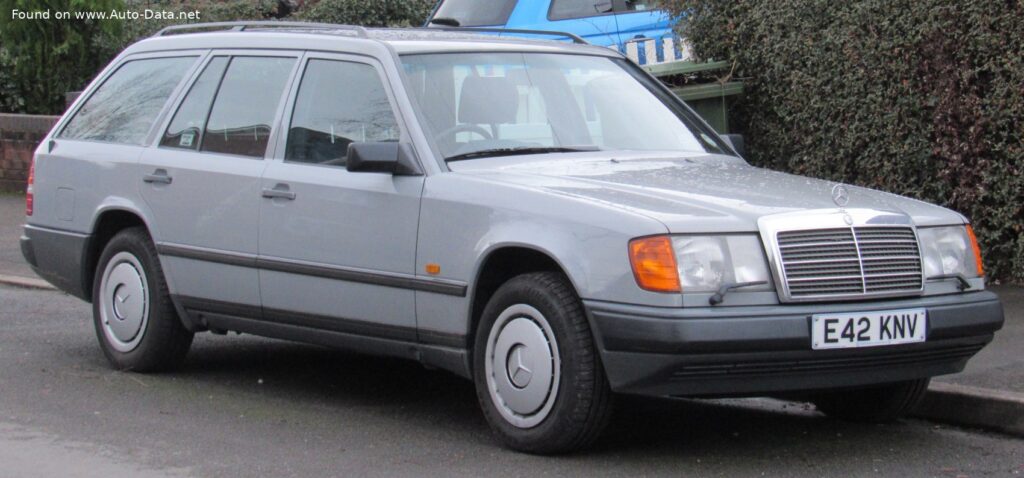
The Mercedes-Benz S124 300 TD Turbo, produced from May 1985 to September 1988, represents a significant chapter in the history of premium executive automobiles. As part of the iconic W124 generation, the S124 designation specifically refers to the station wagon (estate) variant, which seamlessly combined Mercedes-Benz’s renowned build quality, sophisticated engineering, and the practicality demanded by families and professionals alike. This particular model, equipped with a turbocharged diesel engine and an automatic transmission, was a quintessential European luxury workhorse, embodying the brand’s commitment to durability, comfort, and efficiency during the mid-to-late 1980s. While not as widely available in the United States in this exact diesel configuration as its gasoline counterparts, the W124 chassis itself earned immense respect for its “over-engineered” quality, setting a benchmark for automotive longevity and reliability. The Mercedes-Benz S124 300 TD Turbo was more than just a car; it was a statement of pragmatic luxury and robust design, built to tackle countless miles with unwavering composure.
Powertrain & Engine Architecture
At the heart of the Mercedes-Benz S124 300 TD Turbo lies the formidable OM 603 D 30 A / 603.960 engine, a 3.0-liter (2996 cm3 or 182.83 cu. in.) inline-six diesel powerplant. This engine was a marvel of its time, showcasing Mercedes-Benz’s leadership in diesel technology. Featuring a turbocharger, it produced a respectable 143 horsepower at 4600 rpm and a robust 197 lb.-ft. (267 Nm) of torque at a low 2400 rpm. The inclusion of a turbocharger was crucial, transforming the performance characteristics of the diesel engine from merely economical to genuinely capable, offering a substantial boost in power and refinement over naturally aspirated diesel predecessors.
The OM603 engine utilized a precombustion chamber injection system, a hallmark of Mercedes-Benz diesel engines of the era. This system involved injecting fuel into a small precombustion chamber within the cylinder head, where it was partially ignited before entering the main combustion chamber. This design promoted more complete combustion, reducing emissions and improving fuel efficiency. The engine also featured a single overhead camshaft (SOHC) valvetrain, operating two valves per cylinder. This configuration provided a good balance between performance and simplicity.
Power was delivered to the rear wheels via a smooth and durable 4-speed automatic transmission, a common and highly regarded setup for Mercedes-Benz vehicles of this era, emphasizing comfort and effortless cruising. This transmission, typically the 4G-Tronic unit, was known for its reliability and smooth shifting characteristics. It was designed to handle the substantial torque output of the diesel engine without issue. The transmission’s gear ratios were optimized for both fuel efficiency and comfortable highway cruising.
Driving Characteristics
The S124 300 TD Turbo offered a distinctly different driving experience compared to its gasoline-powered siblings or even the naturally aspirated diesel versions. The turbocharger provided a noticeable boost in acceleration, making highway merging and overtaking maneuvers considerably easier. While not a sports car, the 300 TD Turbo felt surprisingly capable for a large station wagon. The automatic transmission contributed to a relaxed driving experience, eliminating the need for constant gear changes.
Compared to the manual transmission versions, the automatic offered less driver engagement but greater convenience. The 4-speed automatic, while reliable, did result in slightly lower fuel economy and a marginally slower 0-60 mph time compared to the 5-speed manual. However, the difference was often negligible in real-world driving conditions. The torque converter in the automatic transmission also provided a smoother launch from a standstill. The gear ratios were tailored to maximize fuel efficiency at cruising speeds, making it an excellent long-distance vehicle.
Equipment & Trim Levels
The S124 300 TD Turbo was positioned as a mid-to-premium trim level within the W124 estate range. Standard equipment included power windows, central locking, and a high-quality audio system. The interior typically featured MB-Tex (Mercedes-Benz’s synthetic leather) upholstery, known for its durability and resistance to wear. Cloth upholstery was also available as an option. The dashboard layout was functional and ergonomically designed, with clear instrumentation and intuitive controls.
Optional extras included leather upholstery, a sunroof, automatic climate control, and upgraded audio systems. Many examples were also equipped with the optional self-leveling suspension, which helped maintain a consistent ride height even when the vehicle was heavily loaded. The S124 300 TD Turbo was often purchased with a range of convenience features, reflecting its status as a luxury vehicle. The wood trim on the dashboard and door panels added a touch of elegance to the interior.
Chassis & Braking
The S124 300 TD Turbo benefited from the W124 chassis’s advanced engineering. The front suspension featured independent wishbones, coil springs, and anti-roll bar, providing excellent handling and ride comfort. The rear suspension was particularly noteworthy, utilizing a sophisticated independent multi-link setup. This design minimized body roll, improved stability, and provided a smooth ride even on uneven surfaces.
Braking was handled by ventilated disc brakes on the front wheels and disc brakes on the rear wheels, a significant upgrade over the rear drum brakes found on some lower-trim W124 models. Anti-lock Braking System (ABS) was standard or widely available, enhancing braking control in adverse conditions. The hydraulic power steering provided precise and communicative feedback, contributing to the car’s confident driving dynamics. Stabilizer bars (anti-roll bars) were fitted to both the front and rear axles to further reduce body roll during cornering.
Market Reception & Comparison
Critics generally praised the Mercedes-Benz S124 300 TD Turbo for its robust build quality, comfortable ride, and impressive fuel economy. The turbocharged diesel engine was lauded for its smooth operation and ample torque. However, some reviewers noted that the performance, while adequate, was not as exhilarating as that of the gasoline-powered models.
Compared to the 300E (gasoline) and other W124 variants, the 300 TD Turbo offered superior fuel economy and a more relaxed driving experience. It was also considered to be more durable and reliable than many of its gasoline counterparts, particularly over the long term. Against competitors like the BMW 5-Series Touring and Audi 100/A6 Avant, the Mercedes-Benz offered a unique blend of luxury, practicality, and diesel efficiency. The Volvo 740/940 Estate provided similar practicality but lacked the same level of refinement and prestige. The 300 TD Turbo’s diesel engine, while offering excellent fuel economy, was generally quieter and more refined than those found in many of its competitors.
Technical Specifications
| Feature | Value |
| Brand | Mercedes-Benz |
| Model | W124 (S124 Generation) |
| Type (Engine) | 300 TD Turbo (143 Hp) Automatic |
| Production Start | May, 1985 |
| Production End | September, 1988 |
| Body Type | Station wagon (estate) |
| Seats | 5 |
| Doors | 5 |
| Fuel Type | Diesel |
| Fuel Consumption (City) | 9.4 L/100 km (25 US mpg) |
| Fuel Consumption (Highway) | 6.9 L/100 km (34.1 US mpg) |
| Acceleration 0-60 mph | 10.4 sec |
| Maximum Speed | 195 km/h (121.17 mph) |
| Power | 143 Hp @ 4600 rpm |
| Torque | 267 Nm (196.93 lb.-ft.) @ 2400 rpm |
| Engine Layout | Front, Longitudinal |
| Engine Model/Code | OM 603 D 30 A / 603.960 |
| Engine Displacement | 2996 cm3 (3.0 L / 182.83 cu. in.) |
| Number of Cylinders | 6, Inline |
| Cylinder Bore | 87 mm (3.43 in.) |
| Piston Stroke | 84 mm (3.31 in.) |
| Compression Ratio | 22:1 |
| Valves per Cylinder | 2 |
| Fuel Injection System | Precombustion chamber injection |
| Engine Aspiration | Turbocharger |
| Valvetrain | SOHC |
| Engine Oil Capacity | 7.5 L (7.93 US qt) |
| Coolant Capacity | 9.5 L (10.04 US qt) |
| Kerb Weight | 1560 kg (3439.21 lbs.) |
| Max. Weight | 2180 kg (4806.08 lbs.) |
| Max Load | 620 kg (1366.87 lbs.) |
| Fuel Tank Capacity | 72 L (19.02 US gal) |
| Length | 4765 mm (187.6 in.) |
| Width | 1740 mm (68.5 in.) |
| Height | 1490 mm (58.66 in.) |
| Wheelbase | 2800 mm (110.24 in.) |
| Front Track | 1497 mm (58.94 in.) |
| Rear Track | 1488 mm (58.58 in.) |
| Drivetrain Architecture | Rear wheel drive |
| Transmission | 4 gears, automatic transmission |
| Front Suspension | Wishbone |
| Rear Suspension | Independent multi-link suspension |
| Front Brakes | Ventilated discs |
| Rear Brakes | Disc |
| Assisting Systems | ABS (Anti-lock braking system) |
| Steering Type | Cone worm with recirculation balls |
| Power Steering | Hydraulic Steering |
| Front Tires | 195/65 R15 |
| Rear Tires | 195/65 R15 |
| Front Wheel Rims | 6.5J x 15 |
| Rear Wheel Rims | 6.5J x 15 |
Legacy
The Mercedes-Benz S124 300 TD Turbo, and indeed the entire W124 generation, left an indelible mark on the automotive landscape, particularly in its primary European markets. It quickly gained a reputation for being “over-engineered,” a term that became synonymous with Mercedes-Benz’s commitment to uncompromising quality and durability. This specific diesel wagon variant was a testament to that philosophy, proving to be an exceptionally reliable and long-lasting vehicle, with many examples still operating reliably today, decades after their production.
In the used car market, the S124 300 TD Turbo remains highly sought after by enthusiasts and collectors. Well-maintained examples command premium prices, reflecting their rarity and enduring appeal. The OM603 engine is renowned for its longevity and relatively simple maintenance requirements. While parts availability can be a concern for some older vehicles, the W124 enjoys a strong aftermarket support network. The S124 300 TD Turbo represents a golden age of Mercedes-Benz engineering, offering a unique blend of luxury, practicality, and durability that is difficult to find in modern vehicles. Its legacy as a robust and reliable workhorse continues to endure, solidifying its place as a modern classic.
