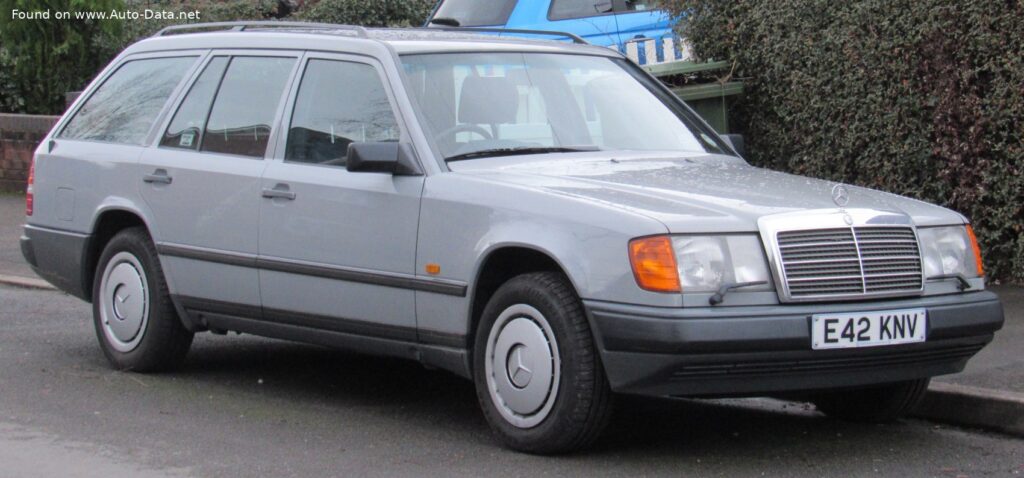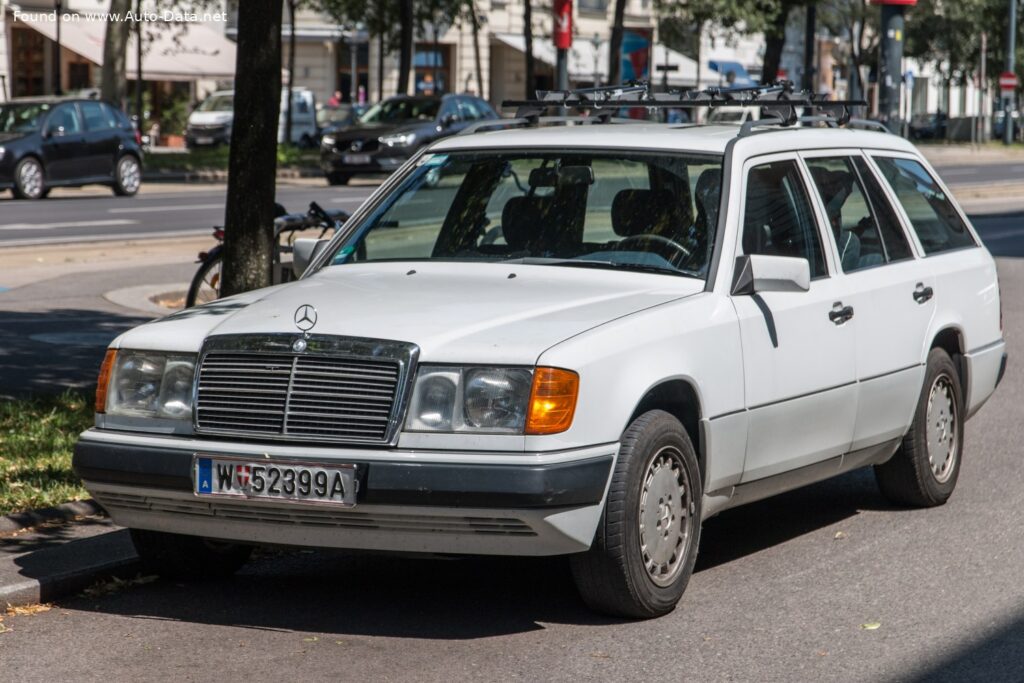
The Mercedes-Benz S124 (facelift 1989) 220 TE (150 Hp) represents a significant chapter in the history of the German automaker’s revered W124 generation. Produced from June 1992 to July 1993, this particular variant, identifiable by its “S124” chassis code for the station wagon body style and the “TE” designation for the gasoline-powered Touring Estate, was a refined iteration of an already highly acclaimed platform. Positioned in the executive car segment, the W124 series, introduced in 1984, quickly established itself as a benchmark for build quality, durability, and engineering excellence. The 1989 facelift brought subtle yet impactful enhancements, primarily aesthetic and technological, keeping the model competitive and fresh through the early 1990s. While not a common sight on American roads during its original production run, its reputation for robust construction and sophisticated ride quality resonated globally, making it a highly sought-after classic in the enthusiast community today, particularly in its primary European market.
Powertrain & Engine Architecture
Under the hood of the Mercedes-Benz S124 (facelift 1989) 220 TE (150 Hp) lies the M 111 E 22 engine, a naturally aspirated inline-four-cylinder powerplant renowned for its smooth operation and reliability. With an engine displacement of 2199 cubic centimeters (approximately 2.2 liters or 134.19 cubic inches), this engine generated a respectable 150 horsepower at 5500 revolutions per minute. Its power-per-liter output stood at 68.2 horsepower per liter, a solid figure for a non-turbocharged engine of its era.
Torque delivery was equally impressive, peaking at 154.89 pound-feet (210 Newton-meters) at 4000 rpm, providing ample pulling power for a family wagon. The engine’s layout was a classic front, longitudinal configuration, driving the rear wheels, a hallmark of Mercedes-Benz engineering for balanced weight distribution and driving dynamics. The M 111 E 22 featured a Double Overhead Camshaft (DOHC) valvetrain with four valves per cylinder, a relatively advanced setup for the time, contributing to its efficiency and power output. Fuel was delivered via a multi-port manifold injection system, ensuring precise fuel metering.
The 220 TE was typically paired with either a 5-speed manual transmission or a 4-speed automatic transmission. The automatic, a common choice for buyers prioritizing comfort and ease of use, was a traditional hydraulic unit, known for its smooth shifts but lacking the efficiency of modern electronically controlled transmissions. The automatic transmission’s gear ratios were optimized for relaxed cruising and acceptable acceleration, rather than outright performance.
Driving Characteristics
The 220 TE with the automatic transmission offered a comfortable and refined driving experience. While not particularly sporty, the engine provided sufficient power for everyday driving and highway cruising. Acceleration from 0 to 60 miles per hour took approximately 10.3 seconds, which was competitive for the segment but noticeably slower than the manual transmission version or higher-output W124 models like the 280E. The automatic transmission’s shift points were calibrated for smoothness and fuel economy, sometimes resulting in a slight delay in response during overtaking maneuvers.
Compared to the manual transmission 220 TE, the automatic version sacrificed some driver engagement and responsiveness. The manual allowed for more precise control over gear selection, enabling drivers to exploit the engine’s powerband more effectively. Compared to the six-cylinder 280E, the 220 TE offered a more economical driving experience, but at the cost of significantly reduced performance. The 280E’s larger engine and higher output provided a more spirited driving experience, making it the preferred choice for drivers who prioritized performance over fuel efficiency.
Equipment & Trim Levels
The 220 TE, even in base form, was well-equipped for its time. Standard features typically included power windows, central locking, a sunroof, and a high-quality audio system. The interior was characterized by its elegant design and durable materials, with cloth upholstery being standard. Leather upholstery was available as an optional extra, along with wood trim and other luxury appointments.
Optional extras for the 220 TE were extensive, reflecting Mercedes-Benz’s commitment to personalization. These included automatic climate control, heated seats, a trip computer, and upgraded audio systems. The S124 also offered a range of safety features, such as anti-lock brakes (ABS) and airbags, which were becoming increasingly common in the early 1990s. The 220 TE sat in a mid-range position within the W124 lineup, offering a balance of luxury, comfort, and practicality. It was positioned above the base 200E and 200 TE models, but below the more luxurious and powerful 280E and 300E variants.
Chassis & Braking
The S124 chassis was renowned for its robust construction and excellent ride quality. The 220 TE utilized a sophisticated suspension system, featuring independent wishbones at the front and an independent multi-link suspension at the rear. This arrangement provided a comfortable ride while maintaining good handling stability. The steering was hydraulic power-assisted, offering precise control and effortless maneuverability.
The braking system comprised ventilated discs at the front and solid discs at the rear, providing strong and consistent stopping power. ABS (Anti-lock Braking System) was standard, enhancing braking control in adverse conditions. The 220 TE’s suspension was tuned to prioritize comfort and ride quality, rather than outright sportiness. Stabilizer bars were fitted to both the front and rear axles to reduce body roll during cornering. The tires were typically 195/65 R15, a size chosen for its balance of ride comfort, handling, and availability.
Market Reception & Comparison
Critics generally praised the Mercedes-Benz S124 220 TE for its build quality, ride comfort, and practicality. The M111 engine was lauded for its smoothness and reliability, while the spacious interior and generous cargo capacity made it an ideal family vehicle. However, some critics noted that the 220 TE’s performance was somewhat underwhelming, particularly when compared to its six-cylinder counterparts.
In terms of fuel economy, the 220 TE offered a reasonable compromise between performance and efficiency. It achieved approximately 19.3 US miles per gallon in urban driving conditions and 32.2 US miles per gallon on the extra-urban cycle. Compared to the 280E, the 220 TE offered significantly better fuel economy, but at the cost of reduced performance. Reliability was a key strength of the 220 TE. The M111 engine and the robust chassis were known for their durability, making it a relatively trouble-free vehicle to own. The automatic transmission, while smooth, was sometimes prone to issues with the hydraulic control unit as it aged.
Technical Specifications
| Category | Specification |
| General Information | |
| Brand | Mercedes-Benz |
| Model | W124 |
| Generation | S124 (facelift 1989) |
| Type (Engine) | 220 TE (150 Hp) |
| Start of Production | June, 1992 |
| End of Production | July, 1993 |
| Powertrain Architecture | Internal Combustion engine |
| Body Type | Station wagon (estate) |
| Seats | 5 |
| Doors | 5 |
| Performance Specs | |
| Fuel Consumption (Urban) | 12.2 l/100 km (19.3 US mpg) |
| Fuel Consumption (Extra Urban) | 7.3 l/100 km (32.2 US mpg) |
| Fuel Type | Petrol (Gasoline) |
| Acceleration 0 – 60 mph | 10.3 sec |
| Acceleration 0 – 62 mph (0 – 100 km/h) | 10.8 sec |
| Maximum Speed | 123.03 mph (198 km/h) |
| Weight-to-Power Ratio | 9.9 kg/Hp (21.8 lbs/Hp), 101.4 Hp/tonne |
| Weight-to-Torque Ratio | 7 kg/Nm (15.4 lbs/Nm), 141.9 Nm/tonne |
| Engine Specs | |
| Power | 150 Hp @ 5500 rpm |
| Power per Liter | 68.2 Hp/l |
| Torque | 210 Nm @ 4000 rpm (154.89 lb.-ft. @ 4000 rpm) |
| Engine Layout | Front, Longitudinal |
| Engine Model/Code | M 111 E 22 / 111.960 |
| Engine Displacement | 2199 cm3 (2.2 liters / 134.19 cu. in.) |
| Number of Cylinders | 4 |
| Engine Configuration | Inline |
| Cylinder Bore | 89.9 mm (3.54 in.) |
| Piston Stroke | 86.6 mm (3.41 in.) |
| Compression Ratio | 10:1 |
| Number of Valves per Cylinder | 4 |
| Fuel Injection System | Multi-port manifold injection |
| Engine Aspiration | Naturally aspirated engine |
| Valvetrain | DOHC |
Legacy
The Mercedes-Benz W124 series, including the 220 TE, has earned a reputation as one of the most durable and reliable vehicles ever produced. The M111 engine, in particular, is known for its longevity and relatively simple maintenance requirements. Today, well-maintained examples of the 220 TE are highly sought after by classic car enthusiasts and collectors.
In the used car market, the 220 TE commands a premium compared to other W124 variants, reflecting its desirability and rarity. While the automatic transmission may require occasional servicing, the overall reliability of the powertrain is excellent. The S124’s robust construction and timeless design ensure that it will remain a desirable classic for years to come. The Mercedes-Benz S124 (facelift 1989) 220 TE (150 Hp) stands as a testament to an era of German engineering excellence, embodying the values of quality, durability, and refinement.