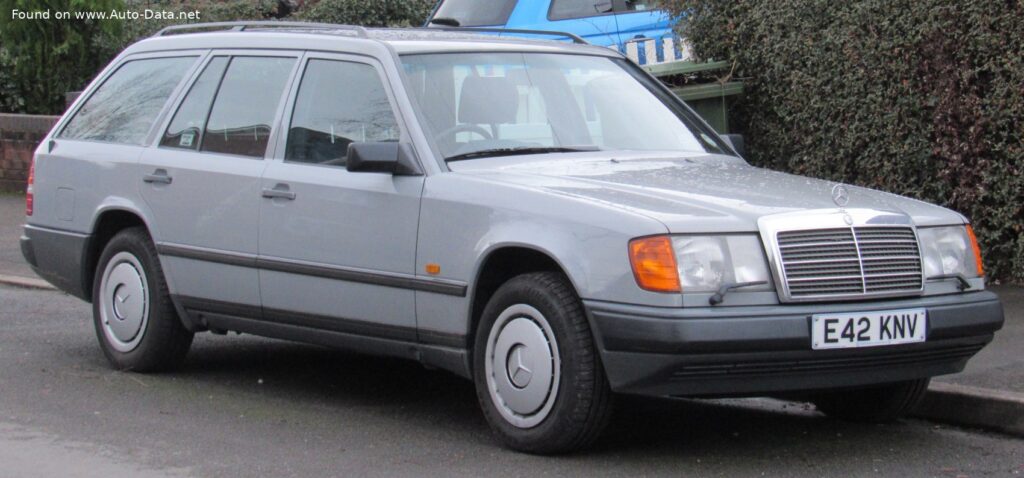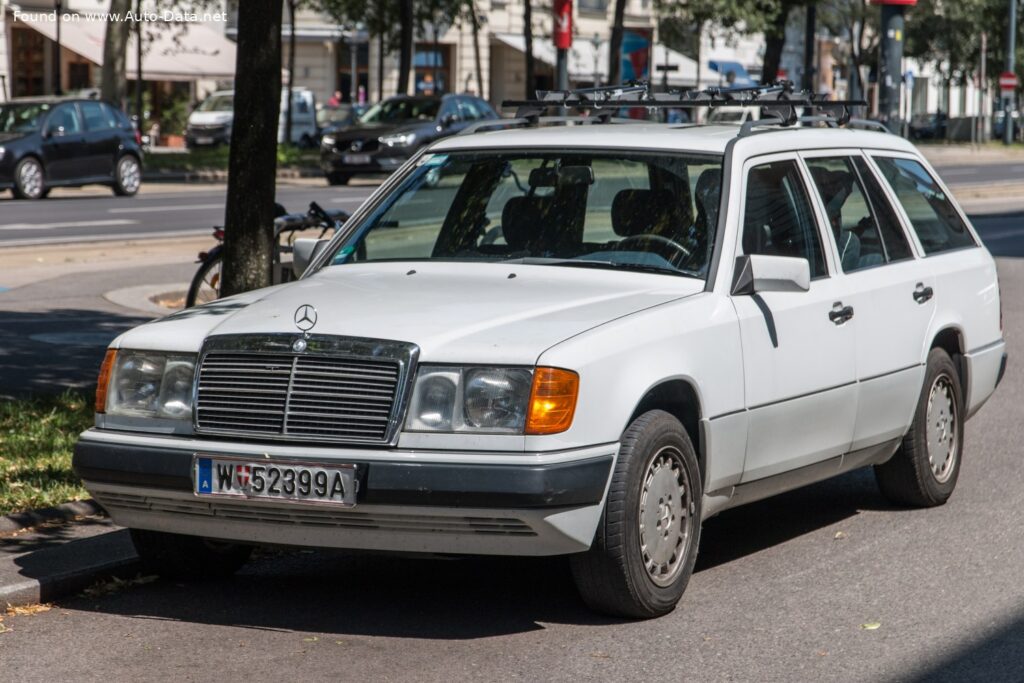
The Mercedes-Benz S124 (facelift 1989) 300 TD Turbo (147 Hp) 4MATIC Automatic represents a significant chapter in the history of premium executive automobiles. Part of the legendary W124 generation, often hailed as one of Mercedes-Benz’s finest achievements in terms of engineering and build quality, this particular model combined robust turbodiesel power with advanced all-wheel-drive technology in a highly practical station wagon (estate) body style. Introduced in September 1989 as part of the W124’s mid-cycle refresh, the S124 300 TD Turbo 4MATIC was a sophisticated offering primarily targeted at the European market, where its blend of efficiency, space, and all-weather capability made it an ideal choice for discerning families and professionals. While not officially sold in the United States in this specific configuration, its underlying W124 platform and powertrain elements were familiar to American consumers through other models. This vehicle exemplified Mercedes-Benz’s commitment to durability, safety, and driving refinement during an era often referred to as the marque’s “golden age” of over-engineering.
Engine & Performance of the Mercedes-Benz S124 (facelift 1989) 300 TD Turbo 4MATIC Automatic
At the heart of the Mercedes-Benz S124 (facelift 1989) 300 TD Turbo (147 Hp) 4MATIC Automatic was the formidable OM 603 D 30 A / 603.963 inline-six turbodiesel engine. With an engine displacement of 2996 cubic centimeters (approximately 3.0 liters or 182.83 cubic inches), this powerplant was renowned for its impressive torque delivery and legendary longevity. The addition of a turbocharger significantly boosted its output, enabling it to produce a healthy 147 horsepower at 4600 rpm and a substantial 237 Nm (174.8 lb.-ft.) of torque at a low 2400 rpm. This low-end torque was crucial for effortless cruising and confident acceleration, particularly when the vehicle was fully loaded.
Power was seamlessly managed by a 4-speed automatic transmission, a common and reliable choice for Mercedes-Benz during this period. Performance figures for the 300 TD Turbo 4MATIC were respectable for a large turbodiesel wagon of its time. It could accelerate from 0 to 60 mph in a calculated 12.2 seconds (0-100 km/h in 12.8 seconds) and reach a maximum speed of 116.82 mph (188 km/h). Fuel efficiency, a key consideration for diesel engines, was commendable for a vehicle of its size and capability, with an urban consumption of 10.2 liters per 100 km (23.1 US mpg) and an extra-urban figure of 7.5 liters per 100 km (31.4 US mpg).
A defining feature of this particular S124 was its sophisticated 4MATIC all-wheel-drive system. Unlike many simpler 4×4 systems, Mercedes-Benz’s 4MATIC, first introduced in the mid-1980s, was an advanced, electronically controlled system designed to provide optimal traction in varying conditions without compromising on-road refinement. The powertrain architecture was designed such that the internal combustion engine permanently drove the rear wheels, with the front wheels engaging through an electrically or mechanically operated clutch only when necessary. This ensured excellent stability and grip on slippery surfaces, making the 300 TD Turbo 4MATIC an exceptionally capable vehicle for diverse climates and terrains, a significant advantage in many European markets.
Design & Features of the S124 Facelift
The Mercedes-Benz S124 (facelift 1989) retained the iconic, understated design language that characterized the W124 series. As a station wagon (known as an “estate” in Europe), the S124 offered immense practicality without sacrificing elegance. Its five-door, five-seat configuration provided ample passenger space and a cavernous cargo area, making it a highly versatile vehicle for families, tradespeople, or anyone requiring significant hauling capacity. The facelift models, introduced in 1989, brought subtle refinements to the exterior, including color-keyed side cladding (often referred to as “Sacco panels”), revised bumper designs, and updated interior trim, enhancing its contemporary appeal while preserving its classic silhouette.
Measuring 187.6 inches (4765 mm) in length, 68.5 inches (1740 mm) in width, and 58.94 inches (1497 mm) in height, with a generous 110.24-inch (2800 mm) wheelbase, the S124 commanded a substantial road presence. The design prioritized functionality and durability, evident in its robust body construction and high-quality materials. Inside, the W124 cabin was a benchmark for ergonomic design and material quality. While specific interior features are not detailed, Mercedes-Benz of this era was known for offering a comfortable and well-appointed environment, often including features like power windows, central locking, and high-quality upholstery, all built to withstand decades of use.
Safety was a paramount concern for Mercedes-Benz, and the S124 was equipped with advanced features for its time. The inclusion of an Anti-lock Braking System (ABS) provided enhanced control during emergency braking maneuvers. The vehicle featured ventilated disc brakes at the front and disc brakes at the rear, ensuring strong and consistent stopping power. The independent multi-link rear suspension, a Mercedes-Benz innovation, contributed significantly to the car’s refined ride quality and stable handling, while the wishbone front suspension provided precise steering. Hydraulic power steering, utilizing a cone worm with recirculation balls, offered a comfortable and communicative driving experience.
Technical Specifications: Mercedes-Benz S124 (facelift 1989) 300 TD Turbo (147 Hp) 4MATIC Automatic
| Category | Specification |
| Brand | Mercedes-Benz |
| Model | W124 |
| Generation | S124 (facelift 1989) |
| Type (Engine) | 300 TD Turbo (147 Hp) 4MATIC Automatic |
| Production Start | September, 1989 |
| Production End | July, 1993 |
| Powertrain Architecture | Internal Combustion engine |
| Body type | Station wagon (estate) |
| Seats | 5 |
| Doors | 5 |
| Fuel consumption (urban) | 10.2 l/100 km (23.1 US mpg) |
| Fuel consumption (extra urban) | 7.5 l/100 km (31.4 US mpg) |
| Fuel Type | Diesel |
| Acceleration 0 – 60 mph | 12.2 sec |
| Acceleration 0 – 100 km/h | 12.8 sec |
| Maximum speed | 116.82 mph (188 km/h) |
| Weight-to-power ratio | 11.6 kg/Hp, 86 Hp/tonne |
| Weight-to-torque ratio | 7.2 kg/Nm, 138.6 Nm/tonne |
| Power | 147 Hp @ 4600 rpm |
| Power per liter | 49.1 Hp/l |
| Torque | 237 Nm @ 2400 rpm (174.8 lb.-ft. @ 2400 rpm) |
| Engine layout | Front, Longitudinal |
| Engine Model/Code | OM 603 D 30 A / 603.963 |
| Engine displacement | 2996 cm3 (182.83 cu. in.) |
| Number of cylinders | 6 |
| Engine configuration | Inline |
| Cylinder Bore | 87 mm (3.43 in.) |
| Piston Stroke | 84 mm (3.31 in.) |
| Compression ratio | 22:1 |
| Valves per cylinder | 2 |
| Fuel injection system | Precombustion chamber injection |
| Engine aspiration | Turbocharger |
| Valvetrain | SOHC |
| Engine oil capacity | 7.5 l (7.93 US qt) |
| Kerb Weight | 1710 kg (3769.9 lbs.) |
| Max. weight | 2310 kg (5092.68 lbs.) |
| Max load | 600 kg (1322.77 lbs.) |
| Fuel tank capacity | 72 l (19.02 US gal) |
| Length | 4765 mm (187.6 in.) |
| Width | 1740 mm (68.5 in.) |
| Height | 1497 mm (58.94 in.) |
| Wheelbase | 2800 mm (110.24 in.) |
| Front track | 1497 mm (58.94 in.) |
| Rear (Back) track | 1485 mm (58.46 in.) |
| Drivetrain Architecture | The Internal combustion engine (ICE) drives the rear wheels permanently, and the front wheels are driven through an electrically or mechanically operated clutch if necessary. |
| Drive wheel | All wheel drive (4×4) |
| Number of gears and type of gearbox | 4 gears, automatic transmission |
| Front suspension | Wishbone |
| Rear suspension | Independent multi-link suspension |
| Front brakes | Ventilated discs |
| Rear brakes | Disc |
| Assisting systems | ABS (Anti-lock braking system) |
| Steering type | Cone worm with recirculation balls |
| Power steering | Hydraulic Steering |
| Tires size Front/Rear: | 195/65 R15 |
| Wheel rims size Front/Rear: | 6.5J x 15 |
Legacy & Market Impact of the S124 (facelift 1989) 300 TD Turbo 4MATIC Automatic
The Mercedes-Benz W124 series, and particularly its S124 station wagon variant, holds a revered place in automotive history. It is widely considered one of the last Mercedes-Benz models built with an almost obsessive focus on engineering excellence and durability, earning it the moniker “the last over-engineered Mercedes.” The S124 (facelift 1989) 300 TD Turbo (147 Hp) 4MATIC Automatic, with its potent diesel engine and sophisticated all-wheel-drive system, perfectly encapsulated this philosophy.
In its primary European market, this vehicle was a direct competitor to other premium executive wagons such as the BMW 5-Series Touring (E34 generation) and the Audi 100 Avant (C3 and later C4 generations). While BMW offered sportier dynamics and Audi pioneered quattro all-wheel drive, the Mercedes-Benz S124 distinguished itself with its unparalleled ride comfort, robust build quality, and a reputation for enduring reliability that few could match. The 4MATIC system, in particular, gave it an edge in regions with challenging winter conditions, providing superior traction and safety.
The OM603 turbodiesel engine itself became a legend for its ability to rack up hundreds of thousands of miles with proper maintenance, a testament to its robust design. This combined with the W124’s overall structural integrity meant that many of these vehicles remained on the road for decades, often serving as dependable workhorses or cherished family vehicles. Its influence extended beyond mere utility; the S124’s elegant, timeless design has ensured its status as a desirable classic car today, commanding strong prices for well-maintained examples. Enthusiasts and collectors appreciate its blend of traditional Mercedes-Benz values—solidity, comfort, and understated luxury—with modern (for its time) technological advancements like the 4MATIC system and turbocharging.
The legacy of the Mercedes-Benz S124 (facelift 1989) 300 TD Turbo (147 Hp) 4MATIC Automatic is one of quiet competence and enduring quality. It set a high benchmark for what an executive station wagon could be, proving that practicality could coexist with luxury, performance, and advanced engineering. Its continued presence on roads worldwide serves as a powerful reminder of an era when Mercedes-Benz built vehicles to an almost uncompromising standard, designed to last rather than to be replaced.