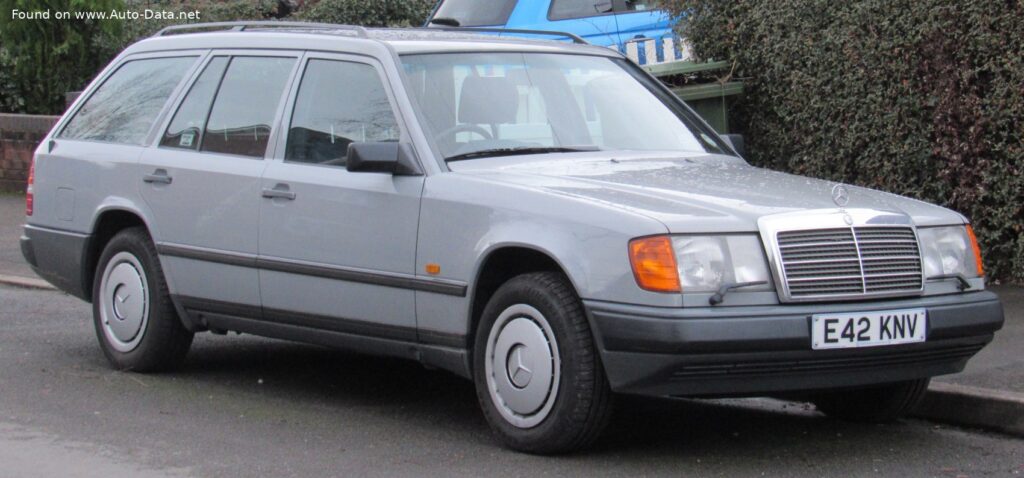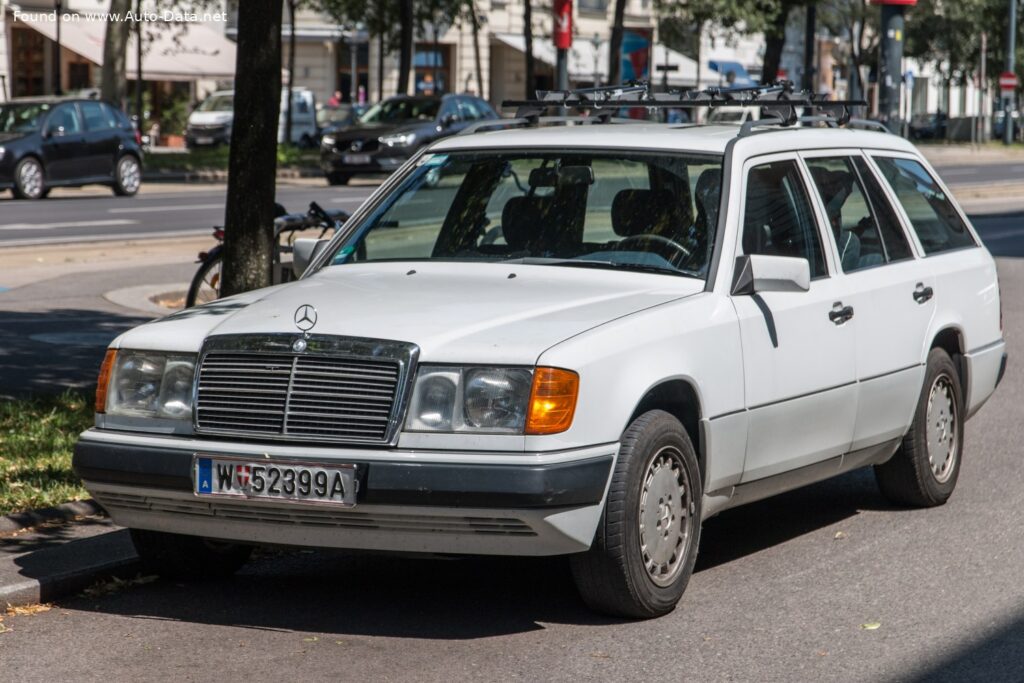
The Mercedes-Benz S124 (facelift 1989) 300 TD Turbo represents a high point in German automotive engineering, celebrated for its exceptional build quality, durability, and elegant design. Part of the broader W124 series produced from 1984 to 1996, the S124 specifically denotes the station wagon (or “estate” in European terminology) body style. This model, particularly the 300 TD Turbo iteration introduced during the 1989 facelift, combined the robust S124 chassis with a powerful turbocharged diesel engine, establishing itself as a sophisticated and long-lasting vehicle. Manufactured from September 1989 to July 1993, it appealed to buyers seeking the practicality of a wagon without sacrificing Mercedes-Benz’s renowned comfort, safety, and performance, especially in markets where diesel engines were favored for their efficiency and torque.
The W124 Chassis and the 1989 Facelift
The W124 platform was a significant engineering achievement upon its 1984 debut, succeeding the popular W123. It introduced advancements in safety, aerodynamics, and suspension technology. The S124 wagon, launched shortly after the sedan, quickly became a benchmark for luxury station wagons, offering substantial cargo capacity and, in some markets, an optional third row of rear-facing seats. The 1989 facelift, known as the “MOPF” (Modellpflege, meaning model refinement), brought both cosmetic and technical updates to refresh the W124’s appearance and enhance its features.
Visually, the most noticeable changes included revised side cladding – often referred to as “Sacco planks” after designer Bruno Sacco – which integrated more seamlessly with the bumpers and bodywork, creating a more modern aesthetic. The front grille was subtly redesigned, and the turn signal lenses switched from amber to clear, reflecting a popular styling trend of the late 1980s. Interior refinements included updated materials and switchgear. Crucially, the facelift often coincided with powertrain upgrades, such as the introduction of the turbocharged diesel engine in the 300 TD Turbo. These improvements ensured the W124 remained competitive and desirable in the luxury segment as it approached the end of the decade.
Engine & Performance
The Mercedes-Benz S124 (facelift 1989) 300 TD Turbo was powered by the robust OM 603 D 30 A / 603.960 engine. This 3.0-liter (2996 cm³ or 182.83 cubic inches) inline-six diesel engine exemplified Mercedes-Benz’s dedication to durable and efficient diesel power. Equipped with a single overhead camshaft (SOHC) and two valves per cylinder, it utilized a precombustion chamber injection system, a common technology of the era that contributed to smoother, quieter operation and reduced emissions compared to direct injection systems.
The turbocharger was the defining feature of the 300 TD Turbo, significantly boosting performance. It produced 147 horsepower at 4600 rpm and, more importantly for a diesel, a substantial 174.8 lb.-ft. of torque at 2400 rpm. This high torque output made the S124 remarkably tractable and effortless to drive, even when carrying passengers and cargo. Power was delivered to the rear wheels through a durable and smooth 4-speed automatic transmission, a common choice for luxury vehicles prioritizing comfort and longevity.
Performance figures were impressive for a large, luxury diesel wagon of its time. The 300 TD Turbo could accelerate from 0 to 60 mph in 10.4 seconds and achieve a top speed of 121 mph. Beyond speed, the engine was designed for longevity and fuel efficiency, achieving 25 US mpg in urban driving and 34.1 US mpg on the highway. The engine’s 7.5-liter (7.93 US quarts) oil capacity further contributed to its legendary durability and extended service intervals.
Design & Features
The S124’s design embodies Mercedes-Benz’s philosophy of functional elegance. The station wagon body provided exceptional practicality, featuring a large, accessible cargo area that could be expanded by folding down the rear seats. Its five-door, five-seat configuration (with optional third-row seating in some markets) made it a versatile family vehicle. Measuring 187.6 inches in length, 68.5 inches in width, and 58.62 inches in height, with a 110.24-inch wheelbase, the S124 offered ample interior space and a commanding road presence.
The W124’s interior was a showcase of ergonomic design and material quality. High-grade fabrics, leather, and wood trim created a luxurious and inviting atmosphere. Controls were intuitively placed, and visibility was excellent. Mercedes-Benz prioritized long-distance comfort with supportive seats and a quiet cabin, enhanced by the smooth operation of the inline-six diesel engine.
The S124 featured sophisticated chassis engineering, including an independent multi-link rear suspension – a groundbreaking design that provided superior ride comfort and handling stability, even when fully loaded. The front suspension utilized a wishbone setup, contributing to precise steering and a refined ride. Ventilated disc brakes at the front and solid discs at the rear, coupled with an Anti-lock Braking System (ABS), provided substantial stopping power and enhanced safety. Hydraulic power steering offered a reassuringly solid feel and excellent feedback, reinforcing the car’s reputation for robust engineering.
Technical Specifications
| Category | Specification |
| General Information | |
| Brand | Mercedes-Benz |
| Model | W124 |
| Generation | S124 (facelift 1989) |
| Type (Engine) | 300 TD Turbo (147 Hp) Automatic |
| Production Start | September, 1989 |
| Production End | July, 1993 |
| Powertrain Architecture | Internal Combustion Engine |
| Body type | Station Wagon (Estate) |
| Seats | 5 |
| Doors | 5 |
| Performance Specs | |
| Fuel Consumption (Urban) | 9.4 l/100 km (25 US mpg) |
| Fuel Consumption (Extra Urban) | 6.9 l/100 km (34.1 US mpg) |
| Fuel Type | Diesel |
| Acceleration 0-60 mph | 10.4 seconds |
| Maximum Speed | 195 km/h (121.17 mph) |
| Weight-to-Power Ratio | 10.9 kg/Hp (91.9 Hp/tonne) |
| Weight-to-Torque Ratio | 6.8 kg/Nm (148.1 Nm/tonne) |
| Engine Specs | |
| Power | 147 Hp @ 4600 rpm |
| Power per Liter | 49.1 Hp/l |
| Torque | 237 Nm @ 2400 rpm (174.8 lb.-ft. @ 2400 rpm) |
| Engine Layout | Front, Longitudinal |
| Engine Model/Code | OM 603 D 30 A / 603.960 |
| Engine Displacement | 2996 cm³ (3.0 liters / 182.83 cu. in.) |
| Number of Cylinders | 6 |
| Engine Configuration | Inline |
| Cylinder Bore | 87 mm (3.43 in.) |
| Piston Stroke | 84 mm (3.31 in.) |
| Compression Ratio | 22:1 |
| Number of Valves per Cylinder | 2 |
| Fuel Injection System | Precombustion chamber injection |
| Engine Aspiration | Turbocharger |
| Valvetrain | SOHC |
| Engine Oil Capacity | 7.5 l (7.93 US qt) |
| Space, Volume and Weights | |
| Kerb Weight | 1600 kg (3527.4 lbs) |
| Max. Weight | 2220 kg (4894.26 lbs) |
| Max Load | 620 kg (1366.87 lbs) |
| Fuel Tank Capacity | 72 l (19.02 US gal) |
| Dimensions | |
| Length | 4765 mm (187.6 in.) |
| Width | 1740 mm (68.5 in.) |
| Height | 1489 mm (58.62 in.) |
| Wheelbase | 2800 mm (110.24 in.) |
| Front Track | 1497 mm (58.94 in.) |
| Rear (Back) Track | 1497 mm (58.94 in.) |
| Drivetrain, Brakes and Suspension Specs | |
| Drivetrain Architecture | The Internal Combustion Engine (ICE) drives the rear wheels of the vehicle. |
| Drive Wheel | Rear wheel drive |
| Number of Gears and Type of Gearbox | 4 gears, automatic transmission |
| Front Suspension | Wishbone |
| Rear Suspension | Independent multi-link suspension |
| Front Brakes | Ventilated discs |
| Rear Brakes | Disc |
| Assisting Systems | ABS (Anti-lock braking system) |
| Steering Type | Cone worm with recirculation balls |
| Power Steering | Hydraulic Steering |
| Tires Size (Front & Rear) | 195/65 R15 |
| Wheel Rims Size (Front & Rear) | 6.5J x 15 |
Legacy and Enduring Appeal
The Mercedes-Benz W124, and particularly the S124 wagon, is considered one of the most robust and well-built automobiles ever produced. The Mercedes-Benz S124 (facelift 1989) 300 TD Turbo embodies this reputation for “over-engineering,” resulting in exceptional longevity and reliability. Designed for years of rigorous use, many examples remain on the road today, a testament to their inherent quality.
In its primary European market, the 300 TD Turbo competed with premium wagons like the BMW 5-Series Touring (E34), the Audi 100 Avant, and the Volvo 700/900 series wagons. While competitors offered their own strengths, the S124 consistently stood out for its blend of luxurious comfort, unparalleled build quality, advanced (for its time) multi-link suspension, and the formidable durability of its diesel powertrains. It was often the choice for those who valued understated quality, long-term ownership, and practical luxury.
The historical significance of the S124 lies in its role as a benchmark. It set new standards for safety, material quality, and driving dynamics in the executive car segment. Its influence can be seen in subsequent Mercedes-Benz models, which continued to refine the W124’s core principles. Today, the S124, especially the robust diesel wagons, has achieved cult status among enthusiasts and collectors. They are highly sought after for their classic Mercedes-Benz aesthetic, their comfortable and composed ride, and their legendary mechanical resilience. These vehicles represent an era when engineering integrity and durability were paramount, making the Mercedes-Benz S124 (facelift 1989) 300 TD Turbo more than just a car; it’s a piece of automotive history that continues to impress with its enduring quality and timeless appeal.