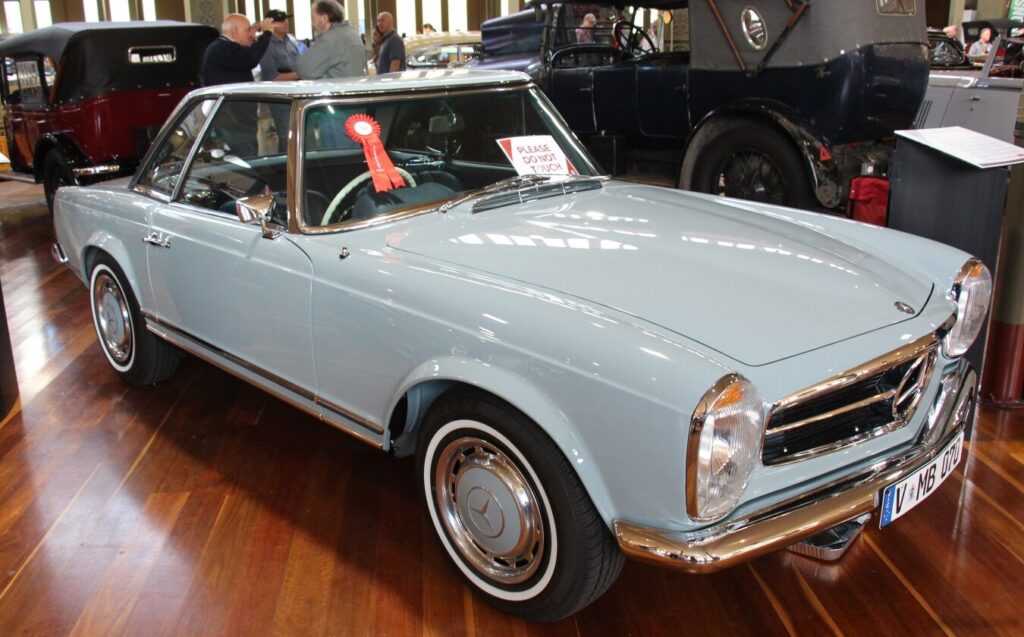
The Mercedes-Benz W113, marketed as the SL Coupe, represented a significant evolution in the iconic SL lineage. Specifically, the 230 SL variant, produced from March 1963 to January 1967, occupied a sweet spot in the range, offering a blend of performance and refinement. This model, powered by the M127 II engine and typically equipped with a four-speed manual transmission, was a key component of the W113’s success, appealing to buyers seeking a sophisticated grand tourer. The 230 SL was built upon the W113 platform, known for its elegant design penned by Friedrich Geiger and its advanced engineering for the time. It served as a replacement for the 190 SL and paved the way for the later 250 SL and 280 SL models.
Technical Specifications
| Brand | Mercedes-Benz |
| Model | SL |
| Generation | SL Coupe (W113) |
| Type (Engine) | 230 SL (150 Hp) Manual 4-speed |
| Start of production | March, 1963 |
| End of production | January, 1967 |
| Powertrain Architecture | Internal Combustion engine |
| Body type | Coupe |
| Seats | 2 |
| Doors | 2 |
| Fuel consumption (combined) | 10.2 l/100 km (23.1 US mpg, 27.7 UK mpg, 9.8 km/l) |
| Fuel Type | Petrol (Gasoline) |
| Acceleration 0 – 100 km/h | 11.1 sec |
| Acceleration 0 – 62 mph | 11.1 sec |
| Acceleration 0 – 60 mph | 10.5 sec |
| Maximum speed | 200 km/h (124.27 mph) |
| Weight-to-power ratio | 8.6 kg/Hp, 115.8 Hp/tonne |
| Weight-to-torque ratio | 6.6 kg/Nm, 151.4 Nm/tonne |
| Power | 150 Hp @ 5500 rpm |
| Power per litre | 65 Hp/l |
| Torque | 196 Nm @ 4200 rpm (144.56 lb.-ft. @ 4200 rpm) |
| Engine layout | Front, Longitudinal |
| Engine Model/Code | M 127 II / 127.981 |
| Engine displacement | 2306 cm3 (140.72 cu. in.) |
| Number of cylinders | 6 |
| Engine configuration | Inline |
| Cylinder Bore | 82 mm (3.23 in.) |
| Piston Stroke | 72.8 mm (2.87 in.) |
| Compression ratio | 9.3:1 |
| Number of valves per cylinder | 2 |
| Fuel injection system | Multi-port manifold injection |
| Engine aspiration | Naturally aspirated engine |
| Valvetrain | SOHC |
| Engine oil capacity | 5.5 l (5.81 US qt | 4.84 UK qt) |
| Coolant | 10.8 l (11.41 US qt | 9.5 UK qt) |
| Kerb Weight | 1295 kg (2854.99 lbs.) |
| Max. weight | 1650 kg (3637.63 lbs.) |
| Max load | 355 kg (782.64 lbs.) |
| Trunk (boot) space – minimum | 340 l (12.01 cu. ft.) |
| Fuel tank capacity | 65 l (17.17 US gal | 14.3 UK gal) |
| Length | 4285 mm (168.7 in.) |
| Width | 1760 mm (69.29 in.) |
| Height | 1290 mm (50.79 in.) |
| Wheelbase | 2400 mm (94.49 in.) |
| Front track | 1486 mm (58.5 in.) |
| Rear (Back) track | 1487 mm (58.54 in.) |
| Ride height (ground clearance) | 139 mm (5.47 in.) |
| Minimum turning circle (turning diameter) | 10 m (32.81 ft.) |
| Drivetrain Architecture | The Internal combustion engine (ICE) drives the rear wheels of the vehicle. |
| Drive wheel | Rear wheel drive |
| Number of gears and type of gearbox | 4 gears, manual transmission |
| Front suspension | Double wishbone, Transverse stabilizer |
| Rear suspension | Trailing arm |
| Front brakes | Disc |
| Rear brakes | Drum |
| Assisting systems | ABS (Anti-lock braking system) |
| Steering type | Cone worm with recirculation balls |
| Wheel rims size | 5.5J x 14 |
Powertrain & Engine Architecture
The heart of the 230 SL is the M127 II inline-six engine. This 2.3-liter powerplant featured a cast iron block and an aluminum cylinder head, a relatively advanced design for the early 1960s. It employed multi-port fuel injection, a significant upgrade over the carburetors found in its predecessor, the 190 SL. This system, while not as sophisticated as later electronic injection systems, provided improved fuel atomization and more precise fuel delivery, contributing to the engine’s smooth operation and respectable power output. The engine utilized a single overhead camshaft (SOHC) valvetrain, operating two valves per cylinder. The four-speed manual transmission was a fully synchronized unit, offering a precise and engaging driving experience. The transmission’s gear ratios were tailored to provide a balance between acceleration and cruising efficiency.
Driving Characteristics
The 230 SL with the manual transmission offered a spirited driving experience. While not a high-performance sports car by modern standards, its 150 horsepower and 144.56 lb-ft of torque provided ample power for comfortable and confident cruising. Acceleration to 60 mph took around 10.5 seconds, and it could reach a top speed of 124 mph. The manual gearbox allowed drivers to fully exploit the engine’s powerband, and the relatively light weight (around 2855 lbs) contributed to its nimble handling. Compared to the later 250 SL and 280 SL, the 230 SL felt more responsive and engaging, particularly at lower speeds. The 230 SL’s driving experience was further enhanced by its well-tuned suspension, which provided a comfortable ride without sacrificing handling precision.
Equipment & Trim Levels
The 230 SL was positioned as a premium grand tourer, and its standard equipment reflected this. Interior appointments included comfortable bucket seats, often upholstered in leather, and a wood-trimmed dashboard. A full suite of gauges provided the driver with essential information, and power-assisted steering was often included. Optional extras included a radio, whitewall tires, and a hardtop in addition to the standard soft top. The interior was relatively minimalist by today’s standards, but it exuded an air of understated elegance. The 230 SL was available in a range of exterior colors, with popular choices including white, silver, and red.
Chassis & Braking
The W113 chassis was a robust and well-engineered structure, featuring independent suspension at all four wheels. The front suspension utilized double wishbones and a transverse stabilizer bar, while the rear suspension employed a trailing arm design. This setup provided a comfortable ride and good handling characteristics. Braking duties were handled by disc brakes at the front and drum brakes at the rear. While not as powerful as modern braking systems, they were adequate for the car’s performance capabilities. The steering was a cone worm with recirculation balls, providing a relatively direct and precise feel.
Market Reception & Comparison
The 230 SL was well-received by critics and buyers alike. It was praised for its elegant styling, refined interior, and enjoyable driving experience. Compared to the 190 SL it replaced, the 230 SL offered significantly improved performance and sophistication. Against its contemporaries, such as the Jaguar E-Type and the Porsche 356, the 230 SL offered a unique blend of luxury, performance, and reliability. Fuel economy was reasonable for the time, averaging around 23 mpg. The 230 SL proved to be a reliable car, although maintenance could be expensive due to its complex fuel injection system.
Legacy
The Mercedes-Benz 230 SL (W113) has become a highly sought-after classic car. Its elegant design, robust engineering, and enjoyable driving experience have ensured its enduring appeal. The M127 engine, while requiring periodic maintenance, is known for its durability. Today, well-maintained examples command high prices in the collector car market. The 230 SL represents a high point in Mercedes-Benz engineering and design, and it remains a testament to the enduring appeal of the classic SL roadster.