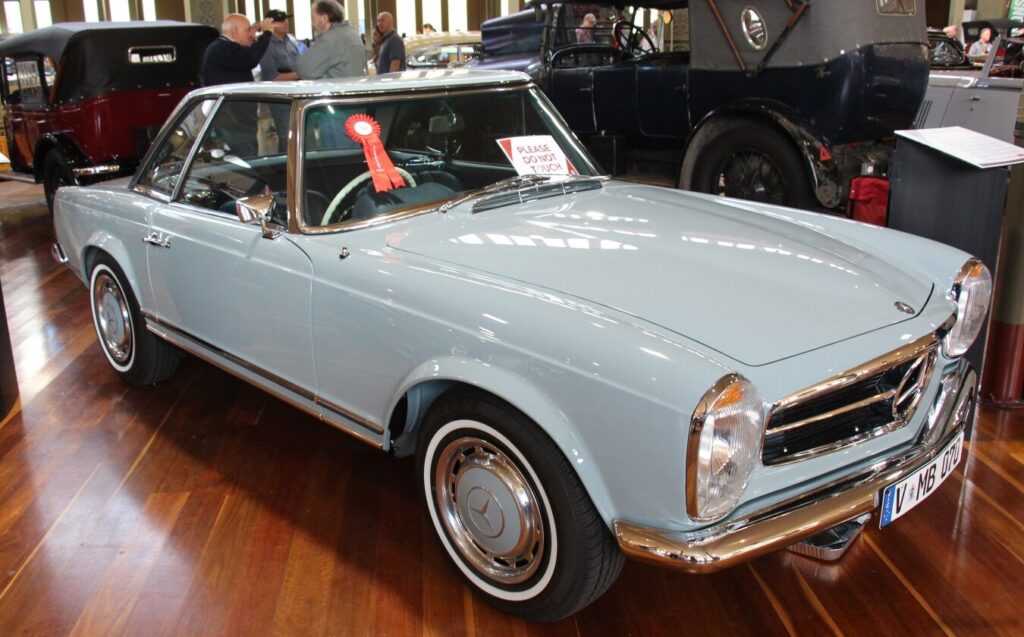
The Mercedes-Benz W113 SL Coupe, specifically the 250 SL variant with a 150 horsepower engine and a four-speed manual transmission, represents a pivotal point in the evolution of the iconic SL (Sport Leicht) lineage. Produced from November 1966 to January 1968, this model bridged the gap between the earlier 230 SL and the later, more powerful 280 SL. It was positioned as a refined grand tourer, offering a blend of performance, comfort, and sophisticated styling within the broader W113 platform, which itself was a significant departure from the roadster-only SL tradition.
Technical Specifications
| Brand | Mercedes-Benz |
| Model | SL |
| Generation | SL Coupe (W113) |
| Type (Engine) | 250 SL (150 Hp) Manual 4-speed |
| Start of production | November, 1966 |
| End of production | January, 1968 |
| Powertrain Architecture | Internal Combustion engine |
| Body type | Coupe |
| Seats | 2 |
| Doors | 2 |
| Fuel consumption (combined) | 11.2 l/100 km (21 US mpg, 25.2 UK mpg, 8.9 km/l) |
| Fuel Type | Petrol (Gasoline) |
| Acceleration 0 – 100 km/h | 10 sec |
| Acceleration 0 – 62 mph | 10 sec |
| Acceleration 0 – 60 mph | 9.5 sec |
| Maximum speed | 200 km/h (124.27 mph) |
| Weight-to-power ratio | 9.1 kg/Hp, 110.3 Hp/tonne |
| Weight-to-torque ratio | 6.3 kg/Nm, 158.8 Nm/tonne |
| Power | 150 Hp @ 5500 rpm |
| Power per litre | 60.1 Hp/l |
| Torque | 216 Nm @ 4200 rpm (159.31 lb.-ft. @ 4200 rpm) |
| Engine layout | Front, Longitudinal |
| Engine Model/Code | M 129 III / 129.982 |
| Engine displacement | 2496 cm3 (152.32 cu. in.) |
| Number of cylinders | 6 |
| Engine configuration | Inline |
| Cylinder Bore | 82 mm (3.23 in.) |
| Piston Stroke | 78.8 mm (3.1 in.) |
| Compression ratio | 9.5:1 |
| Number of valves per cylinder | 2 |
| Fuel injection system | Multi-port manifold injection |
| Engine aspiration | Naturally aspirated engine |
| Valvetrain | SOHC |
| Engine oil capacity | 5.5 l (5.81 US qt | 4.84 UK qt) |
| Coolant | 12.9 l (13.63 US qt | 11.35 UK qt) |
| Kerb Weight | 1360 kg (2998.29 lbs.) |
| Max. weight | 1715 kg (3780.93 lbs.) |
| Max load | 355 kg (782.64 lbs.) |
| Trunk (boot) space – minimum | 340 l (12.01 cu. ft.) |
| Fuel tank capacity | 82 l (21.66 US gal | 18.04 UK gal) |
| Length | 4285 mm (168.7 in.) |
| Width | 1760 mm (69.29 in.) |
| Height | 1295 mm (50.98 in.) |
| Wheelbase | 2400 mm (94.49 in.) |
| Front track | 1484 mm (58.43 in.) |
| Rear (Back) track | 1485 mm (58.46 in.) |
| Drivetrain Architecture | The Internal combustion engine (ICE) drives the rear wheels of the vehicle. |
| Drive wheel | Rear wheel drive |
| Number of gears and type of gearbox | 4 gears, manual transmission |
| Front suspension | Double wishbone, Transverse stabilizer |
| Rear suspension | Trailing arm |
| Front brakes | Disc |
| Rear brakes | Disc |
| Assisting systems | ABS (Anti-lock braking system) |
| Steering type | Cone worm with recirculation balls |
| Wheel rims size | 6J x 14 |
Powertrain & Engine Architecture
The 250 SL was powered by the M129.982 engine, a 2.5-liter inline-six cylinder engine. This engine featured a cast iron block and an aluminum cylinder head, a common configuration for Mercedes-Benz engines of the era. It utilized Bosch multi-port fuel injection, a relatively advanced system for the time, contributing to improved fuel efficiency and smoother operation compared to carbureted engines. The single overhead camshaft (SOHC) valvetrain operated two valves per cylinder. The engine produced 150 horsepower at 5500 rpm and 216 Nm (159.31 lb-ft) of torque at 4200 rpm. The four-speed manual transmission was a fully synchronized unit, providing precise gear changes. This transmission was a key component in delivering the engine’s power to the rear wheels.
Driving Characteristics
The 250 SL with the manual transmission offered a more engaging driving experience than its automatic counterpart. While not a sports car in the modern sense, it provided ample power for comfortable highway cruising and spirited backroad driving. The 0-60 mph time of around 9.5 seconds was respectable for the late 1960s. The manual gearbox allowed drivers to fully exploit the engine’s torque curve, and the gear ratios were well-suited for both acceleration and fuel economy. Compared to the later 280 SL, the 250 SL felt slightly less powerful, but its lighter weight contributed to a more nimble feel. The manual transmission also appealed to drivers who preferred a more direct connection to the car.
Equipment & Trim Levels
The 250 SL Coupe was generally well-equipped for its time. Standard features included leather upholstery, wood trim on the dashboard and door panels, and a comprehensive instrument cluster. Power steering and power-assisted disc brakes were also standard. Optional extras included a sunroof, air conditioning, and a Becker radio. The interior design was characterized by its elegance and attention to detail, reflecting Mercedes-Benz’s commitment to luxury. The coupe body style offered a more enclosed and refined cabin experience compared to the roadster version.
Chassis & Braking
The W113 chassis featured independent suspension all around, with double wishbones and a transverse stabilizer at the front and a trailing arm suspension at the rear. This setup provided a comfortable ride and good handling characteristics. The 250 SL utilized disc brakes on all four wheels, offering excellent stopping power for the era. The steering was a cone worm with recirculation balls, providing precise and responsive control. The car’s relatively low weight, at 1360 kg (2998.29 lbs), contributed to its agility.
Market Reception & Comparison
The 250 SL Coupe was well-received by automotive critics and buyers alike. It was praised for its elegant styling, comfortable ride, and refined interior. Compared to the automatic version, the manual transmission variant was favored by enthusiasts who appreciated its more engaging driving experience. The 250 SL offered a compelling alternative to other grand touring cars of the time, such as the Jaguar E-Type and the Porsche 911. Fuel economy was reasonable for a car of its size and performance, averaging around 21 US mpg. Reliability was generally good, although maintenance could be expensive due to the car’s complex engineering.
Legacy
The Mercedes-Benz W113 250 SL Coupe remains a highly sought-after classic car today. Its combination of elegant styling, refined engineering, and engaging driving experience has ensured its enduring appeal. The M129 engine, while not the most powerful of its time, is known for its durability and relatively straightforward maintenance. Well-maintained examples command high prices in the collector car market. The 250 SL Coupe represents a significant chapter in the history of the Mercedes-Benz SL, bridging the gap between the classic roadsters and the more modern grand tourers that followed. Its legacy continues to inspire automotive enthusiasts around the world.