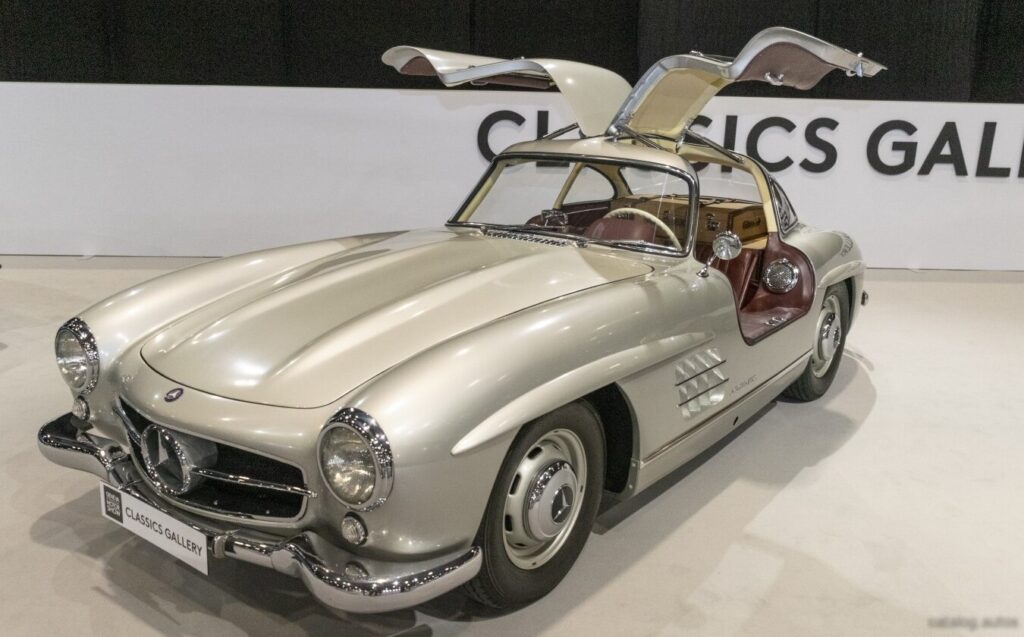
The Mercedes-Benz 300 SL (W198) Coupe, produced between August 1954 and May 1957, represents a pivotal moment in automotive history. Born from the racing success of its SL (Sport Leicht) predecessor, the W198 was the first production automobile to feature direct fuel injection, a technology that significantly boosted performance and efficiency for its time. This coupe, a more practical and accessible version of the iconic “Gullwing” 300 SL, played a crucial role in re-establishing Mercedes-Benz as a leading manufacturer of high-performance luxury vehicles in the post-war era. It was built on the W198 platform, offering a more conventional entry point into the 300 SL experience compared to the more expensive and exotic Gullwing.
Technical Specifications
| Brand | Mercedes-Benz |
| Model | SL |
| Generation | SL Coupe (W198) |
| Type (Engine) | 300 SL (215 Hp) |
| Start of production | August, 1954 |
| End of production | May, 1957 |
| Powertrain Architecture | Internal Combustion engine |
| Body type | Coupe |
| Seats | 2 |
| Doors | 2 |
| Fuel consumption (combined) | 9.5 l/100 km |
| Fuel consumption (US mpg) | 24.8 US mpg |
| Fuel consumption (UK mpg) | 29.7 UK mpg |
| Fuel consumption (km/l) | 10.5 km/l |
| Fuel Type | Petrol (Gasoline) |
| Acceleration 0 – 100 km/h | 10 sec |
| Acceleration 0 – 62 mph | 10 sec |
| Acceleration 0 – 60 mph | 9.5 sec |
| Maximum speed | 260 km/h (161.56 mph) |
| Weight-to-power ratio | 6 kg/Hp, 166 Hp/tonne |
| Weight-to-torque ratio | 4.7 kg/Nm, 212.4 Nm/tonne |
| Power | 215 Hp @ 5800 rpm |
| Power per litre | 71.8 Hp/l |
| Torque | 275 Nm @ 4600 rpm (202.83 lb.-ft. @ 4600 rpm) |
| Engine layout | Front, Longitudinal |
| Engine Model/Code | M 198.980 |
| Engine displacement | 2996 cm3 (182.83 cu. in.) |
| Number of cylinders | 6 |
| Engine configuration | Inline |
| Cylinder Bore | 85 mm (3.35 in.) |
| Piston Stroke | 88 mm (3.46 in.) |
| Compression ratio | 8.55:1 |
| Number of valves per cylinder | 2 |
| Fuel injection system | Direct injection |
| Engine aspiration | Naturally aspirated engine |
| Valvetrain | SOHC |
| Engine oil capacity | 15 l (15.85 US qt | 13.2 UK qt) |
| Coolant capacity | 15.5 l (16.38 US qt | 13.64 UK qt) |
| Kerb Weight | 1295 kg (2854.99 lbs.) |
| Max. weight | 1515 kg (3340 lbs.) |
| Max load | 220 kg (485.02 lbs.) |
| Fuel tank capacity | 100 l (26.42 US gal | 22 UK gal) |
| Length | 4520 mm (177.95 in.) |
| Width | 1790 mm (70.47 in.) |
| Height | 1300 mm (51.18 in.) |
| Wheelbase | 2400 mm (94.49 in.) |
| Front track | 1385 mm (54.53 in.) |
| Rear track | 1435 mm (56.5 in.) |
| Ride height (ground clearance) | 130 mm (5.12 in.) |
| Minimum turning circle | 11.5 m (37.73 ft.) |
| Drivetrain Architecture | Rear wheel drive |
| Number of gears | 4 gears, manual transmission |
| Front suspension | Double wishbone, Transverse stabilizer |
| Rear suspension | Coil spring |
| Front brakes | Drum |
| Rear brakes | Drum |
| Steering type | Cone worm with recirculation balls |
| Tires size | 165/90 R 15 |
| Wheel rims size | 5 K x 15 |
Powertrain & Engine Architecture
The heart of the 300 SL Coupe was the M198.980 engine, a 2,996 cc (182.8 cu in) inline-six cylinder powerplant. What truly set this engine apart was its innovative direct fuel injection system, developed by Bosch. Unlike conventional carbureted or port-injected engines, the Bosch system injected fuel directly into the intake ports, close to the intake valves. This allowed for more precise fuel metering, improved combustion efficiency, and a significant increase in power output. The engine featured a single overhead camshaft (SOHC) valvetrain operating two valves per cylinder. The engine produced 215 horsepower at 5,800 rpm and 275 Nm (202.83 lb-ft) of torque at 4,600 rpm. Power was delivered to the rear wheels through a four-speed manual transmission. The longitudinal engine placement contributed to a balanced weight distribution.
Driving Characteristics
The 300 SL Coupe, even with its relatively high power output for the mid-1950s, wasn’t about brute force acceleration. The direct fuel injection provided a smooth and linear power delivery, making it surprisingly tractable for everyday driving. However, the engine truly came alive at higher revolutions, offering a thrilling experience for enthusiasts. The four-speed manual transmission required skillful operation to extract the most performance, and the gear ratios were spaced to maximize both acceleration and cruising efficiency. Compared to later, more powerful iterations of the SL, the 300 SL Coupe offered a more refined and balanced driving experience, prioritizing elegance and sophistication over outright speed. The relatively light weight (1,295 kg or 2,855 lbs) contributed to its nimble handling.
Equipment & Trim Levels
The 300 SL Coupe was positioned as a premium offering within the Mercedes-Benz lineup. Standard equipment included luxurious leather upholstery, a wood-trimmed dashboard, and a comprehensive instrument panel. While not as lavishly appointed as some contemporary luxury cars, the 300 SL Coupe offered a comfortable and well-appointed interior. Optional extras included a Becker Mexico radio, whitewall tires, and various trim options. The interior design was functional and elegant, reflecting the car’s overall character.
Chassis & Braking
The 300 SL Coupe utilized a robust chassis construction, featuring a double wishbone suspension with a transverse stabilizer at the front and a coil spring suspension at the rear. This setup provided a comfortable ride and good handling characteristics. Braking was accomplished via drum brakes on all four wheels. While adequate for the time, the drum brakes lacked the stopping power of modern disc brake systems. The steering was a cone worm with recirculation balls, providing precise control but requiring some effort at low speeds.
Market Reception & Comparison
The 300 SL Coupe was widely praised by automotive journalists for its performance, handling, and innovative technology. It was seen as a significant step forward in automotive engineering and a testament to Mercedes-Benz’s commitment to quality and innovation. Compared to other luxury coupes of the era, the 300 SL Coupe offered a unique combination of performance and refinement. While fuel economy wasn’t a primary concern for buyers in this segment, the direct fuel injection system did contribute to relatively good efficiency for a high-performance engine. Reliability was generally good, although the complex fuel injection system required regular maintenance.
Legacy
The Mercedes-Benz 300 SL Coupe holds a significant place in automotive history. Its pioneering direct fuel injection system paved the way for future engine technologies, and its elegant design continues to inspire automotive designers today. The 300 SL Coupe remains a highly sought-after collector’s car, commanding premium prices in the used car market. The M198 engine, while requiring specialized knowledge for maintenance, is generally considered a durable and reliable powerplant when properly cared for. The 300 SL Coupe represents a golden age of automotive engineering and a lasting symbol of Mercedes-Benz’s commitment to excellence.