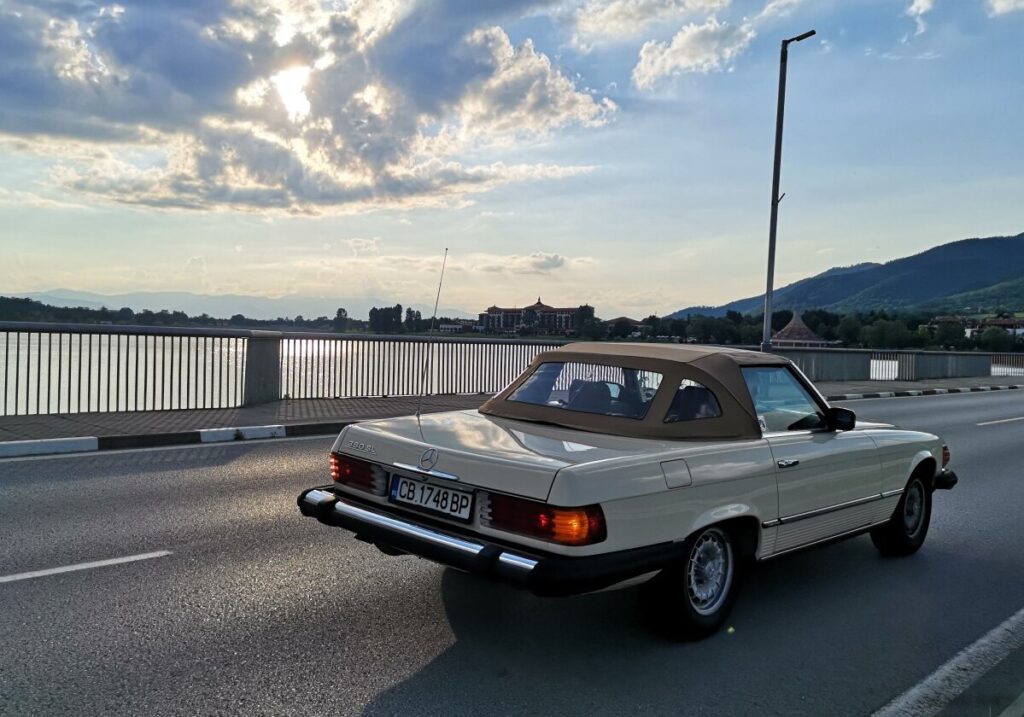
The Mercedes-Benz SL (R107) 280 SL, produced between February 1976 and April 1978, represented a significant evolution in the iconic SL lineage. Positioned as a mid-range offering within the R107 generation – which spanned from 1971 to 1989 – the 280 SL aimed to balance performance and luxury, appealing to buyers seeking a sophisticated grand tourer. It was a direct successor to the earlier 280 SL (W113) “Pagoda” and laid the groundwork for the more powerful and technologically advanced SL models that followed. The R107 chassis, designed by Bruno Sacco, prioritized safety and comfort alongside the traditional SL sporting character.
Technical Specifications
| Brand | Mercedes-Benz |
| Model | SL |
| Generation | SL (R107) |
| Type (Engine) | 280 SL (177 Hp) Automatic |
| Start of production | February, 1976 |
| End of production | April, 1978 |
| Powertrain Architecture | Internal Combustion engine |
| Body type | Roadster |
| Seats | 2 |
| Doors | 2 |
| Fuel consumption (combined) | 12.5 l/100 km (18.8 US mpg, 22.6 UK mpg, 8 km/l) |
| Fuel Type | Petrol (Gasoline) |
| Acceleration 0 – 100 km/h | 10.1 sec |
| Acceleration 0 – 62 mph | 10.1 sec |
| Acceleration 0 – 60 mph | 9.6 sec |
| Maximum speed | 195 km/h (121.17 mph) |
| Weight-to-power ratio | 8.5 kg/Hp, 118 Hp/tonne |
| Weight-to-torque ratio | 6.4 kg/Nm, 155.3 Nm/tonne |
| Power | 177 Hp @ 6000 rpm |
| Power per litre | 64.5 Hp/l |
| Torque | 233 Nm @ 4500 rpm (171.85 lb.-ft. @ 4500 rpm) |
| Engine layout | Front, Longitudinal |
| Engine Model/Code | M 110 E 28 / 110.986 |
| Engine displacement | 2746 cm3 (167.57 cu. in.) |
| Number of cylinders | 6 |
| Engine configuration | Inline |
| Cylinder Bore | 86 mm (3.39 in.) |
| Piston Stroke | 78.8 mm (3.1 in.) |
| Compression ratio | 8.7:1 |
| Number of valves per cylinder | 2 |
| Fuel injection system | Multi-port manifold injection |
| Engine aspiration | Naturally aspirated engine |
| Valvetrain | DOHC |
| Engine oil capacity | 6 l (6.34 US qt | 5.28 UK qt) |
| Coolant | 12 l (12.68 US qt | 10.56 UK qt) |
| Kerb Weight | 1500 kg (3306.93 lbs.) |
| Max. weight | 1920 kg (4232.88 lbs.) |
| Max load | 420 kg (925.94 lbs.) |
| Fuel tank capacity | 90 l (23.78 US gal | 19.8 UK gal) |
| Length | 4390 mm (172.83 in.) |
| Width | 1790 mm (70.47 in.) |
| Height | 1300 mm (51.18 in.) |
| Wheelbase | 2460 mm (96.85 in.) |
| Front track | 1452 mm (57.17 in.) |
| Rear (Back) track | 1440 mm (56.69 in.) |
| Drivetrain Architecture | The Internal combustion engine (ICE) drives the rear wheels of the vehicle. |
| Drive wheel | Rear wheel drive |
| Number of gears and type of gearbox | 4 gears, automatic transmission |
| Front suspension | Double wishbone |
| Rear suspension | Trailing arm |
| Front brakes | Ventilated discs |
| Rear brakes | Disc |
| Steering type | Cone worm with recirculation balls |
| Power steering | Hydraulic Steering |
| Tires size | Front wheel tires: 195/70 R14Rear wheel tires: 195/70 R14 |
| Wheel rims size | Front wheel rims: 6.5J x 14Rear wheel rims: 6.5J x 14 |
Powertrain & Engine Architecture
The heart of the 280 SL was the M110 E 28 inline-six engine, a 2.8-liter (2746 cc) powerplant. This engine featured a cast-iron block and an aluminum cylinder head, employing a dual overhead camshaft (DOHC) valvetrain with two valves per cylinder. Bosch K-Jetronic fuel injection was utilized, providing precise fuel delivery for improved efficiency and performance compared to earlier carbureted systems. The engine produced 177 horsepower at 6000 rpm and 233 Nm (171.85 lb-ft) of torque at 4500 rpm. The automatic transmission was a four-speed unit, designed to provide smooth and comfortable shifting. This transmission, while reliable, wasn’t known for particularly quick shifts, prioritizing refinement over outright performance.
Driving Characteristics
The 280 SL Automatic offered a relaxed and refined driving experience. Acceleration from 0 to 60 mph took approximately 9.6 seconds, and it could reach a top speed of 195 km/h (121 mph). Compared to the manual transmission versions of the 280 SL, the automatic suffered a slight performance penalty due to the inherent losses in the torque converter and the less aggressive gear ratios. However, the automatic transmission made the car significantly easier to drive in city traffic and on long highway journeys. The power delivery was smooth and linear, making it a comfortable cruiser. The steering, while not particularly sporty, was precise and provided adequate feedback.
Equipment & Trim Levels
The 280 SL came reasonably well-equipped as standard. Interior appointments included leather upholstery, wood trim, and power windows. Air conditioning was a popular option, as was a sunroof. The dashboard layout was functional and elegant, typical of Mercedes-Benz design of the era. Optional extras included upgraded sound systems, cruise control, and a self-leveling suspension system. The 280 SL occupied a middle ground in the R107 lineup; it wasn’t as sparsely equipped as the base 280 SL, but it lacked some of the luxury features found on the higher-end 350 SL and 450 SL models.
Chassis & Braking
The R107 chassis featured independent suspension all around, with double wishbones at the front and a trailing arm setup at the rear. This provided a comfortable ride and good handling characteristics. The 280 SL utilized ventilated disc brakes at the front and solid disc brakes at the rear, providing adequate stopping power for its weight and performance. Hydraulic power steering was standard, making the car easy to maneuver at low speeds. The suspension was tuned for comfort rather than outright sportiness, but it provided a stable and predictable platform.
Market Reception & Comparison
The 280 SL Automatic was generally well-received by automotive critics. It was praised for its comfortable ride, refined interior, and reliable powertrain. However, some critics noted that the automatic transmission dulled the car’s performance compared to the manual version. Compared to the more powerful 350 SL and 450 SL models, the 280 SL offered a more affordable entry point into the R107 range. It also offered better fuel economy than the larger-engined models, although fuel consumption was still relatively high by modern standards. The 280 SL was seen as a good value for buyers seeking a stylish and comfortable grand tourer.
Legacy
The M110 engine, found in the 280 SL, is known for its durability and longevity. With proper maintenance, these engines can reliably exceed 200,000 miles. The automatic transmission, while not as sporty as some, is also generally reliable. Today, the R107 280 SL is a popular choice among classic Mercedes-Benz enthusiasts. It offers a good balance of style, comfort, and reliability at a relatively affordable price point. Parts availability is generally good, making it easier to maintain and restore these cars. The 280 SL represents a significant chapter in the SL’s history, bridging the gap between the classic “Pagoda” models and the more modern SL generations.