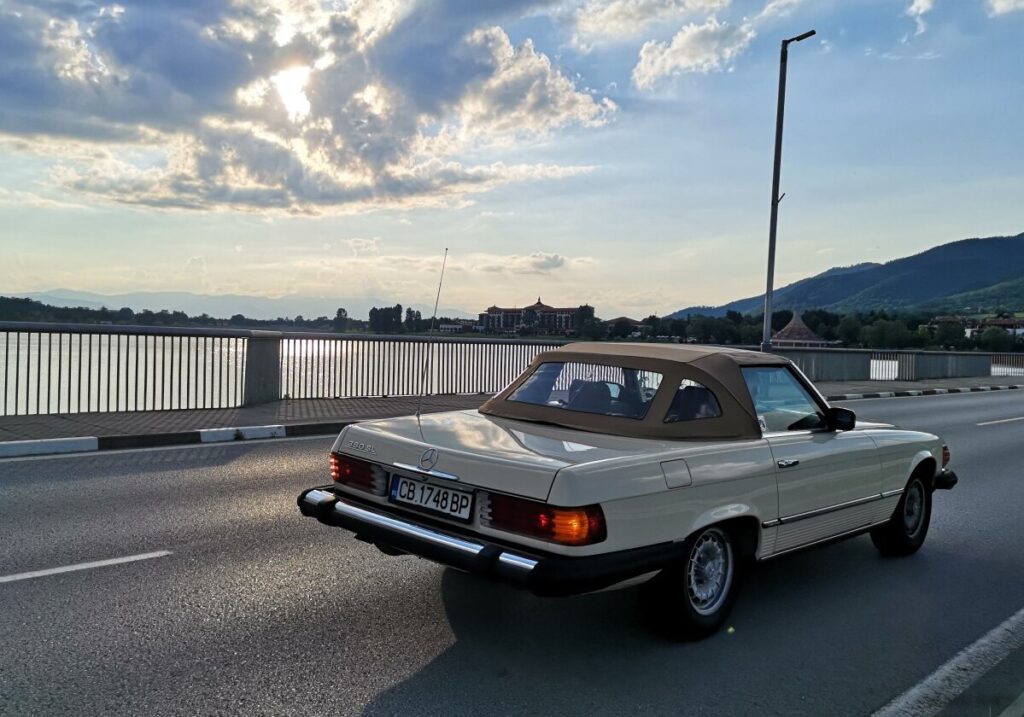
The Mercedes-Benz R107 500 SL, produced from April 1980 to October 1981, represented the pinnacle of the initial R107 series. Positioned as the flagship model, it offered a significant performance upgrade over the earlier 350 SL and 450 SL variants. The R107 generation, built on the W114 chassis platform, aimed to replace the venerable W113 “Pagoda” SL, offering a blend of luxury, performance, and modern engineering. The 500 SL, with its potent V8 engine, catered to buyers seeking a grand touring experience with genuine sporting credentials. It was primarily marketed in North America and Europe, becoming a symbol of 1980s affluence and style.
Technical Specifications
| Brand | Mercedes-Benz |
| Model | SL |
| Generation | SL (R107) |
| Type (Engine) | 500 SL V8 (240 Hp) Automatic |
| Start of production | April, 1980 |
| End of production | October, 1981 |
| Powertrain Architecture | Internal Combustion engine |
| Body type | Roadster |
| Seats | 2 |
| Doors | 2 |
| Fuel consumption (urban) | 21 l/100 km (11.2 US mpg, 13.5 UK mpg, 4.8 km/l) |
| Fuel consumption (extra urban) | 10.9 l/100 km (21.6 US mpg, 25.9 UK mpg, 9.2 km/l) |
| Fuel Type | Petrol (Gasoline) |
| Maximum speed | 225 km/h (139.81 mph) |
| Weight-to-power ratio | 6.4 kg/Hp, 155.8 Hp/tonne |
| Weight-to-torque ratio | 3.8 kg/Nm, 262.3 Nm/tonne |
| Power | 240 Hp @ 5000 rpm |
| Power per litre | 48.3 Hp/l |
| Torque | 404 Nm @ 3200 rpm (297.98 lb.-ft. @ 3200 rpm) |
| Engine layout | Front, Longitudinal |
| Engine Model/Code | M 117.960 |
| Engine displacement | 4973 cm3 (303.47 cu. in.) |
| Number of cylinders | 8 |
| Engine configuration | V-engine |
| Cylinder Bore | 96.5 mm (3.8 in.) |
| Piston Stroke | 85 mm (3.35 in.) |
| Compression ratio | 8.8:1 |
| Number of valves per cylinder | 2 |
| Fuel injection system | Multi-port manifold injection |
| Engine aspiration | Naturally aspirated engine |
| Valvetrain | SOHC |
| Engine oil capacity | 8 l (8.45 US qt | 7.04 UK qt) |
| Coolant | 12.5 l (13.21 US qt | 11 UK qt) |
| Kerb Weight | 1540 kg (3395.12 lbs.) |
| Max. weight | 1960 kg (4321.06 lbs.) |
| Max load | 420 kg (925.94 lbs.) |
| Trunk (boot) space – maximum | 261 l (9.22 cu. ft.) |
| Fuel tank capacity | 90 l (23.78 US gal | 19.8 UK gal) |
| Permitted trailer load with brakes (12%) | 1500 kg (3306.93 lbs.) |
| Permitted trailer load without brakes | 750 kg (1653.47 lbs.) |
| Length | 4390 mm (172.83 in.) |
| Width | 1790 mm (70.47 in.) |
| Height | 1300 mm (51.18 in.) |
| Wheelbase | 2455 mm (96.65 in.) |
| Front track | 1452 mm (57.17 in.) |
| Rear (Back) track | 1440 mm (56.69 in.) |
| Minimum turning circle (turning diameter) | 10.34 m (33.92 ft.) |
| Drivetrain Architecture | The Internal combustion engine (ICE) drives the rear wheels of the vehicle. |
| Drive wheel | Rear wheel drive |
| Number of gears and type of gearbox | 4 gears, automatic transmission |
| Front suspension | Coil spring, Double wishbone |
| Rear suspension | Threaded twist beam, Transverse stabilizer, Coil spring |
| Front brakes | Ventilated discs, 278 mm |
| Rear brakes | Disc, 279 mm |
| Steering type | Cone worm with recirculation balls |
| Power steering | Hydraulic Steering |
| Tires size | Front wheel tires: 205/70 VR14 Rear wheel tires: 205/70 VR14 |
| Wheel rims size | Front wheel rims: 6.5J x 14 Rear wheel rims: 6.5J x 14 |
Powertrain & Engine Architecture
The heart of the 500 SL is the M117.960 5.0-liter (4973 cc) V8 engine. This engine, a descendant of the earlier M116 and M117 series, featured a cast iron block and aluminum cylinder heads. It employed a single overhead camshaft (SOHC) design with two valves per cylinder. Bosch K-Jetronic fuel injection delivered precise fuel metering, contributing to both performance and relatively good fuel economy for the era. The engine produced 240 horsepower at 5000 rpm and a substantial 404 Nm (298 lb-ft) of torque at 3200 rpm. The automatic transmission was a robust four-speed unit, designed to handle the V8’s power. While not particularly advanced by modern standards, it provided smooth and reliable shifting, perfectly suited to the grand touring nature of the vehicle.
Driving Characteristics
The 500 SL Automatic offered a distinctly different driving experience compared to the manual transmission or smaller-engined versions. The automatic transmission, while smooth, did result in some power loss compared to the five-speed manual. Acceleration was brisk, with 0-60 mph times typically around 7.6 seconds, making it a genuinely quick car for its time. The torque-rich V8 provided effortless cruising, and the automatic transmission allowed for relaxed long-distance driving. However, the automatic’s shift points weren’t always optimal for spirited driving, and the car lacked the direct connection offered by a manual gearbox. The gear ratios were geared towards comfortable highway cruising rather than outright acceleration.
Equipment & Trim Levels
The 500 SL came standard with a high level of equipment, befitting its flagship status. Leather upholstery was standard, as were power windows, central locking, and a high-quality sound system. Air conditioning was also a standard feature. Optional extras included a sunroof, heated seats, and upgraded audio systems. The interior design was typically Mercedes-Benz of the period – luxurious and well-appointed, with a focus on comfort and build quality. The dashboard featured wood trim and analog gauges, providing a classic and elegant aesthetic.
Chassis & Braking
The R107 chassis featured independent suspension all around. The front suspension utilized coil springs and double wishbones, while the rear employed a semi-trailing arm setup with coil springs and a transverse stabilizer bar. This configuration provided a comfortable ride and good handling characteristics. Braking was handled by ventilated disc brakes at the front and solid discs at the rear. Power-assisted steering was standard, making the car relatively easy to maneuver, despite its size. The suspension was tuned for comfort, but the 500 SL’s increased weight necessitated slightly firmer springs and dampers compared to the lighter models.
Market Reception & Comparison
The 500 SL was generally well-received by critics, who praised its performance, luxury, and build quality. However, some criticized its weight and the slightly detached feel of the automatic transmission. Compared to the 350 SL and 450 SL, the 500 SL offered a significant performance advantage, but at a higher price point. The 500 SL was also more expensive to maintain due to its larger engine and more complex fuel injection system. Fuel economy, while reasonable for a V8 of that era, was still considerably lower than the six-cylinder models.
Legacy
The R107 500 SL has become a highly sought-after classic car. The M117 engine, when properly maintained, is known for its durability and longevity. However, like all classic Mercedes-Benzes, it requires regular attention to prevent corrosion and ensure reliable operation. The automatic transmission is generally reliable, but rebuilds can be expensive. Today, the 500 SL represents a piece of automotive history, embodying the luxury and performance of the 1980s. Well-maintained examples command high prices in the used car market, appealing to collectors and enthusiasts alike. Its enduring appeal lies in its timeless design, robust engineering, and the sheer driving pleasure offered by its potent V8 engine.