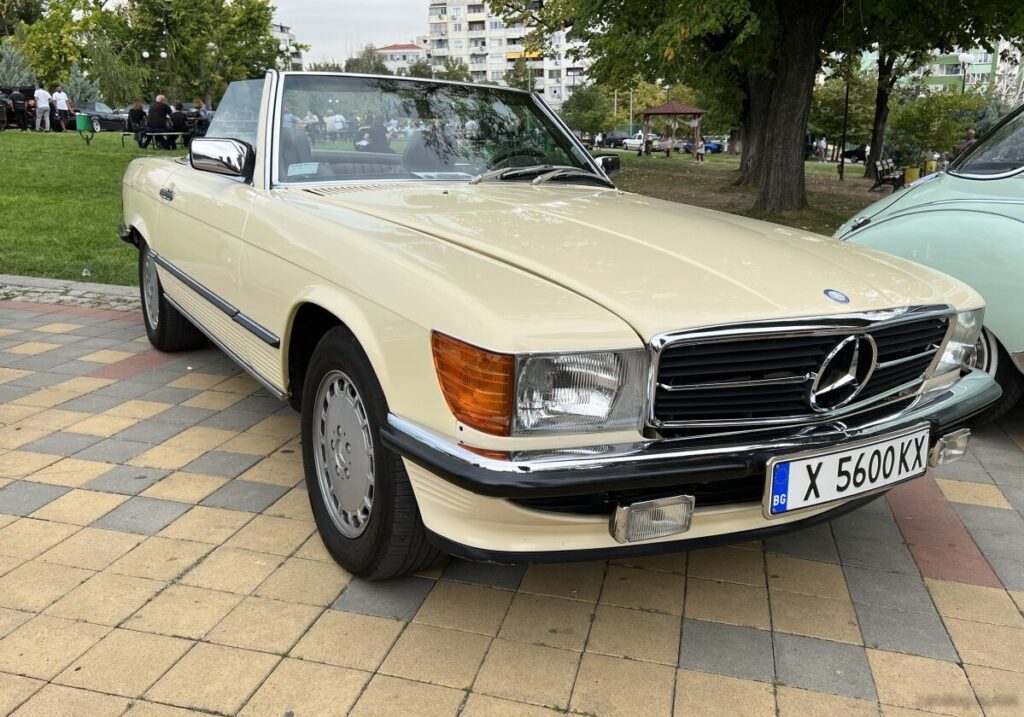
The Mercedes-Benz SL (R107) 300 SL, produced from 1985 to 1989, represents a significant evolution of the iconic R107 series. This facelifted version, distinguished by its smoother, more integrated bodywork, aimed to modernize the SL while retaining its luxurious grand touring character. The 300 SL variant, powered by the M103 engine, occupied a middle ground in the R107 lineup, offering a balance of performance and refinement. It served as a step up from the entry-level 280 SL, but remained more accessible than the flagship 560 SL, appealing to buyers seeking a sophisticated open-top experience without the highest price tag.
Technical Specifications
| Brand | Mercedes-Benz |
| Model | SL |
| Generation | SL (R107, facelift 1985) |
| Type (Engine) | 300 SL (188 Hp) |
| Start of production | 1985 |
| End of production | 1989 |
| Powertrain Architecture | Internal Combustion engine |
| Body type | Roadster |
| Seats | 2 |
| Doors | 2 |
| Fuel consumption (urban) | 14.5 l/100 km (16.2 US mpg, 19.5 UK mpg, 6.9 km/l) |
| Fuel consumption (extra urban) | 8.1 l/100 km (29 US mpg, 34.9 UK mpg, 12.3 km/l) |
| Fuel Type | Petrol (Gasoline) |
| Acceleration 0 – 100 km/h | 9.6 sec |
| Acceleration 0 – 62 mph | 9.6 sec |
| Acceleration 0 – 60 mph | 9.1 sec |
| Maximum speed | 203 km/h (126.14 mph) |
| Weight-to-power ratio | 8 kg/Hp, 125.3 Hp/tonne |
| Weight-to-torque ratio | 5.8 kg/Nm, 173.3 Nm/tonne |
| Power | 188 Hp @ 5700 rpm |
| Power per litre | 63.5 Hp/l |
| Torque | 260 Nm @ 4400 rpm (191.77 lb.-ft. @ 4400 rpm) |
| Engine layout | Front, Longitudinal |
| Engine Model/Code | M 103 E 30 / 103.982 |
| Engine displacement | 2962 cm3 (180.75 cu. in.) |
| Number of cylinders | 6 |
| Engine configuration | Inline |
| Cylinder Bore | 88.49 mm (3.48 in.) |
| Piston Stroke | 80.25 mm (3.16 in.) |
| Compression ratio | 9.2:1 |
| Number of valves per cylinder | 2 |
| Fuel injection system | Multi-port manifold injection |
| Engine aspiration | Naturally aspirated engine |
| Valvetrain | SOHC |
| Engine oil capacity | 6 l (6.34 US qt | 5.28 UK qt) |
| Coolant | 8 l (8.45 US qt | 7.04 UK qt) |
| Kerb Weight | 1500 kg (3306.93 lbs.) |
| Max. weight | 1920 kg (4232.88 lbs.) |
| Max load | 420 kg (925.94 lbs.) |
| Trunk (boot) space – maximum | 261 l (9.22 cu. ft.) |
| Fuel tank capacity | 90 l (23.78 US gal | 19.8 UK gal) |
| Permitted trailer load with brakes (12%) | 1500 kg (3306.93 lbs.) |
| Permitted trailer load without brakes | 750 kg (1653.47 lbs.) |
| Length | 4390 mm (172.83 in.) |
| Width | 1790 mm (70.47 in.) |
| Height | 1300 mm (51.18 in.) |
| Wheelbase | 2460 mm (96.85 in.) |
| Front track | 1461 mm (57.52 in.) |
| Rear (Back) track | 1465 mm (57.68 in.) |
| Minimum turning circle | 10.34 m (33.92 ft.) |
| Drivetrain Architecture | Rear wheel drive |
| Number of gears and type of gearbox | 5 gears, manual transmission |
| Front suspension | Coil spring, Double wishbone |
| Rear suspension | Transverse stabilizer, Trailing arm, Coil spring |
| Front brakes | Ventilated discs, 284 mm |
| Rear brakes | Disc, 279 mm |
| Steering type | Cone worm with recirculation balls |
| Power steering | Hydraulic Steering |
| Tires size | Front wheel tires: 205/65 VR15 Rear wheel tires: 205/65 VR15 |
| Wheel rims size | Front wheel rims: 7J x 15 Rear wheel rims: 7J x 15 |
Powertrain & Engine Architecture
The heart of the 300 SL is the M103 E 30 inline-six engine. This 2.962-liter (180.75 cubic inch) engine is a naturally aspirated, single overhead camshaft (SOHC) design. It features Bosch K-Jetronic multi-port fuel injection, a system known for its reliability and relatively smooth operation. The M103 engine was a significant step forward for Mercedes-Benz, offering improved power and efficiency compared to its predecessors. The engine produces 188 horsepower at 5700 rpm and 260 Nm (191.77 lb-ft) of torque at 4400 rpm. The engine’s robust construction and relatively simple design contributed to its longevity. The 300 SL was typically equipped with a five-speed manual transmission, although an optional four-speed automatic transmission was available. The automatic, while offering convenience, did slightly diminish the car’s acceleration performance.
Driving Characteristics
The 300 SL, even with the manual transmission, wasn’t designed for outright speed. Its focus was on comfortable, refined cruising. The 188 hp engine provided adequate power for relaxed highway driving and spirited backroad excursions. The manual transmission allowed for greater driver control, while the automatic offered a more effortless experience. Acceleration from 0 to 60 mph took around 9.1 seconds, which was respectable for the era but not particularly quick compared to contemporary sports cars. The gear ratios in the manual transmission were well-spaced, providing good flexibility for both city and highway driving. The automatic transmission, while smooth, felt somewhat less responsive and resulted in slightly slower acceleration times. The R107 chassis, while relatively heavy, offered a comfortable ride and predictable handling.
Equipment & Trim Levels
The 300 SL came reasonably well-equipped as standard. Features included power windows, central locking, and a leather-wrapped steering wheel. Interior upholstery was typically leather, with a choice of colors available. Optional extras included air conditioning (almost universally specified), a sunroof, and upgraded audio systems. The dashboard layout was classic Mercedes-Benz, with a focus on functionality and understated elegance. The 300 SL’s trim level sat comfortably between the more basic 280 SL and the luxurious 560 SL, offering a good balance of features and price.
Chassis & Braking
The R107 SL utilized a robust chassis with independent suspension all around. The front suspension featured coil springs and double wishbones, while the rear employed a trailing arm setup with coil springs and a transverse stabilizer bar. This suspension configuration provided a comfortable ride and good handling characteristics. Braking was handled by ventilated discs at the front and solid discs at the rear. Power-assisted steering was standard, making the car relatively easy to maneuver. The R107’s chassis was designed for stability and comfort rather than razor-sharp handling, reflecting its grand touring intentions.
Market Reception & Comparison
The 300 SL was generally well-received by automotive critics. It was praised for its comfortable ride, refined engine, and build quality. However, some critics noted that it wasn’t as sporty or agile as some of its competitors. Compared to the 280 SL, the 300 SL offered a noticeable performance improvement. Against the 560 SL, it provided a more affordable entry point into the R107 range, albeit with slightly less power. Fuel economy was reasonable for a car of its size and era, averaging around 19 mpg combined. Reliability was generally good, although maintenance costs could be high due to the car’s complexity and the cost of Mercedes-Benz parts.
Legacy
The R107 SL, including the 300 SL variant, has become a popular classic car. The M103 engine is known for its durability and relatively straightforward maintenance. While not as sought-after as the 560 SL, the 300 SL offers a compelling combination of performance, refinement, and affordability. Well-maintained examples are increasingly collectible, and the car remains a popular choice for enthusiasts seeking a classic Mercedes-Benz roadster. The 300 SL represents a sweet spot in the R107 lineup, offering a balanced and enjoyable driving experience that continues to appeal to drivers today.