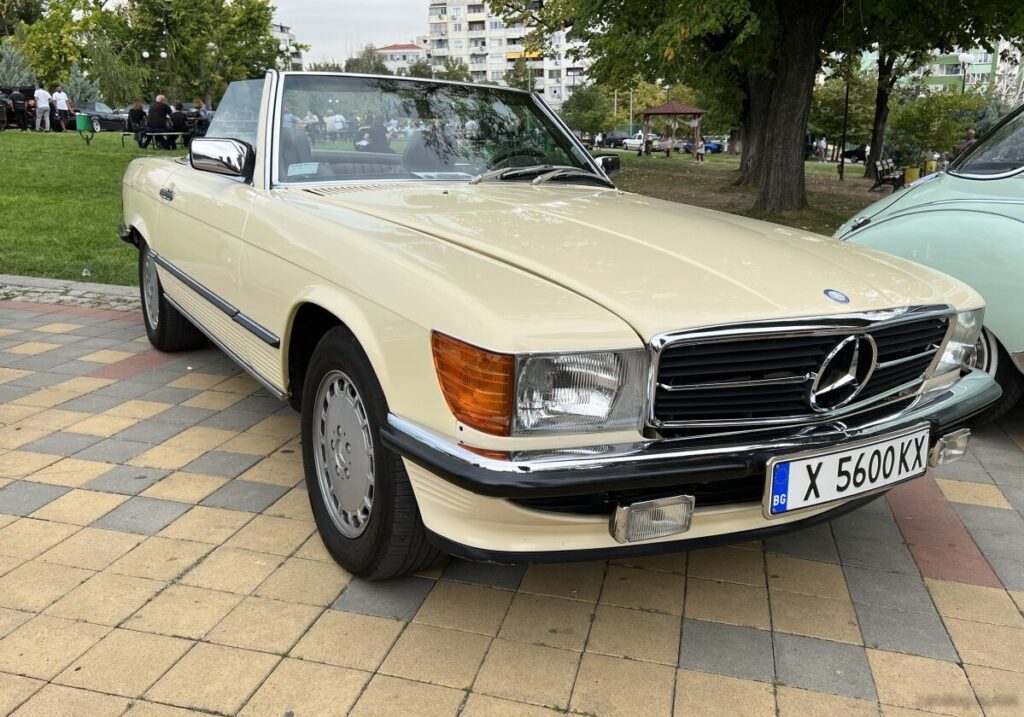
The Mercedes-Benz SL (R107) 500 SL, produced from September 1985 to August 1989, represented the pinnacle of performance within the R107 series during its facelifted iteration. Positioned as the flagship model, the 500 SL offered a significant step up in power and refinement compared to the 380 SL and 420 SL variants. The R107 generation, built on the W116 platform, was known for its robust construction and enduring appeal, and the 500 SL capitalized on these strengths with a larger, more potent engine. This model year saw updates to the exterior, including a flatter front end and smaller bumpers, differentiating it from earlier R107s.
At the heart of the 500 SL lies the M 117 E 50 engine, a 4.973-liter (303.47 cubic inches) naturally aspirated V8. This engine, designated with the code 117.964, featured a single overhead camshaft (SOHC) valvetrain with two valves per cylinder. Fuel delivery was managed by a multi-port manifold injection system, contributing to smooth power delivery and improved efficiency for its time. The engine produced 245 horsepower at 4750 rpm and 392 Nm (289.12 lb-ft) of torque at 3750 rpm. The engine’s bore and stroke measured 96.5 mm (3.8 in) and 85 mm (3.35 in) respectively, with a compression ratio of 9:1. The engine required 8 liters (8.45 US quarts) of oil, specified to Mercedes-Benz standards, and a cooling system capacity of 13.5 liters (14.27 US quarts).
The 500 SL’s performance was a noticeable improvement over its lower-displacement siblings. Acceleration from 0 to 100 km/h (0-62 mph) took 7.3 seconds, while 0-60 mph was achieved in approximately 6.9 seconds. Its top speed was electronically limited to 225 km/h (139.81 mph). The engine’s torque curve provided strong acceleration across a wide range of engine speeds, making it a comfortable and capable grand tourer. The 4-speed automatic transmission, while not offering the driver engagement of a manual, was well-suited to the car’s intended purpose – relaxed, high-speed cruising. The weight-to-power ratio of 6.6 kg/hp and weight-to-torque ratio of 4.1 kg/Nm further highlighted the car’s performance capabilities.
The 500 SL was generously equipped, reflecting its status as the range-topping model. Standard features included leather upholstery, power windows, power steering, and an anti-lock braking system (ABS). The interior design was characterized by its classic Mercedes-Benz aesthetic, with wood trim and a well-laid-out dashboard. Optional extras included a sunroof, upgraded sound system, and automatic climate control. The car’s two-seater roadster configuration emphasized open-air driving enjoyment.
The chassis of the 500 SL featured a double wishbone suspension at the front and a threaded twist beam rear suspension. Braking duties were handled by ventilated discs at the front and solid discs at the rear. The hydraulic power steering provided a comfortable driving experience, although it lacked the direct feel of some contemporary sports cars. The car rode on 7J x 15 inch wheels, fitted with 205/65 R15 tires. The rear-wheel-drive layout contributed to balanced handling characteristics.
Contemporary reviews praised the 500 SL for its powerful engine, comfortable ride, and luxurious interior. However, some critics noted the car’s relatively high fuel consumption – 15.9 l/100 km (14.8 US mpg) in urban driving and 9.5 l/100 km (24.8 US mpg) on the highway. Compared to the 420 SL, the 500 SL offered significantly more performance, but at a higher price point. The 380 SL, being the entry-level model, provided a more economical option, albeit with considerably less power. Reliability was generally good, although the complexity of the fuel injection system required regular maintenance.
| Brand | Mercedes-Benz |
| Model | SL |
| Generation | SL (R107, facelift 1985) |
| Type (Engine) | 500 SL V8 (245 Hp) Automatic |
| Start of production | September, 1985 |
| End of production | August, 1989 |
| Powertrain Architecture | Internal Combustion engine |
| Body type | Roadster |
| Seats | 2 |
| Doors | 2 |
| Fuel consumption (urban) | 15.9 l/100 km (14.8 US mpg) |
| Fuel consumption (extra urban) | 9.5 l/100 km (24.8 US mpg) |
| Fuel Type | Petrol (Gasoline) |
| Acceleration 0 – 100 km/h | 7.3 sec |
| Acceleration 0 – 62 mph | 7.3 sec |
| Acceleration 0 – 60 mph | 6.9 sec |
| Maximum speed | 225 km/h (139.81 mph) |
| Power | 245 Hp @ 4750 rpm |
| Torque | 392 Nm @ 3750 rpm (289.12 lb.-ft. @ 3750 rpm) |
| Engine layout | Front, Longitudinal |
| Engine Model/Code | M 117 E 50 / 117.964 |
| Engine displacement | 4973 cm3 (303.47 cu. in.) |
| Number of cylinders | 8 |
| Engine configuration | V-engine |
| Cylinder Bore | 96.5 mm (3.8 in.) |
| Piston Stroke | 85 mm (3.35 in.) |
| Compression ratio | 9:1 |
| Number of valves per cylinder | 2 |
| Fuel injection system | Multi-port manifold injection |
| Engine aspiration | Naturally aspirated engine |
| Valvetrain | SOHC |
| Engine oil capacity | 8 l (8.45 US qt | 7.04 UK qt) |
| Coolant | 13.5 l (14.27 US qt | 11.88 UK qt) |
| Kerb Weight | 1610 kg (3549.44 lbs.) |
| Max. weight | 2030 kg (4475.38 lbs.) |
| Max load | 420 kg (925.94 lbs.) |
| Fuel tank capacity | 85 l (22.45 US gal | 18.7 UK gal) |
| Length | 4390 mm (172.83 in.) |
| Width | 1790 mm (70.47 in.) |
| Height | 1307 mm (51.46 in.) |
| Wheelbase | 2455 mm (96.65 in.) |
| Front track | 1465 mm (57.68 in.) |
| Rear track | 1466 mm (57.72 in.) |
| Drivetrain Architecture | Rear wheel drive |
| Number of gears and type of gearbox | 4 gears, automatic transmission |
| Front suspension | Double wishbone |
| Rear suspension | Threaded twist beam |
| Front brakes | Ventilated discs |
| Rear brakes | Disc |
| Assisting systems | ABS (Anti-lock braking system) |
| Steering type | Cone worm with recirculation balls |
| Power steering | Hydraulic Steering |
| Tires size | Front wheel tires: 205/65 R15Rear wheel tires: 205/65 R15 |
| Wheel rims size | Front wheel rims: 7J x 15Rear wheel rims: 7J x 15 |
Today, the R107 500 SL remains a sought-after classic. The M 117 engine, while known for its durability, requires diligent maintenance to prevent oil leaks and ensure proper operation of the fuel injection system. Well-maintained examples command premium prices in the used car market, appealing to collectors and enthusiasts who appreciate the car’s blend of performance, luxury, and timeless design. The 500 SL’s robust construction and relatively simple mechanics, compared to later Mercedes-Benz models, contribute to its enduring appeal and make it a viable option for those seeking a classic roadster experience.