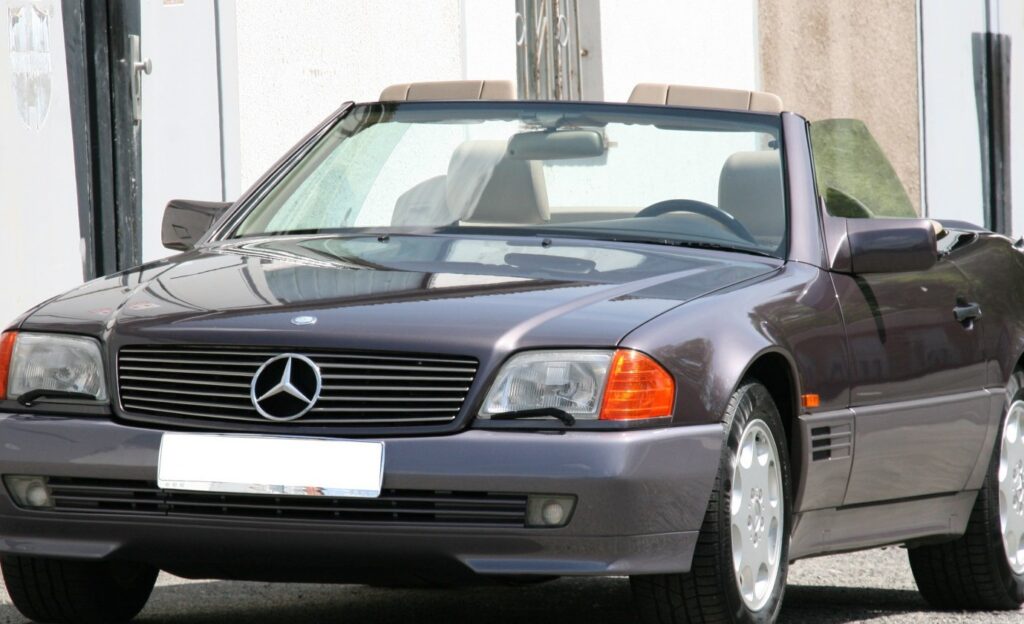
The Mercedes-Benz SL (R129) 300 SL, produced between March 1989 and June 1993, represented a significant evolution of the iconic SL roadster lineage. Positioned as the entry-level model within the R129 generation – which also included the 320SL, 500SL, and later the 600SL – the 300 SL offered a blend of luxury, performance, and open-air motoring at a more accessible price point. Built on the 129 platform, it aimed to deliver the classic SL experience to a broader audience. The R129 series was notable for its advanced safety features, including automatic roll bars, a feature that became synonymous with the generation.
At the heart of the 300 SL was the M103.984 engine, a 2.96-liter (180.63 cubic inches) inline-six cylinder powerplant. This engine utilized multi-port manifold fuel injection and a single overhead camshaft (SOHC) valvetrain. Producing 190 horsepower at 5700 rpm and 260 Nm (191.77 lb-ft) of torque at 4500 rpm, the M103 was known for its smooth operation and relative reliability. The engine’s longitudinal front-engine layout contributed to a balanced weight distribution. The 300 SL was exclusively offered with a four-speed automatic transmission, designed to provide comfortable and effortless cruising. This transmission, while not known for its sportiness, was well-suited to the car’s grand touring character.
The 300 SL Automatic delivered a comfortable, rather than overtly sporty, driving experience. Acceleration from 0 to 60 mph took approximately 9 seconds, and it could achieve a top speed of 223 km/h (138.57 mph). The automatic transmission’s gear ratios were geared towards relaxed highway cruising, prioritizing smoothness over rapid acceleration. Compared to the manual transmission options available on other R129 models, or the higher-output 320SL and 500SL variants, the 300 SL Automatic felt less engaging but more accessible to a wider range of drivers. The engine provided adequate power for everyday driving and comfortable long-distance journeys.
The 300 SL came standard with a respectable level of equipment for its time. Interior appointments typically included leather upholstery, power windows, power locks, and a basic audio system. The dashboard layout was typical of Mercedes-Benz in the late 1980s and early 1990s – functional and well-built, though not overly flashy. Optional extras included upgraded audio systems, automatic climate control, and various trim enhancements. The two-seater roadster configuration emphasized the open-air driving experience, with a power-operated soft top as standard equipment.
The R129 300 SL featured a coil spring and wishbone front suspension with a transverse stabilizer, providing a comfortable ride and predictable handling. The rear suspension utilized an independent multi-link setup, also with a transverse stabilizer and coil springs. Braking duties were handled by ventilated discs at the front and solid discs at the rear. Anti-lock braking system (ABS) was standard, enhancing safety and control. Steering was hydraulic power-assisted, utilizing a cone worm and recirculation balls system. The car rode on 225/55 ZR 16 tires mounted on 8J x 16 H2 alloy wheels.
Contemporary reviews of the 300 SL Automatic generally praised its comfort, build quality, and elegant styling. However, some critics noted that the 190 hp engine and automatic transmission combination lacked the performance to truly exploit the chassis’ potential. Fuel economy was reasonable for a vehicle of its class, averaging around 21.6 US mpg combined. Reliability was generally good, though maintenance costs could be significant, as with any Mercedes-Benz of the era. Compared to the 320SL, the 300 SL offered a more affordable entry point into R129 ownership, but at the expense of outright performance. The 300 SL appealed to buyers seeking a luxurious and comfortable roadster without the higher price tag of its more powerful siblings.
| Fuel consumption (urban) | 15 l/100 km (15.7 US mpg, 18.8 UK mpg, 6.7 km/l) |
| Fuel consumption (extra urban) | 9.2 l/100 km (25.6 US mpg, 30.7 UK mpg, 10.9 km/l) |
| Fuel consumption (combined) | 10.9 l/100 km (21.6 US mpg, 25.9 UK mpg, 9.2 km/l) |
| Fuel Type | Petrol (Gasoline) |
| Acceleration 0 – 100 km/h | 9.5 sec |
| Acceleration 0 – 62 mph | 9.5 sec |
| Acceleration 0 – 60 mph | 9 sec |
| Maximum speed | 223 km/h (138.57 mph) |
| Emission standard | Euro 1 |
| Weight-to-power ratio | 8.7 kg/Hp, 115.2 Hp/tonne |
| Weight-to-torque ratio | 6.3 kg/Nm, 157.6 Nm/tonne |
| Power | 190 Hp @ 5700 rpm |
| Power per litre | 64.2 Hp/l |
| Torque | 260 Nm @ 4500 rpm (191.77 lb.-ft. @ 4500 rpm) |
| Engine layout | Front, Longitudinal |
| Engine Model/Code | M 103.984 |
| Engine displacement | 2960 cm3 (180.63 cu. in.) |
| Number of cylinders | 6 |
| Engine configuration | Inline |
| Cylinder Bore | 88.5 mm (3.48 in.) |
| Piston Stroke | 80.2 mm (3.16 in.) |
| Compression ratio | 9.2:1 |
| Number of valves per cylinder | 2 |
| Fuel injection system | Multi-port manifold injection |
| Engine aspiration | Naturally aspirated engine |
| Valvetrain | SOHC |
| Engine oil capacity | 6.5 l (6.87 US qt | 5.72 UK qt) |
| Coolant | 11.5 l (12.15 US qt | 10.12 UK qt) |
| Kerb Weight | 1650-1700 kg (3637.63 – 3747.86 lbs.) |
| Max. weight | 2040-2090 kg (4497.43 – 4607.66 lbs.) |
| Max load | 390 kg (859.8 lbs.) |
| Trunk (boot) space – minimum | 265 l (9.36 cu. ft.) |
| Fuel tank capacity | 80 l (21.13 US gal | 17.6 UK gal) |
| Length | 4470 mm (175.98 in.) |
| Width | 1812 mm (71.34 in.) |
| Height | 1303 mm (51.3 in.) |
| Wheelbase | 2515 mm (99.02 in.) |
| Front track | 1535 mm (60.43 in.) |
| Rear (Back) track | 1523 mm (59.96 in.) |
| Drag coefficient (Cd) | 0.32-0.40 |
| Minimum turning circle (turning diameter) | 10.7 m (35.1 ft.) |
| Drivetrain Architecture | Rear wheel drive |
| Number of gears and type of gearbox | 4 gears, automatic transmission |
| Front suspension | Coil spring, Wishbone, Transverse stabilizer |
| Rear suspension | Independent multi-link suspension, Transverse stabilizer, Coil spring |
| Front brakes | Ventilated discs |
| Rear brakes | Disc |
| Assisting systems | ABS (Anti-lock braking system) |
| Steering type | Cone worm with recirculation balls |
| Power steering | Hydraulic Steering |
| Tires size | 225/55 ZR 16 |
| Wheel rims size | 8 J x 16 H 2 |
Today, the R129 300 SL Automatic remains a desirable classic, particularly among those seeking a comfortable and stylish roadster experience. While not the fastest or most engaging variant of the R129, its relative affordability and ease of maintenance compared to the higher-spec models have contributed to its enduring appeal. Well-maintained examples continue to command reasonable prices in the used car market, offering a taste of Mercedes-Benz luxury from a bygone era. The M103 engine, while aging, is generally considered robust and capable of providing many more years of reliable service with proper care.