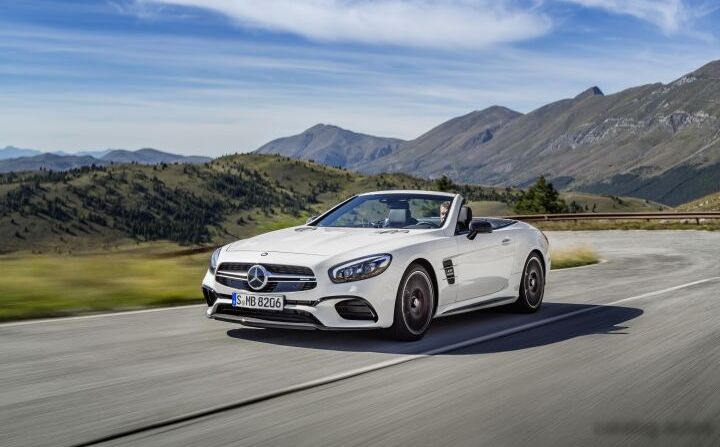
The Mercedes-Benz SL (R231) underwent a significant facelift in 2016, introducing updated styling, enhanced technology, and revised engine options. Among these, the AMG SL 63 V8 (585 Hp) MCT variant represented the pinnacle of performance for the R231 generation. Produced from 2016 to July 2018, this model combined a potent, hand-built AMG V8 engine with the advanced MCT (Multi Clutch Technology) seven-speed automatic transmission, offering a luxurious and exhilarating grand touring experience. The R231 SL series itself was a continuation of the long-running SL lineage, positioned as a two-seat roadster competing with vehicles like the Porsche 911 and BMW SLK/SLC.
AMG SL 63 V8 (585 Hp) MCT: Overview and Positioning
The AMG SL 63 occupied the top tier of the R231 SL lineup. Below it were the SL 400 and SL 550 models, offering less powerful engine options and a slightly more comfort-oriented driving experience. The SL 63 was specifically targeted at drivers seeking uncompromising performance, aggressive styling, and the prestige associated with the AMG brand. It was not a track-focused machine, but rather a high-performance roadster designed for long-distance cruising and spirited driving on winding roads. The “MCT” designation refers to the transmission, a key component differentiating it from earlier SL 63 models.
Powertrain & Engine Architecture
The heart of the AMG SL 63 is the M157.983 5.5-liter V8 engine. This engine is hand-assembled at the AMG engine production facility in Affalterbach, Germany, following the “one man, one engine” philosophy. It features a cast aluminum block and heads, and utilizes direct fuel injection along with twin turbochargers. The twin-turbo setup delivers 585 horsepower at 5500 rpm and a substantial 900 Nm (663.81 lb-ft) of torque between 2250 and 3750 rpm. The engine also incorporates cylinder deactivation technology, allowing it to operate on four cylinders under light load conditions to improve fuel efficiency. Compression ratio is 10:1. Engine oil capacity is 8.5 liters (8.98 US quarts / 7.48 UK quarts).
The MCT seven-speed automatic transmission is a crucial element of the SL 63’s performance. Unlike a traditional torque converter automatic, the MCT utilizes a wet multi-plate clutch pack instead of a torque converter. This design provides faster shift times, more direct power delivery, and improved efficiency. The transmission offers multiple driving modes, including Comfort, Sport, Sport Plus, and Manual, allowing the driver to tailor the shift points and responsiveness to their preferences. Paddle shifters are also included for manual gear selection.
Engine Specifications (M157.983)
- Displacement: 5461 cm³ (333.25 cu. in.)
- Configuration: V8
- Aspiration: Bi-Turbo with Intercooler
- Fuel Injection: Direct Injection
- Power Output: 585 hp @ 5500 rpm
- Torque Output: 900 Nm (663.81 lb-ft) @ 2250-3750 rpm
- Power per Liter: 107.1 hp/liter
Driving Characteristics
The AMG SL 63 delivers a driving experience that is both powerful and refined. The combination of the high-output V8 and the MCT transmission results in exhilarating acceleration. Mercedes-Benz claimed a 0-100 km/h (0-62 mph) time of 4.1 seconds, with independent tests suggesting a 0-60 mph time of around 3.9 seconds. The engine’s broad torque curve provides effortless acceleration in any gear, making overtaking maneuvers quick and easy. The MCT transmission shifts quickly and smoothly, contributing to the car’s overall responsiveness. While the SL 63 is a relatively heavy vehicle (1770 kg / 3902.18 lbs), the powerful engine and well-tuned suspension help to mask its weight. The suspension is tuned for a balance between comfort and handling, providing a compliant ride on most road surfaces while still offering good body control in corners.
Equipment & Trim Levels
The AMG SL 63 came standard with a comprehensive list of features, befitting its flagship status. Standard equipment included leather upholstery, heated and ventilated seats, a premium sound system, a navigation system, and a host of driver-assistance technologies. Interior trim options included various wood veneers, carbon fiber accents, and aluminum trim pieces. Optional extras included a panoramic sunroof, upgraded leather packages, and advanced driver-assistance systems such as adaptive cruise control and lane-keeping assist. The exterior styling was also enhanced with AMG-specific body styling, including a more aggressive front bumper, side skirts, and rear diffuser. Wheels were typically 19-inch AMG alloy wheels, fitted with performance tires (255/35 ZR 19 front, 285/30 ZR 19 rear).
Chassis & Braking
The SL 63 features an independent multi-link suspension at both the front and rear. The suspension is electronically controlled, allowing the driver to adjust the damping settings to suit their preferences. The car also features AMG’s three-stage ESP (Electronic Stability Program), which allows for varying levels of intervention. Braking duties are handled by ventilated discs at all four corners. The front brakes measure 390mm in diameter, while the rear brakes measure 360mm in diameter. The braking system is equipped with ABS (Anti-lock Braking System) and other advanced safety features. The steering is a speed-sensitive power steering rack and pinion system, providing precise and responsive steering feel.
Market Reception & Comparison
The AMG SL 63 was generally well-received by automotive critics. It was praised for its powerful engine, responsive transmission, and luxurious interior. However, some critics noted that the car’s weight could be felt during spirited driving. Fuel economy was also a concern, with combined fuel consumption figures ranging from 10.1-9.8 l/100 km (23.3-24 US mpg). Compared to the SL 400 and SL 550, the SL 63 offered significantly more performance, but at a higher price point. Compared to rivals like the Porsche 911, the SL 63 offered a more comfortable and luxurious driving experience, but lacked the same level of track-focused performance. Reliability was generally good, although the complex engine and transmission systems could be expensive to repair.
Technical Specifications
| Body Type | Roadster, 2 Doors, 2 Seats |
| Engine Type | Petrol (Gasoline) |
| Engine Displacement | 5461 cm³ (333.25 cu. in.) |
| Number of Cylinders | 8, V-engine |
| Power Output | 585 Hp @ 5500 rpm |
| Torque Output | 900 Nm (663.81 lb-ft) @ 2250-3750 rpm |
| Transmission | 7-speed automatic, MCT |
| Drive Type | Rear-wheel drive |
| Acceleration 0-100 km/h | 4.1 sec |
| Acceleration 0-60 mph | 3.9 sec (Calculated) |
| Maximum Speed | 250 km/h (155.34 mph) |
| Kerb Weight | 1770 kg (3902.18 lbs) |
| Max. Weight | 2180 kg (4806.08 lbs) |
| Fuel Tank Capacity | 75 l (19.81 US gal / 16.5 UK gal) |
| Fuel Consumption (Combined) | 10.1-9.8 l/100 km (23.3-24 US mpg) |
| CO2 Emissions | 234-229 g/km |
| Drag Coefficient (Cd) | 0.32 |
Legacy
The AMG SL 63 (R231, facelift) remains a desirable used car today, appealing to buyers seeking a high-performance roadster with a luxurious interior. The M157 engine, while complex, has proven to be relatively reliable when properly maintained. However, potential buyers should be aware of the potential for expensive repairs, particularly related to the turbochargers and transmission. The car’s combination of performance, luxury, and exclusivity ensures its continued appeal in the used car market, representing a compelling option for those seeking a grand touring experience with a powerful AMG V8 engine.