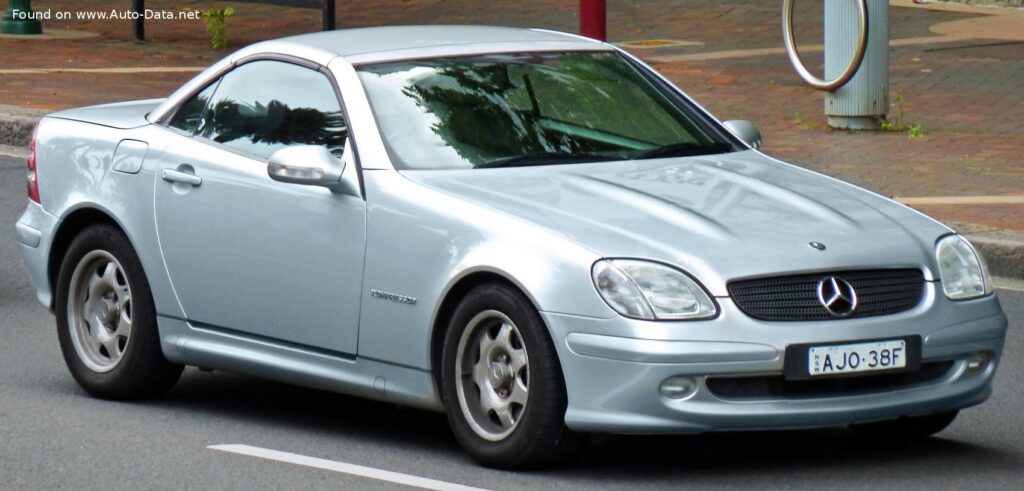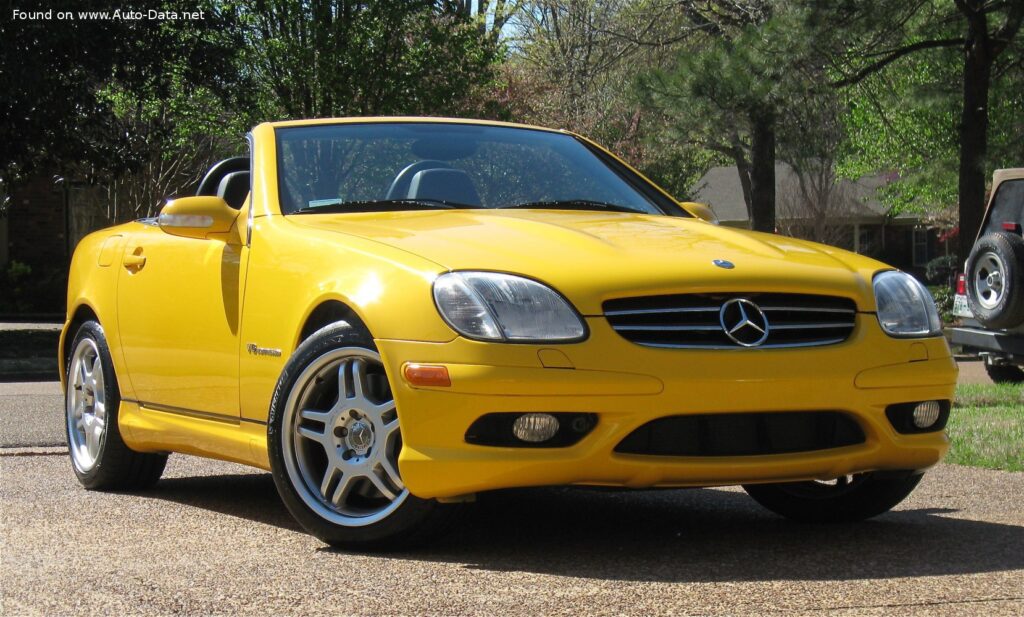
The Mercedes-Benz SLK (R170, facelift 2000) SLK 230 Kompressor represents a pivotal moment for the German automaker, marking its successful entry into the burgeoning compact luxury roadster segment. Initially launched in 1996, the R170 generation quickly became known for its innovative retractable hardtop roof – dubbed the “Vario-Roof” – allowing for seamless transitions between a secure coupe and an open-air roadster. This groundbreaking feature, combined with Mercedes-Benz’s reputation for luxury and engineering, positioned the SLK as a strong competitor against rivals like the BMW Z3 and Porsche Boxster.
The Mercedes-Benz SLK (R170, facelift 2000) SLK 230 Kompressor: A Modern Classic Roadster
The model under review, the Mercedes-Benz SLK (R170, facelift 2000) SLK 230 Kompressor (197 Hp), is the refined and updated version of the first-generation SLK. Introduced in February 2000, the facelift brought cosmetic and mechanical improvements to enhance performance and appeal. The SLK 230 Kompressor, powered by its supercharged four-cylinder engine, offered a compelling balance of spirited performance and reasonable fuel efficiency, making it a popular choice for enthusiasts and luxury buyers seeking a distinctive two-seater experience. Production continued until April 2004, solidifying its place in Mercedes-Benz’s history and as a pioneer in the retractable hardtop market.
Powertrain and Driving Dynamics
The heart of the Mercedes-Benz SLK (R170, facelift 2000) SLK 230 Kompressor (197 Hp) is the M 111.983 engine, a 2.3-liter (2295 cm3) inline-four cylinder unit distinguished by its supercharger and intercooler. This “Kompressor” technology, a signature of Mercedes-Benz engineering during this period, significantly boosted performance, delivering 197 horsepower at 5300 rpm. The engine also produced a robust 206.52 lb.-ft. of torque across a broad range from 2500 to 5000 rpm. This wide torque band ensured excellent responsiveness and acceleration, making the SLK 230 Kompressor lively and engaging in various driving conditions.
Power was delivered to the rear wheels via a precise 6-speed manual transmission, offering drivers a direct connection to the car’s performance. This powertrain combination allowed the SLK 230 Kompressor to accelerate from 0 to 60 mph in 6.8 seconds, with a top speed of 149.13 mph. These figures were competitive for its segment at the turn of the millennium. The vehicle’s weight-to-power ratio of 6.6 kg/Hp (approximately 14.55 lbs/Hp) contributed to its agile feel.
In terms of efficiency, the SLK 230 Kompressor achieved a combined fuel economy of 24 US mpg (9.8 l/100 km), respectable given its performance. It also met the Euro 4 emission standard, with CO2 emissions of 233 g/km, reflecting Mercedes-Benz’s commitment to balancing performance with environmental considerations. The rear-wheel-drive architecture, coupled with a sophisticated suspension system featuring double wishbones and coil springs at the front and an independent multi-link setup with coil springs at the rear, provided a confident and planted ride. Hydraulic power steering with a recirculating ball mechanism offered communicative feedback, while ventilated disc brakes at the front and solid discs at the rear, assisted by ABS, ensured strong stopping power.
Design, Comfort, and Innovation
The SLK (R170) was visually striking, embodying a sleek, compact roadster aesthetic that blended classic sports car proportions with modern Mercedes-Benz design language. The facelifted model retained the original’s essence while introducing subtle enhancements, such as redesigned bumpers, side skirts, and clear-lens headlights and taillights, giving it a more contemporary and aggressive look. As a pure two-seater roadster, it offered an intimate driving experience.
Its defining feature, the electro-hydraulically operated Vario-Roof, was a marvel of engineering. This innovative retractable hardtop allowed the SLK to transform from an open-top roadster to a weather-sealed coupe in approximately 25 seconds, offering the thrill of open-air motoring and the security, noise insulation, and climate control of a fixed-roof vehicle. This feature significantly influenced the automotive industry, inspiring many subsequent convertible designs.
Inside, the SLK 230 Kompressor featured a driver-focused cockpit with high-quality materials typical of Mercedes-Benz. The facelift introduced updated trim options, revised instrumentation, and improved ergonomics. Standard features often included leather upholstery, automatic climate control, and a premium audio system, emphasizing the luxury aspect of the vehicle. Despite its compact dimensions—a length of 157.87 inches and a width of 67.52 inches—the cabin was designed to be comfortable for two occupants. Trunk space, while compromised with the roof stowed (5.12 cu. ft.), expanded to a more practical 12.29 cu. ft. with the roof up, offering reasonable utility for a roadster. Safety features for the era included standard anti-lock braking system (ABS) and robust structural integrity. The staggered tire setup (205/55 R 16 front, 225/50 R 16 rear) on 16-inch alloy wheels further enhanced its sporty stance and handling characteristics.
Technical Specifications
| General Information | |
|---|---|
| Brand | Mercedes-Benz |
| Model | SLK |
| Generation | SLK (R170, facelift 2000) |
| Type (Engine) | SLK 230 Kompressor (197 Hp) |
| Start of Production | February, 2000 |
| End of Production | April, 2004 |
| Powertrain Architecture | Internal Combustion engine |
| Body type | Roadster |
| Seats | 2 |
| Doors | 2 |
| Performance Specifications | |
| Fuel Consumption (Urban, NEDC) | 14.1 l/100 km (16.7 US mpg) |
| Fuel Consumption (Extra Urban, NEDC) | 7.3 l/100 km (32.2 US mpg) |
| Fuel Consumption (Combined, NEDC) | 9.8 l/100 km (24 US mpg) |
| CO2 Emissions (NEDC) | 233 g/km |
| Fuel Type | Petrol (Gasoline) |
| Acceleration 0 – 60 mph | 6.8 sec |
| Acceleration 0 – 100 km/h | 7.2 sec |
| Maximum Speed | 240 km/h (149.13 mph) |
| Emission Standard | Euro 4 |
| Weight-to-Power Ratio | 6.6 kg/Hp (150.4 Hp/tonne) |
| Weight-to-Torque Ratio | 4.7 kg/Nm (213.7 Nm/tonne) |
| Engine Specifications | |
| Power | 197 Hp @ 5300 rpm |
| Power per liter | 85.8 Hp/l |
| Torque | 280 Nm @ 2500-5000 rpm (206.52 lb.-ft.) |
| Engine Layout | Front, Longitudinal |
| Engine Model/Code | M 111.983 |
| Engine Displacement | 2295 cm3 (2.3 Liters / 140.05 cu. in.) |
| Number of Cylinders | 4 |
| Engine Configuration | Inline |
| Cylinder Bore | 90.9 mm (3.58 in.) |
| Piston Stroke | 88.4 mm (3.48 in.) |
| Compression Ratio | 9:1 |
| Number of Valves per Cylinder | 4 |
| Fuel Injection System | Multi-port manifold injection |
| Engine Aspiration | Supercharger, Intercooler |
| Valvetrain | DOHC |
| Engine Oil Capacity | 5.5 l (5.81 US qt) |
| Coolant Capacity | 8 l (8.45 US qt) |
Legacy and Market Influence
The Mercedes-Benz SLK (R170), particularly the facelifted 2000-2004 models like the SLK 230 Kompressor, left a lasting mark on the automotive landscape. Its primary legacy is the popularization of the retractable hardtop, a feature that became mainstream thanks to the SLK’s success. This innovation provided a compelling value proposition, offering the appeal of a convertible with the practicality, security, and refinement of a coupe.
In the compact luxury roadster segment, the SLK 230 Kompressor carved out a strong niche, competing with the BMW Z3/Z4 and Porsche Boxster. While the SLK might not have matched the Boxster’s handling, it countered with Mercedes-Benz luxury, comfort, and the unique Vario-Roof, appealing to buyers who valued sophistication and innovation. The supercharged four-cylinder engine delivered strong, accessible power, making it a fun and engaging car for daily driving or weekend cruises.
The R170’s success established the SLK nameplate within Mercedes-Benz’s lineup and paved the way for subsequent generations. Today, the Mercedes-Benz SLK (R170) is considered a modern classic, representing an era when Mercedes-Benz was pushing technological boundaries in accessible luxury vehicles. Its relatively simple mechanicals make it an attractive proposition for enthusiasts seeking a stylish and reliable entry into Mercedes-Benz ownership. The SLK 230 Kompressor, in particular, is lauded for its robust engine and engaging manual transmission, embodying a blend of sportiness and usability that continues to captivate collectors and drivers alike. Its market impact was profound, demonstrating that luxury, performance, and groundbreaking technology could coexist in a compact, stylish package.