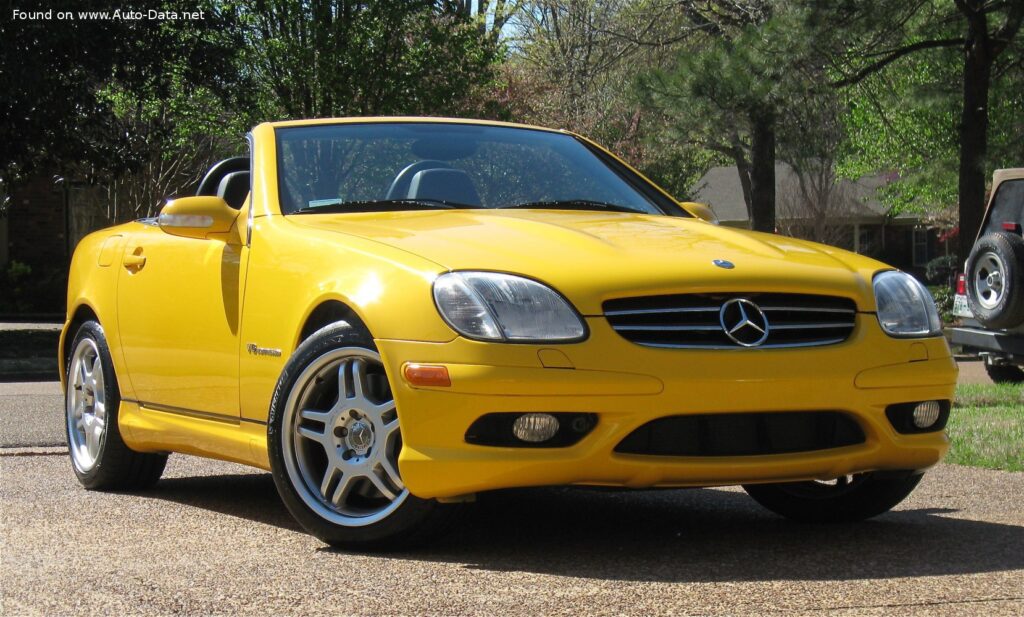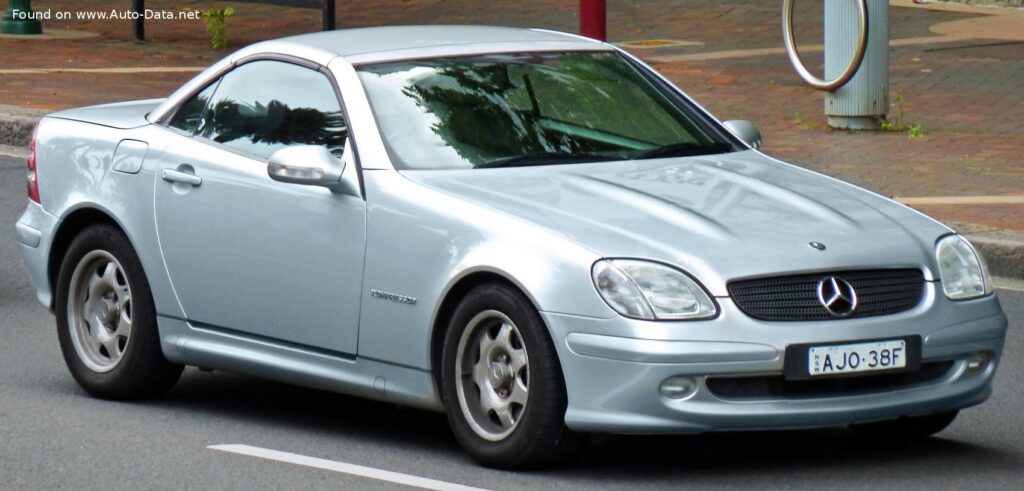
The Mercedes-Benz SLK (R170), debuting in July 1996, represented a significant shift for the German automaker, introducing a compact luxury roadster designed to blend open-air driving with Mercedes-Benz’s renowned refinement. Positioned as Sportlich, Leicht, Kurz – German for Sporty, Light, Short – the SLK’s defining feature was its electro-hydraulic “vario-roof” retractable hardtop, a groundbreaking innovation that transformed the car between coupe and roadster in just 25 seconds. This article details the Mercedes-Benz SLK (R170) SLK 200 (136 Hp) variant, a model primarily marketed in Europe and other international regions where smaller engine displacements were favored due to taxation and fuel economy considerations.
Mercedes-Benz SLK (R170): A New Era of Roadsters
While the US market largely received Kompressor (supercharged) and V6 engine options, the SLK 200 served as an accessible entry point into the SLK lineup. It offered the same stylish design and innovative roof technology, prioritizing efficiency within its segment. The R170 generation established a new benchmark for compact roadsters, influencing competitors and solidifying Mercedes-Benz’s position in the luxury market.
Engine & Performance
The Mercedes-Benz SLK (R170) SLK 200 is powered by a naturally aspirated 2.0-liter (1998 cm³) inline-four engine, designated the M 111.946. This engine, common in Mercedes-Benz’s smaller vehicles of the era, was engineered for smooth operation and reliability. It features a Double Overhead Camshaft (DOHC) valvetrain with four valves per cylinder, optimizing breathing and power delivery. Fuel is delivered via a multi-port manifold injection system, ensuring precise fuel metering for efficient combustion.
The M 111.946 engine in the SLK 200 produces 136 horsepower at 5500 rpm, with torque output of 140.14 lb.-ft. available between 3700 and 4500 rpm. This broad torque curve contributes to flexible driving characteristics. Despite its relatively modest power compared to supercharged versions, the SLK 200 accelerates from 0 to 60 mph in 8.8 seconds and reaches a top speed of 129.25 mph. This performance, combined with its compact dimensions and rear-wheel-drive layout, provides an engaging driving experience, particularly when equipped with the standard 5-speed manual transmission.
Fuel economy was a key consideration for the SLK 200’s target markets. According to NEDC (New European Driving Cycle) figures, the vehicle achieves a combined fuel consumption of 25.8 US mpg. Urban driving yields 18.2 US mpg, while extra-urban cruising improves to 34.1 US mpg. These figures, alongside CO2 emissions of 217 g/km, demonstrate its efficiency within the premium roadster segment.
Design & Features
The Mercedes-Benz SLK (R170) showcased a fresh, youthful design language for the brand, differentiating it from traditional Mercedes-Benz sedans and coupes. Its compact dimensions – 157.28 inches in length, 67.52 inches in width, and 50.55 inches in height – contribute to its agile appearance. The two-door roadster body style, seating for two, exudes sportiness and elegance, drawing inspiration from classic Mercedes-Benz roadsters while incorporating late-1990s styling cues. The distinctive front fascia, with its wide grille and integrated headlights, gives the SLK a confident presence.
The R170’s most notable feature is its “vario-roof.” This electro-hydraulic retractable hardtop provides the security, insulation, and sleek lines of a coupe when closed, and the open-air freedom of a traditional roadster when stowed. The mechanism, a marvel of engineering for its time, smoothly folds the roof into the trunk in approximately 25 seconds. This innovation eliminated the compromises associated with soft-top roadsters, such as vulnerability to vandalism, noise intrusion, and limited weather protection.
Inside, the SLK 200 offers a driver-focused cockpit with a blend of comfort and sporty aesthetics. Quality materials, typical of Mercedes-Benz, are used throughout, though the design is more contemporary than larger Mercedes models. Standard features included power windows, power mirrors, air conditioning, and a basic audio system. Safety features included Anti-lock Braking System (ABS) and dual front airbags. The chassis features a double wishbone front suspension and an independent multi-link rear suspension, providing a balanced ride and handling. Braking is handled by ventilated discs at the front (273 mm) and solid discs at the rear (278 mm), ensuring confident stopping power. Hydraulic power steering, with a recirculating ball design, offers precise control.
Technical Specifications
| General Information | |
| Brand | Mercedes-Benz |
| Model | SLK |
| Generation | SLK (R170) |
| Type (Engine) | SLK 200 (136 Hp) |
| Production Start | July, 1996 |
| Production End | February, 2000 |
| Powertrain Architecture | Internal Combustion Engine |
| Body type | Roadster |
| Seats | 2 |
| Doors | 2 |
| Performance Specs | |
| Fuel Consumption (Urban, NEDC) | 12.9 l/100 km (18.2 US mpg) |
| Fuel Consumption (Extra Urban, NEDC) | 6.9 l/100 km (34.1 US mpg) |
| Fuel Consumption (Combined, NEDC) | 9.1 l/100 km (25.8 US mpg) |
| CO2 Emissions (NEDC) | 217 g/km |
| Fuel Type | Petrol (Gasoline) |
| Acceleration 0 – 60 mph | 8.8 sec |
| Acceleration 0 – 100 km/h | 9.3 sec |
| Maximum Speed | 208 km/h (129.25 mph) |
| Braking 100 km/h – 0 | 37.5 m |
| Weight-to-Power Ratio | 8.8 kg/Hp |
| Weight-to-Torque Ratio | 6.3 kg/Nm |
| Engine Specs | |
| Power | 136 Hp @ 5500 rpm |
| Power per liter | 68.1 Hp/l |
| Torque | 190 Nm (140.14 lb.-ft.) @ 3700-4500 rpm |
| Maximum Engine Speed | 6250 rpm |
| Engine Layout | Front, Longitudinal |
| Engine Model/Code | M 111.946 |
| Engine Displacement | 1998 cm³ (2.0 liters / 121.93 cu. in.) |
| Number of Cylinders | 4 |
| Engine Configuration | Inline |
| Cylinder Bore | 89.9 mm (3.54 in.) |
| Piston Stroke | 78.7 mm (3.1 in.) |
| Compression Ratio | 10.4:1 |
| Number of Valves per Cylinder | 4 |
| Fuel Injection System | Multi-port manifold injection |
| Engine Aspiration | Naturally aspirated |
| Valvetrain | DOHC |
| Engine Oil Capacity | 5.5 l (5.81 US qt) |
| Coolant Capacity | 8 l (8.45 US qt) |
| Space, Volume, and Weights | |
| Kerb Weight | 1195 kg (2634.52 lbs.) |
| Max. Weight | 1530 kg (3373.07 lbs.) |
| Max Load | 335 kg (738.55 lbs.) |
| Trunk (Boot) Space – Minimum | 145 l (5.12 cu. ft.) |
| Trunk (Boot) Space – Maximum | 348 l (12.29 cu. ft.) |
| Fuel Tank Capacity | 53 l (14 US gal) |
| Max. Roof Load | 30 kg (66.14 lbs.) |
| Dimensions | |
| Length | 3995 mm (157.28 in.) |
| Width | 1715 mm (67.52 in.) |
| Height | 1284 mm (50.55 in.) |
| Wheelbase | 2400 mm (94.49 in.) |
| Front Track | 1488 mm (58.58 in.) |
| Rear (Back) Track | 1471 mm (57.91 in.) |
| Drag Coefficient (Cd) | 0.33 |
| Minimum Turning Circle | 10.5 m (34.45 ft.) |
| Drivetrain, Brakes, and Suspension Specs | |
| Drivetrain Architecture | Rear-wheel drive |
| Drive Wheel | Rear wheel drive |
| Number of Gears and Type of Gearbox | 5 gears, manual transmission |
| Front Suspension | Coil spring, Double wishbone, Transverse stabilizer |
| Rear Suspension | Independent multi-link suspension, Coil spring |
| Front Brakes | Ventilated discs, 273 mm |
| Rear Brakes | Disc, 278 mm |
| Assisting Systems | ABS (Anti-lock braking system) |
| Steering Type | Cone worm with recirculation balls |
| Power Steering | Hydraulic Steering |
| Tires Size | 205/60 R 15 91 H |
| Wheel Rims Size | 7 J x 15 H 2 |
The Mercedes-Benz SLK (R170) significantly impacted the automotive world, establishing a new niche for Mercedes-Benz and leaving a lasting legacy. It was conceived during a burgeoning market for compact luxury roadsters, and the SLK quickly became a strong contender. Its innovative vario-roof was its most significant contribution, influencing a wave of models from other manufacturers. For Mercedes-Benz, the SLK (R170) attracted a younger demographic and injected modernity into the brand. While the SLK 200 wasn’t widely sold in the US, its existence demonstrates Mercedes-Benz’s global market strategy. Today, the SLK (R170) remains popular, appreciated for its styling, engineering, and the enduring appeal of its retractable hardtop, representing a pivotal moment in Mercedes-Benz’s history.