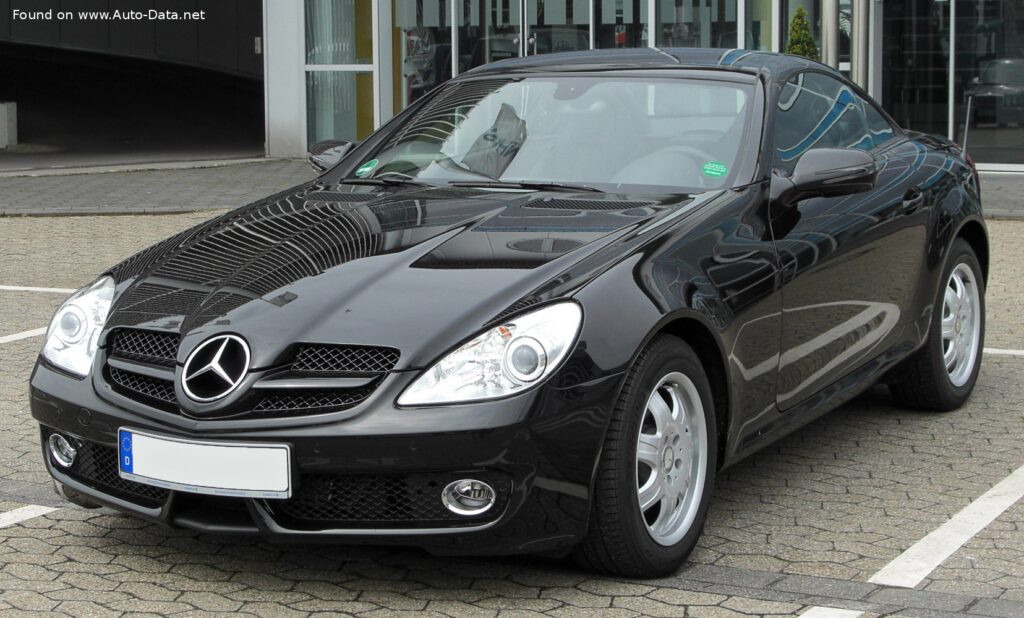
The Mercedes-Benz SLK, a name derived from “Sportlich, Leicht, Kurz” (sporty, light, short), has long represented the German automaker’s foray into the compact luxury roadster segment. The R171 generation, produced from 2004 to 2011, built upon the success of its groundbreaking predecessor, the R170, by refining its design, enhancing its performance, and advancing its technological offerings. The focus of this detailed review is the Mercedes-Benz SLK (R171, facelift 2008) SLK 200 Kompressor (184 Hp), a variant particularly popular in European markets for its blend of performance, efficiency, and premium appeal.
Launched in April 2008, the facelifted R171 aimed to keep the SLK competitive against rivals like the BMW Z4 and Audi TT Roadster. While the more powerful V6 and V8 engines were offered in markets like the United States, the SLK 200 Kompressor served as a crucial entry point in Europe, delivering a compelling mix of dynamic driving characteristics and reasonable running costs. This two-door, two-seat roadster maintained its iconic retractable hardtop, known as the “Vario-roof,” offering the versatility of a coupe with the exhilaration of an open-top convertible at the touch of a button. The facelift brought subtle yet effective updates to both the exterior aesthetics and interior appointments, ensuring the SLK remained a desirable option in the evolving luxury convertible landscape until its production ceased in January 2011.
The Mercedes-Benz SLK (R171, facelift 2008): Powertrain and Performance
Engine and Drivetrain
At the heart of the SLK 200 Kompressor (184 Hp) lies Mercedes-Benz’s M 271.954 engine, a 1.8-liter (109.6 cubic inches) inline-four cylinder unit. This powerplant is distinguished by its supercharger and intercooler, a setup that was a hallmark of Mercedes-Benz’s “Kompressor” models during this era. The supercharger, an engine-driven air compressor, provides immediate boost across the rev range, mitigating the turbo lag often associated with turbocharged engines and delivering a more linear power delivery. This design choice contributes to the engine’s impressive output for its size.
The engine produces a respectable 184 horsepower at 5500 rpm, translating to a power-per-liter figure of 102.4 HP/liter, showcasing efficient engineering. Torque is equally impressive, peaking at 184.39 lb.-ft. available across a broad rev band from 2800 to 5000 rpm. This wide torque plateau ensures strong acceleration and flexible in-gear performance, making the car responsive in various driving conditions. Power is sent to the rear wheels via a precise 6-speed manual transmission, offering an engaging driving experience for enthusiasts who prefer direct control over gear changes. The rear-wheel-drive architecture, a staple of sports cars, further enhances the SLK’s dynamic character and handling balance.
Performance Metrics and Efficiency
Despite its relatively modest engine displacement, the SLK 200 Kompressor delivers commendable performance figures. It accelerates from 0 to 60 mph in a swift 7.2 seconds (0-100 km/h in 7.6 seconds), making it agile enough for spirited driving. The top speed is rated at 146.64 mph (236 km/h), demonstrating its capability on unrestricted European highways.
Mercedes-Benz engineered this variant to strike a balance between performance and fuel efficiency, a critical factor in its primary markets. The combined fuel economy is estimated between 29.8 and 30.5 US miles per gallon (7.7-7.9 liters/100 km). In urban driving, it achieves 21 to 21.4 US mpg (11-11.2 liters/100 km), while extra-urban driving can yield an impressive 39.2 to 41.3 US mpg (5.7-6 liters/100 km). These figures, along with CO2 emissions of 182-188 g/km, allowed the vehicle to meet the Euro 5 emission standard, reflecting its environmental consciousness for its time. The car’s curb weight of 2899.08 pounds (1315 kg) contributes to its agility and favorable weight-to-power ratio of 7.1 kg/Hp.
Design, Comfort, and Technology
Exterior Design and Facelift Updates
The SLK (R171) retained its classic roadster proportions, characterized by a long hood, short rear deck, and a cab-rearward stance. The 2008 facelift brought subtle yet impactful enhancements to its already appealing design. The front end received a revised bumper with a more pronounced V-shape and larger air intakes, giving it a more aggressive and contemporary look. The grille featured a bolder design, further aligning it with Mercedes-Benz’s evolving design language. At the rear, new darkened taillight lenses and a revised lower bumper with integrated trapezoidal exhaust tips added a touch of sportiness and sophistication. The overall drag coefficient remained a respectable 0.32, showcasing aerodynamic efficiency.
A defining feature of the SLK is its “Vario-roof,” an electro-hydraulically operated retractable hardtop that transforms the car from a sleek coupe to an open-air roadster in just 22 seconds. This innovation offered the best of both worlds: the security and insulation of a fixed roof with the joy of top-down motoring. The car’s compact dimensions, with a length of 161.69 inches, a width of 69.96 inches (78.94 inches including mirrors), and a height of 51.02 inches, made it nimble and easy to maneuver, especially in urban environments, further aided by a minimum turning circle of 34.48 feet.
Interior Features and Driver Experience
Inside, the facelifted R171 SLK continued to offer a driver-focused cockpit crafted with high-quality materials. The 2008 updates included a new three-spoke steering wheel, revised instrument cluster graphics, and updated trim options, enhancing the cabin’s premium feel. The two-seat configuration provided ample space for occupants, emphasizing a personalized driving experience. While not a large car, the trunk offered a respectable 7.35 cubic feet (208 liters) of space, sufficient for weekend getaways, though naturally reduced when the hardtop was stowed.
Standard features included air conditioning, power windows, and a premium audio system. Mercedes-Benz also offered a range of optional luxuries, such as leather upholstery, heated seats, and the innovative AIRSCARF system, which delivered warm air to the neck and shoulders of occupants, extending comfortable top-down driving into cooler weather. Safety was paramount, with features like Anti-lock Braking System (ABS) and other proprietary Mercedes-Benz assisting systems ensuring occupant protection. The suspension setup, featuring an independent McPherson type at the front and an independent multi-link system at the rear, both with transverse stabilizers, provided a balanced ride that combined comfort with sporty handling. The hydraulic power steering, a rack and pinion system, offered precise feedback and a direct connection to the road.
Technical Specifications
| Category | Specification |
|---|---|
| General Information | |
| Brand | Mercedes-Benz |
| Model | SLK (R171, facelift 2008) |
| Type (Engine) | SLK 200 Kompressor (184 Hp) |
| Production Start | April, 2008 |
| Production End | January, 2011 |
| Body Type | Roadster, 2 Doors, 2 Seats |
| Powertrain Architecture | Internal Combustion Engine (ICE) |
| Performance Specs | |
| Fuel Consumption – Urban (NEDC) | 11-11.2 l/100 km |
| Fuel Consumption – Extra Urban (NEDC) | 5.7-6 l/100 km |
| Fuel Consumption – Combined (NEDC) | 7.7-7.9 l/100 km |
| CO2 Emissions (NEDC) | 182-188 g/km |
| Fuel Type | Petrol (Gasoline) |
| Acceleration 0-60 mph | 7.2 sec |
| Maximum Speed | 236 km/h |
| Emission Standard | Euro 5 |
| Weight-to-Power Ratio | 7.1 kg/Hp |
| Engine Specs | |
| Power | 184 Hp @ 5500 rpm |
| Torque | 250 Nm @ 2800-5000 rpm |
| Engine Layout | Front, Longitudinal |
| Engine Model/Code | M 271.954 |
| Engine Displacement | 1796 cm3 |
| Number of Cylinders | 4 |
| Engine Configuration | Inline |
| Cylinder Bore | 82 mm |
| Piston Stroke | 85 mm |
| Compression Ratio | 8.5:1 |
| Valves per Cylinder | 4 |
| Fuel Injection System | Multi-port manifold injection |
| Engine Aspiration | Supercharger, Intercooler |
| Valvetrain | DOHC |
| Engine Oil Capacity | 5.5 l |
| Coolant Capacity | 8 l |
| Dimensions, Volume & Weights | |
| Kerb Weight | 1315 kg |
| Max. Weight | 1705 kg |
| Max Load | 390 kg |
| Trunk Space – Minimum | 208 l |
| Fuel Tank Capacity | 70 l |
| Max. Roof Load | 50 kg |
| Length | 4107 mm |
| Width | 1777 mm |
| Width (incl. mirrors) | 2005 mm |
| Height | 1296 mm |
| Wheelbase | 2430 mm |
| Drag Coefficient (Cd) | 0.32 |
| Minimum Turning Circle | 10.51 m |
| Drivetrain, Brakes & Suspension | |
| Drivetrain Architecture | ICE drives rear wheels |
| Drive Wheel | Rear wheel drive |
| Gearbox Type | 6 gears, manual transmission |
| Front Suspension | Independent McPherson, Transverse stabilizer |
| Rear Suspension | Independent multi-link, Transverse stabilizer |
| Front Brakes | Ventilated discs |
| Rear Brakes | Disc |
| Assisting Systems | ABS (Anti-lock braking system) |
| Steering Type | Steering rack and pinion |
| Power Steering | Hydraulic Steering |
Legacy and Market Impact
The Mercedes-Benz SLK (R171), particularly the facelifted SLK 200 Kompressor, carved out a significant niche in the European luxury roadster market. It was positioned as an accessible premium convertible, offering the prestige and engineering prowess of Mercedes-Benz without the higher running costs associated with larger, more powerful engines. Its primary competitors included the BMW Z4, Audi TT Roadster, and even the entry-level Porsche Boxster, though the SLK often appealed to a slightly different demographic seeking a balance of comfort, style, and everyday usability alongside open-air enjoyment.
The SLK’s reputation was built on its solid build quality, refined ride, and the ingenious Vario-roof, which offered unmatched versatility. For many European buyers, the 200 Kompressor variant struck an ideal chord, providing sufficient power for spirited driving while maintaining commendable fuel efficiency and lower taxation levels compared to its V6 or V8 siblings. This made it a popular choice for those seeking a stylish, sporty car that could also serve as a daily driver.
Historically, the R171 generation was a successful evolution of the SLK concept. It matured the design, improved the interior quality, and offered a more engaging driving experience than its predecessor. The 2008 facelift ensured its design and technology remained fresh in a competitive segment. While not as raw or track-focused as some of its rivals, the SLK 200 Kompressor offered a distinctly Mercedes-Benz take on the roadster: a sophisticated, comfortable, and elegant machine that could also deliver a dose of driving pleasure. Its legacy is that of a well-rounded, desirable two-seater convertible that broadened the appeal of the Mercedes-Benz brand and solidified its presence in the compact luxury sports car market. It remains a testament to Mercedes-Benz’s ability to blend luxury, performance, and innovative design in a compact package.