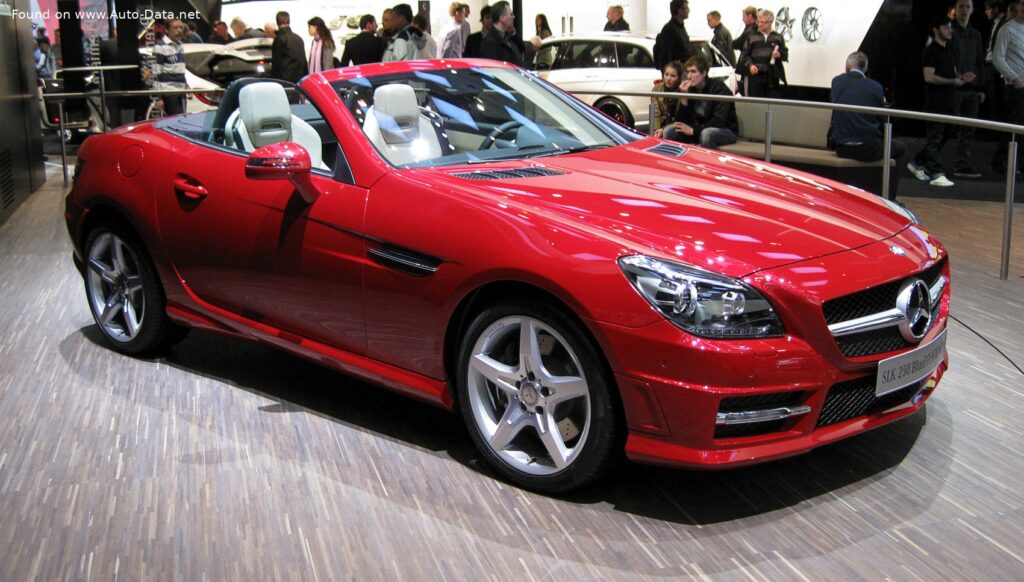
The Mercedes-Benz SLK, a nameplate synonymous with compact luxury roadsters, entered its third and final generation, the R172, in 2011. Positioned as a stylish and engaging two-seater convertible, the R172 aimed to blend the brand’s renowned luxury and sophisticated engineering with a more dynamic driving experience. The specific variant under review, the Mercedes-Benz SLK (R172) SLK 200 2.0 (184 Hp), produced from April 2015 to January 2016, represented a late-production model within this generation, just prior to its rebranding as the SLC-Class. This iteration solidified the SLK’s standing in the European compact luxury segment, offering a compelling blend of performance, efficiency, and open-air motoring, particularly appealing to buyers seeking a sophisticated daily driver with a sporty edge.
While the SLK (R172) was available in the United States, the SLK 200 variant was primarily marketed in Europe and other international markets, where its 2.0-liter turbocharged engine offered an attractive balance of power and fuel economy for the region’s tax and regulatory structures. Nonetheless, its core engineering and design principles were consistent with the global R172 platform, emphasizing Mercedes-Benz’s commitment to quality and innovation in the roadster segment.
Engine & Performance: The Heart of the Mercedes-Benz SLK (R172) SLK 200 2.0 (184 Hp)
Under the hood of the Mercedes-Benz SLK (R172) SLK 200 2.0 (184 Hp) lies a modern M 274.920 series 2.0-liter (1991 cm3 or 121.5 cubic inches) inline-four cylinder engine. This powerplant features a sophisticated architecture, including a DOHC (Dual Overhead Camshaft) valvetrain with four valves per cylinder, direct fuel injection, and a turbocharger with an intercooler. This combination allowed for impressive power delivery and efficiency for its class and era.
The engine generates a robust 184 horsepower at 5500 rpm, translating to a specific output of 92.4 horsepower per liter. More significantly, it produces 221.27 lb.-ft. of torque across a broad and accessible rev range, from 1200 to 4000 rpm. This wide torque band is crucial for real-world drivability, ensuring responsive acceleration from low speeds and effortless cruising. Power is sent to the rear wheels via a precise 6-speed manual transmission, a choice that appeals to driving enthusiasts seeking a more engaging connection with the vehicle.
Performance figures for the SLK 200 are respectable, with the roadster capable of accelerating from 0 to 60 mph in a swift 6.7 seconds (calculated) and reaching a top speed of 149.13 mph (240 km/h). These numbers firmly place it in the sporty category, capable of delivering an exhilarating experience on winding roads or during highway merges.
Despite its performance capabilities, the SLK 200 also boasts impressive fuel economy, largely thanks to its efficient turbocharged engine and the inclusion of a Start & Stop system. The combined NEDC cycle rating indicates 35.6 to 38.6 US mpg (6.1-6.6 l/100 km). Urban consumption ranges from 26.7 to 29 US mpg (8.1-8.8 l/100 km), while extra-urban driving yields an excellent 43.6 to 48 US mpg (4.9-5.4 l/100 km). With CO2 emissions ranging from 142-154 g/km, the vehicle met the stringent Euro 6 emission standard, reflecting Mercedes-Benz’s commitment to environmental responsibility. The 15.85 US gallon (60 liter) fuel tank provides a considerable cruising range.
Chassis and Dynamics
The SLK (R172) platform was engineered for a balanced ride and agile handling. It features an independent McPherson strut suspension with coil springs and an anti-roll bar at the front, complemented by an independent multi-link spring suspension with a stabilizer at the rear. This setup provides a comfortable ride quality while maintaining precise body control during spirited driving. The hydraulic power steering, utilizing a rack and pinion system, offers direct feedback to the driver, enhancing the overall driving experience. Braking is handled by ventilated discs at the front and solid discs at the rear, supported by an Anti-lock Braking System (ABS) for optimal stopping power and stability. The vehicle’s curb weight of 3042.38 lbs (1380 kg) contributes to its nimble feel, resulting in a favorable weight-to-power ratio of 7.5 kg/Hp (133.3 Hp/tonne).
Design & Features
The Mercedes-Benz SLK (R172) represented a significant evolution in the roadster’s design language, drawing inspiration from the iconic SLS AMG. Its styling is characterized by a long hood, a short rear deck, and a prominent grille featuring the large Mercedes-Benz star. The SLK 200 2.0 (184 Hp) maintains this athletic and elegant aesthetic, projecting a sense of sophisticated sportiness. The body type is a classic two-door, two-seat roadster, designed for an intimate and engaging driving experience.
A hallmark feature of the SLK-Class, and particularly the R172, is its retractable hardtop, or “vario-roof.” This innovative system allows the car to transform from a sleek coupe to an open-top roadster with the push of a button, offering the best of both worlds: the security and refinement of a fixed-roof car combined with the exhilaration of open-air motoring. The trunk space is respectable for a compact roadster, ranging from 7.95 to 11.83 cubic feet (225-335 liters), with the smaller figure applying when the roof is stowed.
Inside, the R172 SLK 200 offers a premium cabin experience, typical of Mercedes-Benz. While specific trim levels and options would vary by market, standard features would likely include high-quality materials, comfortable and supportive sport seats, and a driver-focused cockpit. Advanced features for its time often included Mercedes’ COMAND infotainment system, automatic climate control, and a suite of passive and active safety systems. The R172 also introduced innovations such as MAGIC SKY CONTROL, an optional panoramic vario-roof with switchable transparency, and AIRSCARF, a neck-level heating system that allows for comfortable top-down driving even in cooler weather. The drag coefficient of 0.30 indicates a well-aerodynamic design, contributing to both fuel efficiency and reduced wind noise.
Technical Specifications
| Category | Specification |
| General Information | |
| Brand | Mercedes-Benz |
| Model | SLK |
| Generation | SLK (R172) |
| Type (Engine) | SLK 200 2.0 (184 Hp) |
| Start of Production | April, 2015 |
| End of Production | January, 2016 |
| Powertrain Architecture | Internal Combustion engine |
| Body Type | Roadster |
| Seats | 2 |
| Doors | 2 |
| Performance Specs | |
| Fuel Consumption (Urban NEDC) | 8.1-8.8 l/100 km (26.7 – 29 US mpg) |
| Fuel Consumption (Extra Urban NEDC) | 4.9-5.4 l/100 km (43.6 – 48 US mpg) |
| Fuel Consumption (Combined NEDC) | 6.1-6.6 l/100 km (35.6 – 38.6 US mpg) |
| CO2 Emissions (NEDC) | 142-154 g/km |
| Fuel Type | Petrol (Gasoline) |
| Acceleration 0 – 60 mph (Calculated) | 6.7 sec |
| Acceleration 0 – 62 mph (0-100 km/h) | 7 sec |
| Maximum Speed | 149.13 mph (240 km/h) |
| Emission Standard | Euro 6 |
| Weight-to-Power Ratio | 7.5 kg/Hp (133.3 Hp/tonne) |
| Weight-to-Torque Ratio | 4.6 kg/Nm (217.4 Nm/tonne) |
| Engine Specs | |
| Power | 184 Hp @ 5500 rpm |
| Power per Liter | 92.4 Hp/l |
| Torque | 221.27 lb.-ft. (300 Nm) @ 1200-4000 rpm |
| Engine Layout | Front, Longitudinal |
| Engine Model/Code | M 274.920 |
| Engine Displacement | 2.0 liters (1991 cm3 / 121.5 cu. in.) |
| Number of Cylinders | 4 |
| Engine Configuration | Inline |
| Cylinder Bore | 3.27 in. (83 mm) |
| Piston Stroke | 3.62 in. (92 mm) |
| Compression Ratio | 9.8:1 |
| Number of Valves per Cylinder | 4 |
| Fuel Injection System | Direct injection |
| Engine Aspiration | Turbocharger, Intercooler |
| Valvetrain | DOHC |
| Engine Oil Capacity | 6.66 US qt (6.3 l) |
| Engine Systems | Start & Stop System |
| Space, Volume and Weights | |
| Kerb Weight | 3042.38 lbs (1380 kg) |
| Max. Weight | 3902.18 lbs (1770 kg) |
| Max Load | 859.8 lbs (390 kg) |
| Trunk (Boot) Space – Minimum | 7.95 cu. ft. (225 l) |
| Trunk (Boot) Space – Maximum | 11.83 cu. ft. (335 l) |
| Fuel Tank Capacity | 15.85 US gal (60 l) |
| Dimensions | |
| Length | 162.76 in. (4134 mm) |
| Width | 71.26 in. (1810 mm) |
| Width including mirrors | 78.98 in. (2006 mm) |
| Height | 51.22 in. (1301 mm) |
| Wheelbase | 95.67 in. (2430 mm) |
| Front Track | 61.38 in. (1559 mm) |
| Rear Track | 61.61 in. (1565 mm) |
| Front Overhang | 34.25 in. (870 mm) |
| Rear Overhang | 32.83 in. (834 mm) |
| Drag Coefficient (Cd) | 0.30 |
| Minimum Turning Circle | 34.51 ft. (10.52 m) |
| Drivetrain, Brakes and Suspension Specs | |
| Drivetrain Architecture | Internal combustion engine (ICE) drives the rear wheels. |
| Drive Wheel | Rear wheel drive |
| Number of Gears and Type of Gearbox | 6 gears, manual transmission |
| Front Suspension | Independent, type McPherson with coil spring and anti-roll bar |
| Rear Suspension | Independent multi-link spring suspension with stabilizer |
| Front Brakes | Ventilated discs |
| Rear Brakes | Disc |
| Assisting Systems | ABS (Anti-lock braking system) |
| Steering Type | Steering rack and pinion |
| Power Steering | Hydraulic Steering |
| Tires Size (Front) | 205/55 R16; 225/45 R17; 225/40 R18 |
| Tires Size (Rear) | 205/55 R16; 225/50 R16; 245/40 R17; 245/35 R18 |
| Wheel Rims Size (Front) | 7J x 16; 7.5J x 17; 7.5J x 18 |
| Wheel Rims Size (Rear) | 7J x 16; 8J x 16; 8.5J x 17; 8.5J x 18 |
Legacy & Market Impact
The Mercedes-Benz SLK (R172) SLK 200 2.0 (184 Hp), despite its relatively short production run in this specific configuration (2015-2016), played a crucial role in the compact luxury roadster segment, particularly in markets outside of the United States. It continued the legacy of the SLK nameplate, which had established itself as a more accessible and stylish alternative to larger, more expensive grand touring convertibles.
In its primary European and Asian markets, the SLK 200 was a strong competitor against rivals like the Audi TT Roadster, BMW Z4, and to a lesser extent, the Porsche Boxster. While the Boxster offered a more hardcore sports car experience, the SLK 200 carved out its niche by emphasizing refinement, comfort, and Mercedes-Benz’s signature luxury, combined with sufficient performance for spirited driving. Its retractable hardtop was a distinct advantage over soft-top rivals, offering enhanced security and all-weather usability.
The R172 generation itself was praised for its more aggressive styling, improved driving dynamics over its predecessor, and the introduction of advanced technologies like the MAGIC SKY CONTROL roof. The SLK 200, with its efficient yet potent 2.0-liter turbocharged engine and manual transmission option, resonated with buyers who appreciated a blend of engaging performance and sensible running costs. It represented a sophisticated choice for those desiring a premium open-top experience without the larger footprint or higher price point of a full-size luxury convertible.
Its legacy is also marked by its position as the final iteration before the SLK nameplate was retired and rebranded as the Mercedes-Benz SLC-Class in 2016, aligning it with the brand’s updated nomenclature strategy. The SLK 200 (R172) therefore stands as a refined example of Mercedes-Benz’s commitment to the compact luxury roadster, showcasing a blend of traditional craftsmanship, modern engineering, and a timeless appeal that continues to attract enthusiasts in the pre-owned market. Its combination of a powerful yet efficient engine, engaging manual transmission, and the iconic vario-roof cemented its place as a desirable and influential model in its segment.