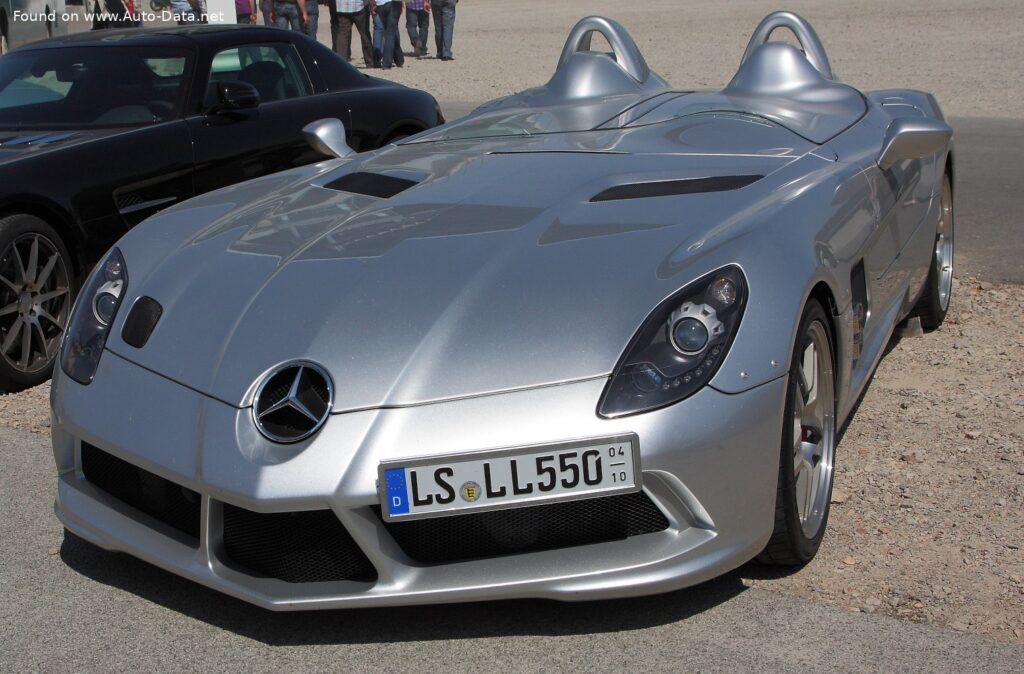
The Mercedes-Benz SLR McLaren (Z199) Stirling Moss stands as one of the most exclusive and visually striking supercars ever produced, a fitting swansong to the collaborative effort between Mercedes-Benz and McLaren Automotive. Unveiled in 2009, this limited-production speedster was a direct homage to the legendary 300 SLR race car driven by Sir Stirling Moss to victory in the 1955 Mille Miglia. Representing the final iteration of the SLR McLaren series, the Stirling Moss variant was designed without a roof or a traditional windshield, offering an unadulterated, visceral driving experience that harked back to the golden age of motorsport. Its radical design and exceptional performance immediately cemented its status as a collector’s item and a testament to automotive engineering and heritage.
Positioned in the ultra-high-end segment of the supercar market, the Mercedes-Benz SLR McLaren (Z199) Stirling Moss was not merely a cosmetic upgrade but a fundamentally re-engineered machine. It shed significant weight, enhanced aerodynamics, and boasted an even more potent version of the already formidable supercharged V8 engine. With only 75 units ever made, each offered exclusively to existing SLR McLaren owners, its rarity matches its performance and design audacity. This vehicle is more than just a car; it is a piece of automotive art, a rolling sculpture celebrating a pivotal moment in racing history, and a definitive statement of luxury and performance from two iconic brands.
Engine & Performance: The Heart of the Mercedes-Benz SLR McLaren (Z199) Stirling Moss
At the core of the Mercedes-Benz SLR McLaren (Z199) Stirling Moss lies a powerhouse developed by AMG: the M 155.980, a 5.5-liter (5439 cm³) supercharged V8 engine. This front-longitudinal powerplant is a masterpiece of engineering, delivering an astounding 650 horsepower at 6500 rpm. The engine’s raw power is complemented by a massive torque output of 604.8 lb.-ft. (820 Nm) available at a relatively accessible 4000 rpm, ensuring breathtaking acceleration across the rev range. This supercharged V8, featuring a multi-port manifold injection system and an intercooler, provides immediate throttle response and a relentless surge of power characteristic of AMG’s high-performance engines.
The performance figures for the Stirling Moss edition are nothing short of spectacular. It catapults from 0 to 60 mph in a blistering 3.3 seconds (0-100 km/h in 3.5 seconds), a testament to its formidable power-to-weight ratio of 2.4 kg/Hp (419.1 Hp/tonne). The top speed is an incredible 217.48 mph (350 km/h), making it one of the fastest roadsters of its era. Power is channeled to the rear wheels via a robust 5-speed AMG SPEEDSHIFT R automatic transmission. While some contemporary supercars were beginning to adopt dual-clutch units, the AMG SPEEDSHIFT R was chosen for its proven durability and quick, precise shifts, perfectly matching the car’s aggressive character. The drivetrain architecture, with the internal combustion engine driving the rear wheels, adheres to the classic high-performance sports car configuration, offering an engaging and pure driving experience.
Despite its focus on extreme performance, the Stirling Moss variant still provided a combined fuel economy of 16.2 US mpg (14.5 l/100 km) under the NEDC cycle, with CO2 emissions rated at 348 g/km. While not an efficiency champion, these figures are respectable for a vehicle of its power and performance capabilities, highlighting the underlying engineering prowess. The engine’s SOHC valvetrain and 3 valves per cylinder configuration, combined with a 9:1 compression ratio, demonstrate a blend of traditional robust design with forced induction technology to achieve its prodigious output.
Design & Features: Radical Aesthetics and Uncompromised Driving
The design of the Mercedes-Benz SLR McLaren (Z199) Stirling Moss is arguably its most defining characteristic. Classified as a roadster, it pushes the boundaries of the concept by completely eliminating the roof and the conventional windshield. Instead, it features two small wind deflectors, designed to channel airflow over the driver and passenger, providing a raw and immersive driving experience. This radical open-cockpit design is a direct homage to the Mercedes-Benz 300 SLR race car, embodying its minimalist, performance-first philosophy.
The bodywork is a symphony of aggressive lines and aerodynamic efficiency. Constructed largely from carbon fiber, the car boasts a significantly lighter curb weight of 3419.37 lbs. (1551 kg) compared to its SLR McLaren coupé and roadster siblings. Distinctive features include prominent air scoops behind the occupants, integrated roll-over bars, and a sculpted rear deck that flows seamlessly into a deployable airbrake, which also serves as a downforce generator. The long hood, short overhangs, and cab-rearward stance are classic sports car proportions, amplified by the Stirling Moss’s extreme open-top design.
Dimensions include an overall length of 189.76 inches (4820 mm), a width of 86.38 inches (2194 mm), and a remarkably low height of 48.03 inches (1220 mm). The 106.3-inch (2700 mm) wheelbase provides stability at high speeds, while the wide front (64.37 inches) and rear (61.77 inches) tracks contribute to its formidable handling. The vehicle rides on staggered wheel sizes, with 255/35 ZR19 tires on 9J x 19 rims at the front and wider 295/30 ZR19 tires on 11.5J x 19 rims at the rear, ensuring maximum grip and visual presence.
Inside, the two-seat cockpit is driver-focused and minimalist, reflecting its track-inspired nature. High-quality materials like carbon fiber, aluminum, and leather are used throughout, but the emphasis remains on functionality and connection to the road. Essential features include hydraulic power steering with a rack and pinion system, ventilated disc brakes at the front and solid discs at the rear, complemented by an Anti-lock Braking System (ABS) for enhanced stopping power. The suspension setup, featuring double wishbones with coil springs and transverse stabilizers at both the front and rear, provides precise handling and a firm, responsive ride, critical for a car capable of such speeds.
Technical Specifications: Mercedes-Benz SLR McLaren (Z199) Stirling Moss
| Category | Specification |
| General Information | |
| Brand | Mercedes-Benz |
| Model | SLR McLaren |
| Generation | SLR McLaren (Z199) Stirling Moss |
| Type (Engine) | 5.5 V8 Kompressor (650 Hp) AMG SPEEDSHIFT R |
| Production Start | June, 2009 |
| Production End | December, 2009 |
| Powertrain Architecture | Internal Combustion Engine |
| Body Type | Roadster |
| Seats | 2 |
| Doors | 2 |
| Performance Specs | |
| Fuel Consumption (Combined NEDC) | 16.2 US mpg (14.5 l/100 km) |
| CO2 Emissions (NEDC) | 348 g/km |
| Fuel Type | Petrol (Gasoline) |
| Acceleration 0-60 mph | 3.3 seconds |
| Acceleration 0-100 km/h | 3.5 seconds |
| Maximum Speed | 217.48 mph (350 km/h) |
| Weight-to-Power Ratio | 2.4 kg/Hp (419.1 Hp/tonne) |
| Weight-to-Torque Ratio | 1.9 kg/Nm (528.7 Nm/tonne) |
| Engine Specs | |
| Power | 650 Hp @ 6500 rpm |
| Power per Liter | 119.5 Hp/l |
| Torque | 604.8 lb.-ft. (820 Nm) @ 4000 rpm |
| Engine Layout | Front, Longitudinal |
| Engine Model/Code | M 155.980 |
| Engine Displacement | 331.91 cu. in. (5439 cm³) |
| Number of Cylinders | 8 |
| Engine Configuration | V-engine |
| Cylinder Bore | 3.82 in. (97 mm) |
| Piston Stroke | 3.62 in. (92 mm) |
| Compression Ratio | 9:1 |
| Valves per Cylinder | 3 |
| Fuel Injection System | Multi-port manifold injection |
| Engine Aspiration | Supercharger, Intercooler |
| Valvetrain | SOHC |
| Engine Oil Capacity | 8.98 US qt (8.5 l) |
| Space, Volume, and Weights | |
| Curb Weight | 3419.37 lbs. (1551 kg) |
| Max. Weight | 3944.07 lbs. (1789 kg) |
| Max Load | 524.7 lbs. (238 kg) |
| Trunk Space (Minimum) | 10.24 cu. ft. (290 l) |
| Fuel Tank Capacity | 25.78 US gal (97.6 l) |
| Dimensions | |
| Length | 189.76 in. (4820 mm) |
| Width | 86.38 in. (2194 mm) |
| Height | 48.03 in. (1220 mm) |
| Wheelbase | 106.3 in. (2700 mm) |
| Front Track | 64.37 in. (1635 mm) |
| Rear Track | 61.77 in. (1569 mm) |
| Minimum Turning Circle | 40.03 ft. (12.2 m) |
| Drivetrain, Brakes, and Suspension | |
| Drivetrain Architecture | Rear wheel drive, Internal Combustion Engine |
| Drive Wheel | Rear Wheel Drive |
| Number of Gears | 5 |
| Type of Gearbox | Automatic transmission AMG SPEEDSHIFT R |
| Front Suspension | Coil spring, Double wishbone, Transverse stabilizer |
| Rear Suspension | Double wishbone, Coil spring |
| Front Brakes | Ventilated discs |
| Rear Brakes | Disc |
| Assisting Systems | ABS (Anti-lock braking system) |
| Steering Type | Steering rack and pinion |
| Power Steering | Hydraulic Steering |
| Front Wheel Tires | 255/35 ZR19 |
| Rear Wheel Tires | 295/30 ZR19 |
| Front Wheel Rims | 9J x 19 |
| Rear Wheel Rims | 11.5J x 19 |
Legacy and Market Impact of the Mercedes-Benz SLR McLaren (Z199) Stirling Moss
The Mercedes-Benz SLR McLaren (Z199) Stirling Moss occupies a unique and revered position in the automotive world. Its legacy is deeply intertwined with its extreme exclusivity, with a production run limited to just 75 units, each carrying a price tag around $1 million at its launch. This rarity, combined with its historical significance as a tribute to Sir Stirling Moss and the 300 SLR, ensures its status as a highly sought-after collector’s item. It was a bold statement, a visceral machine created not for mass appeal but for the most discerning enthusiasts who craved an uncompromised driving experience reminiscent of classic open-top racers.
In terms of market impact, the Stirling Moss variant served several purposes. For Mercedes-Benz and McLaren, it was a powerful demonstration of their engineering prowess and their commitment to pushing boundaries. It showcased their ability to blend cutting-edge technology with profound historical reverence. The car effectively capped off the SLR McLaren production run, leaving a lasting impression of the collaboration’s potential for creating truly extraordinary vehicles. Its radical design generated immense media attention, further elevating the brand image of both manufacturers.
Competitors in this ultra-exclusive niche were few and far between at the time. While other hypercars like the Bugatti Veyron focused on ultimate speed and luxury, or track-focused machines like the Pagani Zonda R offered extreme performance, none quite matched the Stirling Moss’s specific blend of open-cockpit, heritage-inspired design with modern supercar performance. Later spiritual successors might include limited-edition speedsters such as the Ferrari Monza SP1/SP2 or the McLaren Elva, but the Stirling Moss was a pioneer in reclaiming that raw, exposed driving experience for the modern era.
Today, the Mercedes-Benz SLR McLaren (Z199) Stirling Moss commands significantly higher prices in the collector market, often trading for several million dollars. Its value is driven by its rarity, its iconic design, its performance capabilities, and its direct connection to a legendary racing figure. It represents an era when manufacturers were willing to create automotive masterpieces with less regard for conventional practicality and more for pure passion and historical narrative. As such, the Stirling Moss is not just a car; it’s a significant chapter in automotive history, a celebration of heritage, and a thrilling ode to the art of driving.