
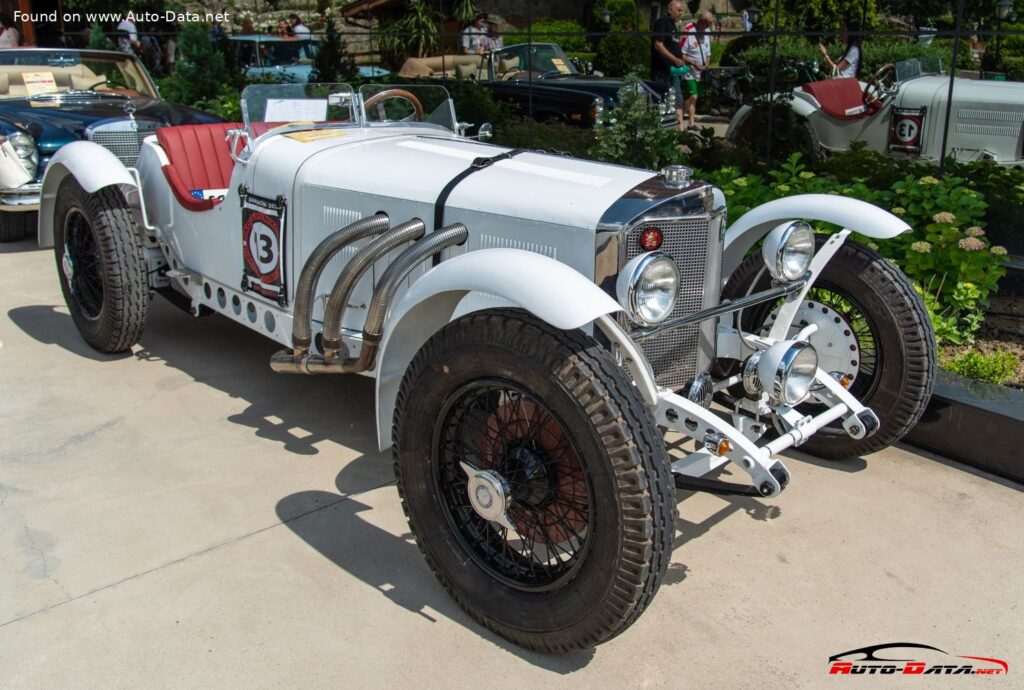
The Mercedes-Benz SSK (W06) is a legendary sports car produced from 1928 to 1932, representing the pinnacle of pre-war German automotive engineering. The “SSK” designation stands for *Super-Sport-Kurz* (Super-Sport Short), signifying a shorter wheelbase version of the already potent S-Series. Designed for racing and high-performance road use, the SSK quickly became synonymous with speed, luxury, and the burgeoning Mercedes-Benz brand. It competed successfully in numerous motorsport events, establishing a legacy that continues to resonate with automotive enthusiasts today. The SSK was not widely sold in the United States during its production run, but its influence extended globally through its racing successes and the prestige of the Mercedes-Benz marque.
The Mercedes-Benz SSK: A Legacy of Performance
The SSK emerged from a lineage of successful Mercedes-Benz racing cars of the 1920s. The W06 chassis, upon which the SSK was based, was a direct evolution of the earlier S-Series models that had already proven their capabilities on the track. However, the SSK distinguished itself with a significantly shortened wheelbase – from 3,400 mm to 2,950 mm – resulting in improved handling and agility. This modification, coupled with a supercharged 7.1-liter inline-six engine, transformed the SSK into a formidable competitor. The car was often commissioned with bespoke coachwork, meaning many examples are unique, further enhancing their collectibility and historical significance.
Engine & Performance
The heart of the SSK is its 7.1-liter (7,069 cc) inline-six engine, designated MS 06. This engine, fed by a carburetor, produced an impressive 250 horsepower at 3,300 rpm and 562 Nm (414.51 lb.-ft.) of torque at 1,900 rpm. The power-to-weight ratio of 6.1 kg/Hp and a power per liter output of 35.4 Hp/l were exceptional for the era. A Roots-type supercharger dramatically increased the engine’s output, providing a significant performance advantage. Power was delivered to the rear wheels through a four-speed manual transmission. The SSK could achieve a maximum speed of 192 km/h (119.3 mph), a remarkable figure for a car of its time. Despite its performance capabilities, fuel economy was understandably poor, averaging 27.2 liters per 100 kilometers (8.6 US mpg).
Design & Features
The Mercedes-Benz SSK was typically configured as a two-seat roadster with a two-door body style. Its long hood housed the massive inline-six engine, while the short rear deck contributed to its sporty proportions. The chassis was a traditional ladder frame construction, and suspension relied on leaf springs at both the front and rear. Braking was accomplished via drum brakes on all four wheels. The SSK’s design prioritized performance over outright comfort, although the cars were often finished to a very high standard, reflecting the luxury aspirations of the Mercedes-Benz brand. The car’s aesthetics were defined by its flowing lines, prominent radiator grille, and often, custom-built bodywork from renowned coachbuilders. Safety features, as understood today, were largely absent; the SSK relied on the driver’s skill and the inherent robustness of its construction for protection.
Technical Specifications
| Brand | Mercedes-Benz |
| Model | SSK |
| Generation | SSK (W06) |
| Type (Engine) | 7.1 (250 Hp) |
| Start of production | 1928 |
| End of production | 1932 |
| Powertrain Architecture | Internal Combustion engine |
| Body type | Roadster |
| Seats | 2 |
| Doors | 2 |
| Fuel consumption (combined) | 27.2 l/100 km |
| Fuel consumption (US mpg) | 8.6 US mpg |
| Fuel consumption (UK mpg) | 10.4 UK mpg |
| Fuel consumption (km/l) | 3.7 km/l |
| Fuel Type | Petrol (Gasoline) |
| Maximum speed | 192 km/h |
| Maximum speed (mph) | 119.3 mph |
| Weight-to-power ratio | 6.1 kg/Hp |
| Weight-to-torque ratio | 2.7 kg/Nm |
| Power | 250 Hp @ 3300 rpm |
| Power per litre | 35.4 Hp/l |
| Torque | 562 Nm @ 1900 rpm |
| Torque (lb.-ft.) | 414.51 lb.-ft. @ 1900 rpm |
| Maximum engine speed | 3340 rpm |
| Engine layout | Front, Longitudinal |
| Engine Model/Code | MS 06 |
| Engine displacement | 7069 cm3 |
| Engine displacement (cu. in.) | 431.38 cu. in. |
| Number of cylinders | 6 |
| Engine configuration | Inline |
| Cylinder Bore | 100 mm |
| Cylinder Bore (in.) | 3.94 in. |
| Piston Stroke | 150 mm |
| Piston Stroke (in.) | 5.91 in. |
| Compression ratio | 5.4:1 |
| Number of valves per cylinder | 2 |
| Fuel injection system | Carburettor |
| Engine aspiration | Supercharger |
| Valvetrain | SOHC |
| Engine oil capacity | 1 l |
| Engine oil capacity (US qt) | 1.06 US qt |
| Engine oil capacity (UK qt) | 0.88 UK qt |
| Kerb Weight | 1520 kg |
| Kerb Weight (lbs.) | 3351.03 lbs. |
| Fuel tank capacity | 120 l |
| Fuel tank capacity (US gal) | 31.7 US gal |
| Fuel tank capacity (UK gal) | 26.4 UK gal |
| Length | 4250 mm |
| Length (in.) | 167.32 in. |
| Width | 1700 mm |
| Width (in.) | 66.93 in. |
| Height | 1250 mm |
| Height (in.) | 49.21 in. |
| Wheelbase | 2950 mm |
| Wheelbase (in.) | 116.14 in. |
| Front track | 1420 mm |
| Front track (in.) | 55.91 in. |
| Rear track | 1420 mm |
| Rear track (in.) | 55.91 in. |
| Drivetrain Architecture | Rear wheel drive |
| Drive wheel | Rear wheel drive |
| Number of gears | 4 |
| Type of gearbox | manual transmission |
| Front suspension | Leaf spring |
| Rear suspension | Leaf spring |
| Front brakes | Drum, 5.00×30 mm |
| Rear brakes | Drum, 5.00×30 mm |
| Steering type | Worm-reduction unit |
| Wheel rims size | 20 |
Today, the Mercedes-Benz SSK is a highly sought-after collector’s car, commanding astronomical prices at auction. Its rarity, historical significance, and stunning design ensure its place as one of the most iconic automobiles of the pre-war era. The SSK represents not only a technological achievement but also a symbol of a bygone era of automotive elegance and sporting prowess.
