
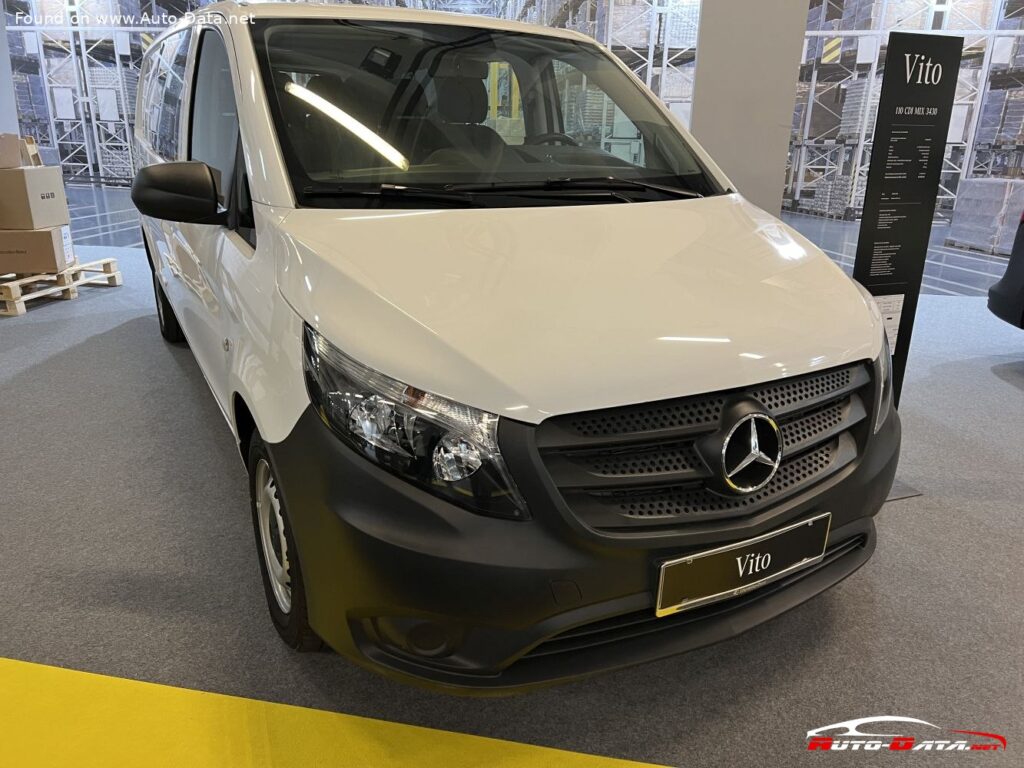
The Mercedes-Benz Vito (W447), particularly the facelifted version introduced in March 2020, represents a significant offering in the mid-size van segment. This iteration, specifically the Crew Van Extra Long 110 CDI 1.7 (102 Hp) model, is designed to balance commercial practicality with passenger comfort. While the Vito isn’t officially sold in the United States, it’s a popular choice in Europe and other markets as a versatile vehicle for both businesses and families needing substantial space and utility. The W447 generation, launched in 2014 and receiving a substantial refresh in 2020, aimed to improve upon its predecessor with enhanced efficiency, technology, and safety features.
Mercedes-Benz Vito W447: A Detailed Overview
The Vito, along with its mechanically similar sibling the Sprinter, has become a mainstay for businesses requiring a reliable and adaptable van. The “Crew Van” designation indicates a configuration with multiple rows of seating, making it suitable for transporting work teams or larger families. The “Extra Long” body style maximizes cargo or passenger space, while the “110 CDI” identifies the engine variant – a 1.7-liter diesel producing 102 horsepower. The 2020 facelift brought styling updates, improved interior materials, and the integration of more advanced driver-assistance systems.
Engine & Performance
The heart of the Vito 110 CDI is a 1.7-liter inline-four cylinder diesel engine, designated OM 622.851. This engine produces 102 horsepower at 3800 rpm and 270 Nm (199.14 lb.-ft.) of torque between 1500 and 2500 rpm. While not designed for outright speed, the engine prioritizes fuel efficiency and durability. Power is delivered to the front wheels via a six-speed manual transmission. The weight-to-power ratio of 20.2 kg/Hp (49.6 Hp/tonne) and weight-to-torque ratio of 7.6 kg/Nm (131.2 Nm/tonne) reflect the van’s focus on usability rather than performance. The engine incorporates a turbocharger and intercooler to optimize combustion and improve power output. Furthermore, it features a diesel particulate filter and a Start & Stop system to meet stringent Euro 6d-TEMP N1 emission standards, resulting in CO2 emissions of 196-206 g/km. Combined fuel consumption is rated between 7.5 and 7.9 liters per 100 kilometers (approximately 29.8 to 31.4 US mpg).
Design & Features
The Mercedes-Benz Vito W447 Crew Van Extra Long is a four or five-door van characterized by its boxy, functional design. The 2020 facelift brought subtle but noticeable changes to the front fascia, including a revised grille, updated headlights, and a more prominent Mercedes-Benz emblem. The “Extra Long” wheelbase contributes to a substantial overall length of 5370 mm (211.42 in), maximizing interior space. The van’s height of 1910 mm (75.2 in) and width of 1928 mm (75.91 in) provide ample headroom and shoulder room. The interior is designed with practicality in mind, featuring durable materials and a modular layout. The Crew Van configuration offers seating for up to six occupants, with flexible seating arrangements to accommodate varying passenger and cargo needs. A significant 4100 liters (144.79 cu. ft.) of minimum trunk space is available behind the rear seats. Standard safety features include ABS (Anti-lock Braking System) and electric power steering. The Vito also boasts a maximum roof load of 150 kg (330.69 lbs) and can tow a braked trailer of up to 2000 kg (4409.25 lbs).
Technical Specifications
| Brand | Mercedes-Benz |
| Model | Vito |
| Generation | Vito (W447, facelift 2020) Crew Van Extra Long |
| Type (Engine) | 110 CDI 1.7 (102 Hp) |
| Start of production | March, 2020 |
| End of production | 2021 |
| Powertrain Architecture | Internal Combustion engine |
| Body type | Van |
| Seats | 6 |
| Doors | 4-5 |
| Combined fuel consumption (WLTP) | 7.5-7.9 l/100 km (31.4 – 29.8 US mpg, 37.7 – 35.8 UK mpg, 13.3 – 12.7 km/l) |
| CO2 emissions (WLTP) | 196-206 g/km |
| Fuel Type | Diesel |
| Emission standard | Euro 6d-TEMP N1 |
| Weight-to-power ratio | 20.2 kg/Hp, 49.6 Hp/tonne |
| Weight-to-torque ratio | 7.6 kg/Nm, 131.2 Nm/tonne |
| Power | 102 Hp @ 3800 rpm |
| Power per litre | 58.3 Hp/l |
| Torque | 270 Nm @ 1500-2500 rpm (199.14 lb.-ft. @ 1500-2500 rpm) |
| Engine layout | Front, Transverse |
| Engine Model/Code | OM 622.851 |
| Engine displacement | 1749 cm3 (106.73 cu. in.) |
| Number of cylinders | 4 |
| Engine configuration | Inline |
| Number of valves per cylinder | 4 |
| Fuel injection system | Diesel Commonrail |
| Engine aspiration | Turbocharger, Intercooler |
| Valvetrain | DOHC |
| Engine oil capacity | 6.8 l (7.19 US qt | 5.98 UK qt) |
| Coolant | 10.4 l (10.99 US qt | 9.15 UK qt) |
| Kerb Weight | 2058-2161 kg (4537.11 – 4764.19 lbs.) |
| Max. weight | 2800-3200 kg (6172.94 – 7054.79 lbs.) |
| Max load | 742-1039 kg (1635.83 – 2290.6 lbs.) |
| Trunk (boot) space – minimum | 4100 l (144.79 cu. ft.) |
| Fuel tank capacity | 57 l (15.06 US gal | 12.54 UK gal) |
| AdBlue tank | 24 l (6.34 US gal | 5.28 UK gal) |
| Max. roof load | 150 kg (330.69 lbs.) |
| Permitted trailer load with brakes (12%) | 2000 kg (4409.25 lbs.) |
| Permitted trailer load without brakes | 750 kg (1653.47 lbs.) |
| Permitted towbar download | 100 kg (220.46 lbs.) |
| Length | 5370 mm (211.42 in.) |
| Width | 1928 mm (75.91 in.) |
| Width including mirrors | 2244 mm (88.35 in.) |
| Height | 1910 mm (75.2 in.) |
| Wheelbase | 3430 mm (135.04 in.) |
| Front track | 1666 mm (65.59 in.) |
| Rear (Back) track | 1646 mm (64.8 in.) |
| Front overhang | 895 mm (35.24 in.) |
| Rear overhang | 1045 mm (41.14 in.) |
| Minimum turning circle (turning diameter) | 13.7 m (44.95 ft.) |
| Drivetrain Architecture | The Internal combustion engine (ICE) drives the front wheels of the vehicle. |
| Drive wheel | Front wheel drive |
| Number of gears and type of gearbox | 6 gears, manual transmission |
| Front suspension | Independent, type McPherson with coil spring and anti-roll bar |
| Rear suspension | Independent coil spring, Trailing arm |
| Front brakes | Ventilated discs |
| Rear brakes | Disc |
| Assisting systems | ABS (Anti-lock braking system) |
| Steering type | Steering rack and pinion |
| Power steering | Electric Steering |
| Tires size | 195/65 R16; 225/60 R16; 225/55 R17; 235/55 R17 |
| Wheel rims size | 6.5J x 16; 6.5J x 17; 7J x 17 |


