
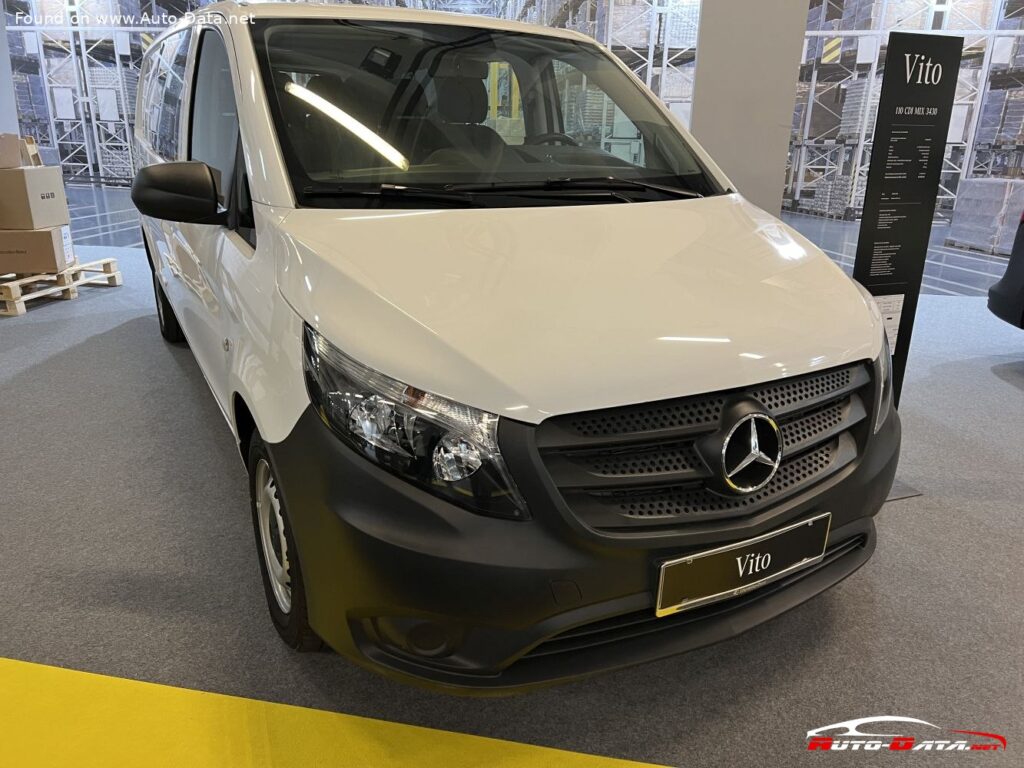
The Mercedes-Benz Vito (W447), particularly the facelifted version introduced in March 2020, represents a significant offering in the mid-size van segment. This iteration, specifically the Crew Van Extra Long 114 CDI 1.7 (136 Hp) model, caters to a diverse range of commercial and passenger transport needs. While not widely sold in the United States, the Vito is a popular choice in Europe, known for its versatility, practicality, and relatively refined driving experience compared to some of its competitors. The W447 generation, launched in 2014 and receiving a substantial facelift in 2020, aimed to modernize the Vito’s appearance, enhance its technology, and improve its efficiency.
Mercedes-Benz Vito W447: A Detailed Overview
The Vito’s design philosophy centers around providing a flexible platform for various applications. The “Crew Van” designation indicates a configuration with seating for up to six passengers, making it suitable for shuttle services, tradespeople requiring mobile workspaces, or larger families. The “Extra Long” wheelbase maximizes cargo capacity, further enhancing its utility. The 114 CDI 1.7 variant signifies the engine type – a 1.7-liter turbocharged diesel engine producing 136 horsepower.
Engine & Performance
Powering the Vito 114 CDI is a 1.7-liter inline four-cylinder diesel engine, designated OM 622.851. This engine delivers 136 horsepower at 3800 rpm and 330 Nm (243.4 lb.-ft.) of torque between 1750 and 2500 rpm. While not designed for outright speed, the engine provides sufficient power for everyday driving and hauling loads. The engine’s turbocharger and intercooler contribute to improved efficiency and responsiveness. The front-engine, front-wheel-drive configuration is standard, contributing to a lower load floor and improved fuel economy. A six-speed manual transmission is the standard gearbox, offering precise control and driver engagement. The Vito 114 CDI achieves a combined fuel consumption of 7.4 to 7.7 liters per 100 kilometers (31.8 to 30.5 US mpg), with CO2 emissions ranging from 192 to 202 g/km, meeting Euro 6d-TEMP N1 emission standards. The weight-to-power ratio is 15.1 kg/Hp, and the weight-to-torque ratio is 6.2 kg/Nm.
Design & Features
The W447 Vito Crew Van Extra Long is characterized by its practical and functional design. The van body style offers a large interior volume, with a minimum trunk space of 4100 liters (144.79 cu. ft.). The vehicle measures 5370 mm (211.42 in.) in length, 1928 mm (75.91 in.) in width, and 1910 mm (75.2 in.) in height. The facelifted model features updated front-end styling, including a redesigned grille and headlights, giving it a more modern appearance. Inside, the cabin prioritizes functionality and durability. The Crew Van configuration provides comfortable seating for up to six occupants, with ample space for passengers and cargo. Standard features include ABS (Anti-lock Braking System), electric power steering, and a Start & Stop system to improve fuel efficiency. The Vito also incorporates a particulate filter to reduce emissions. The vehicle’s suspension utilizes an independent McPherson strut setup at the front and an independent coil spring trailing arm setup at the rear, providing a comfortable ride even when loaded.
Safety and Technology
The 2020 facelift brought enhanced safety features to the Vito. While specific features vary depending on trim level and optional packages, standard safety equipment typically includes ABS, Electronic Stability Program (ESP), and driver and passenger airbags. Available advanced driver-assistance systems (ADAS) could include features like lane keeping assist, adaptive cruise control, and automatic emergency braking, enhancing safety and convenience. The Vito’s infotainment system, while not as sophisticated as those found in passenger cars, provides essential connectivity features, including Bluetooth and USB connectivity.
Technical Specifications
| General Information | |
| Brand | Mercedes-Benz |
| Model | Vito |
| Generation | Vito (W447, facelift 2020) Crew Van Extra Long |
| Type (Engine) | 114 CDI 1.7 (136 Hp) |
| Start of production | March, 2020 |
| End of production | 2021 |
| Powertrain Architecture | Internal Combustion engine |
| Body type | Van |
| Seats | 6 |
| Doors | 4-5 |
| Performance Specs | |
| Combined fuel consumption (WLTP) | 7.4-7.7 l/100 km (31.8 – 30.5 US mpg, 38.2 – 36.7 UK mpg, 13.5 – 13 km/l) |
| CO2 emissions (WLTP) | 192-202 g/km |
| Fuel Type | Diesel |
| Emission standard | Euro 6d-TEMP N1 |
| Weight-to-power ratio | 15.1 kg/Hp, 66.1 Hp/tonne |
| Weight-to-torque ratio | 6.2 kg/Nm, 160.3 Nm/tonne |
| Engine Specs | |
| Power | 136 Hp @ 3800 rpm |
| Power per litre | 77.8 Hp/l |
| Torque | 330 Nm @ 1750-2500 rpm (243.4 lb.-ft. @ 1750-2500 rpm) |
| Engine layout | Front, Transverse |
| Engine Model/Code | OM 622.851 |
| Engine displacement | 1749 cm3 (106.73 cu. in.) |
| Number of cylinders | 4 |
| Engine configuration | Inline |
| Number of valves per cylinder | 4 |
| Fuel injection system | Diesel Commonrail |
| Engine aspiration | Turbocharger, Intercooler |
| Valvetrain | DOHC |
| Engine oil capacity | 6.8 l (7.19 US qt | 5.98 UK qt) |
| Coolant | 10.4 l (10.99 US qt | 9.15 UK qt) |
| Space, Volume and Weights | |
| Kerb Weight | 2058-2161 kg (4537.11 – 4764.19 lbs.) |
| Max. weight | 2800-3200 kg (6172.94 – 7054.79 lbs.) |
| Max load | 742-1039 kg (1635.83 – 2290.6 lbs.) |
| Trunk (boot) space – minimum | 4100 l (144.79 cu. ft.) |
| Fuel tank capacity | 57 l (15.06 US gal | 12.54 UK gal) |
| AdBlue tank | 24 l (6.34 US gal | 5.28 UK gal) |
| Max. roof load | 150 kg (330.69 lbs.) |
| Permitted trailer load with brakes (12%) | 2000 kg (4409.25 lbs.) |
| Permitted trailer load without brakes | 750 kg (1653.47 lbs.) |
| Permitted towbar download | 100 kg (220.46 lbs.) |
| Dimensions | |
| Length | 5370 mm (211.42 in.) |
| Width | 1928 mm (75.91 in.) |
| Width including mirrors | 2244 mm (88.35 in.) |
| Height | 1910 mm (75.2 in.) |
| Wheelbase | 3430 mm (135.04 in.) |
| Front track | 1666 mm (65.59 in.) |
| Rear (Back) track | 1646 mm (64.8 in.) |
| Front overhang | 895 mm (35.24 in.) |
| Rear overhang | 1045 mm (41.14 in.) |
| Minimum turning circle (turning diameter) | 13.7 m (44.95 ft.) |
| Drivetrain, Brakes and Suspension Specs | |
| Drivetrain Architecture | The Internal combustion engine (ICE) drives the front wheels of the vehicle. |
| Drive wheel | Front wheel drive |
| Number of gears and type of gearbox | 6 gears, manual transmission |
| Front suspension | Independent, type McPherson with coil spring and anti-roll bar |
| Rear suspension | Independent coil spring, Trailing arm |
| Front brakes | Ventilated discs |
| Rear brakes | Disc |
| Assisting systems | ABS (Anti-lock braking system) |
| Steering type | Steering rack and pinion |
| Power steering | Electric Steering |
| Tires size | 195/65 R16; 225/60 R16; 225/55 R17; 235/55 R17 |
| Wheel rims size | 6.5J x 16; 6.5J x 17; 7J x 17 |


