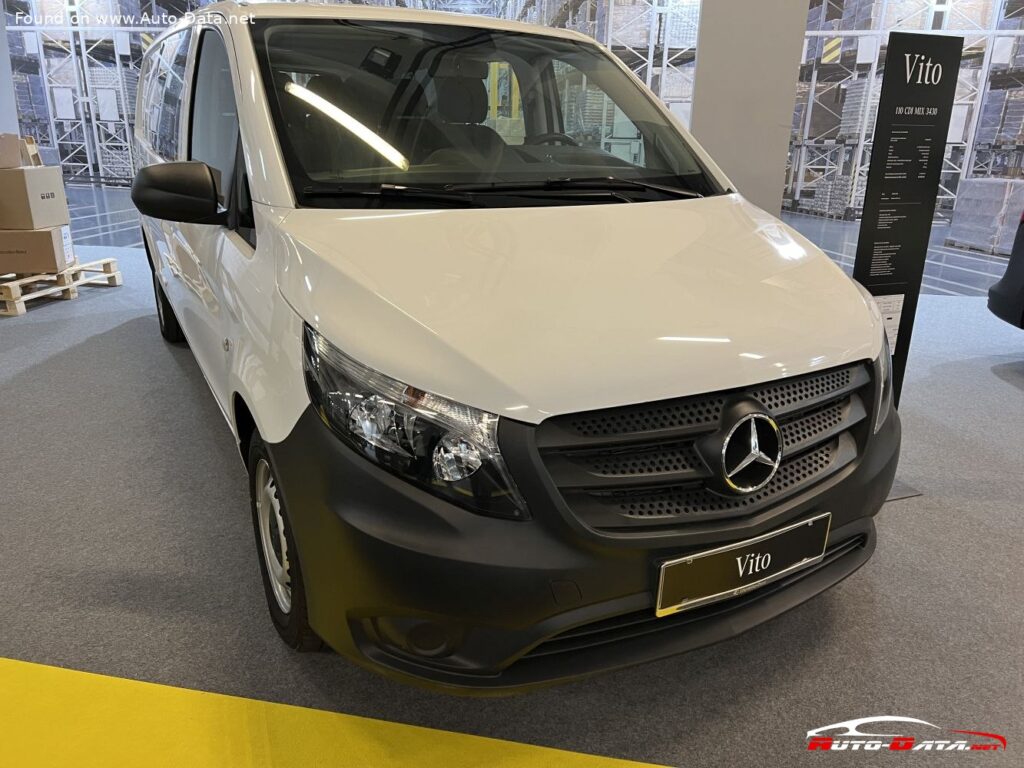
The Mercedes-Benz Vito (W447), particularly the facelifted version introduced in 2020, represents the third generation of this popular commercial vehicle. Positioned within the mid-size van segment, the Vito caters to businesses and individuals requiring a versatile and practical vehicle for cargo transport and specialized applications. The W447 generation, launched in 2014, received a significant refresh in 2020, incorporating updated styling, enhanced technology, and improved efficiency. This article focuses on the Extra Long Panel Van configuration equipped with the 110 CDI 1.7-liter diesel engine producing 102 horsepower, a common specification in European markets.
Mercedes-Benz Vito W447: Overview and Market Positioning
Unlike many Mercedes-Benz passenger vehicles readily available in the United States, the Vito is primarily a European market vehicle. It competes with vans like the Volkswagen Transporter, Ford Transit, and Peugeot Expert. The Vito’s strength lies in its adaptability; it’s offered in various lengths, heights, and configurations, including cargo vans, passenger vans (known as the V-Class in some markets), and even specialized models for conversions like camper vans. The Extra Long variant, as discussed here, maximizes cargo capacity, making it ideal for businesses needing substantial load space. The 110 CDI engine level provides a balance between fuel economy and adequate performance for typical commercial duties.
Engine & Performance
The Vito 110 CDI utilizes a 1.7-liter inline-four cylinder diesel engine, designated OM 622.851. This engine produces 102 horsepower at 3800 rpm and 270 Nm (199.14 lb.-ft.) of torque between 1500 and 2500 rpm. While not designed for outright speed, the engine’s torque delivery provides sufficient power for hauling loads and navigating varied terrains. Power per liter is rated at 58.3 hp/l. The engine features a turbocharger with intercooler and a diesel commonrail fuel injection system for optimized combustion and efficiency. Power is delivered to the front wheels via a six-speed manual transmission. The weight-to-power ratio is 19.5 kg/hp, and the weight-to-torque ratio is 7.4 kg/Nm. The inclusion of a Start & Stop system and a particulate filter demonstrates Mercedes-Benz’s commitment to reducing emissions, meeting Euro 6d-TEMP N1 standards. Fuel consumption figures, measured using the WLTP cycle, range from 7.5 to 7.7 liters per 100 kilometers (31.4 – 30.5 US mpg) combined, varying based on driving conditions.
Design & Features
The W447 Vito Panel Van Extra Long is characterized by its functional and robust design. The body style is a traditional van, featuring four or five doors for access to the cargo area. The “Extra Long” designation indicates an extended wheelbase and body length, maximizing interior space. The 2020 facelift brought subtle styling updates, including a revised front grille, updated headlights, and a more modern interior. Inside, the Vito prioritizes practicality. The standard configuration offers seating for three occupants. The primary focus is the expansive cargo area, offering a minimum volume of 6600 liters (233.08 cu. ft.). Features include a robust chassis construction, designed to withstand the demands of commercial use. Safety features, typical of modern vans, include ABS (Anti-lock Braking System) and driver-assistance systems available as options. The Vito’s design emphasizes durability and ease of maintenance, crucial factors for commercial operators.
Technical Specifications
| General Information | |
| Brand | Mercedes-Benz |
| Model | Vito |
| Generation | Vito (W447, facelift 2020) Panel Van Extra Long |
| Type (Engine) | 110 CDI 1.7 (102 Hp) |
| Start of production | March, 2020 |
| End of production | 2021 |
| Powertrain Architecture | Internal Combustion engine |
| Body type | Van |
| Seats | 3 |
| Doors | 4-5 |
| Performance Specs | |
| Fuel consumption at Low speed (WLTP) | 9.3-9.4 l/100 km (25.3 – 25 US mpg) |
| Fuel consumption at Medium speed (WLTP) | 7.4-7.5 l/100 km (31.8 – 31.4 US mpg) |
| Fuel consumption at High speed (WLTP) | 6.5-6.8 l/100 km (36.2 – 34.6 US mpg) |
| Fuel consumption at Very High speed (WLTP) | 7.9-8 l/100 km (29.8 – 29.4 US mpg) |
| Combined fuel consumption (WLTP) | 7.5-7.7 l/100 km (31.4 – 30.5 US mpg) |
| CO2 emissions (WLTP) | 198-199 g/km |
| Fuel Type | Diesel |
| Emission standard | Euro 6d-TEMP N1 |
| Weight-to-power ratio | 19.5 kg/Hp |
| Weight-to-torque ratio | 7.4 kg/Nm |
| Engine Specs | |
| Power | 102 Hp @ 3800 rpm |
| Torque | 270 Nm @ 1500-2500 rpm (199.14 lb.-ft. @ 1500-2500 rpm) |
| Engine layout | Front, Transverse |
| Engine Model/Code | OM 622.851 |
| Engine displacement | 1749 cm3 (106.73 cu. in.) |
| Number of cylinders | 4 |
| Engine configuration | Inline |
| Fuel injection system | Diesel Commonrail |
| Space, Volume and Weights | |
| Kerb Weight | 1988-2037 kg (4382.79 – 4490.82 lbs.) |
| Max. weight | 2800-3200 kg (6172.94 – 7054.79 lbs.) |
| Max load | 812-1163 kg (1790.15 – 2563.98 lbs.) |
| Trunk (boot) space – minimum | 6600 l (233.08 cu. ft.) |
| Fuel tank capacity | 57 l (15.06 US gal) |
| AdBlue tank | 24 l (6.34 US gal) |
| Max. roof load | 150 kg (330.69 lbs.) |
| Dimensions | |
| Length | 5370 mm (211.42 in.) |
| Width | 1928 mm (75.91 in.) |
| Height | 1910 mm (75.2 in.) |
| Wheelbase | 3430 mm (135.04 in.) |
| Drivetrain, Brakes and Suspension | |
| Drivetrain Architecture | Front wheel drive |
| Number of gears and type of gearbox | 6 gears, manual transmission |
The Mercedes-Benz Vito W447, in its various configurations, remains a popular choice for commercial operators in Europe due to its versatility, reliability, and relatively efficient diesel powertrains. The 110 CDI model provides a practical balance of performance and economy for a wide range of applications.