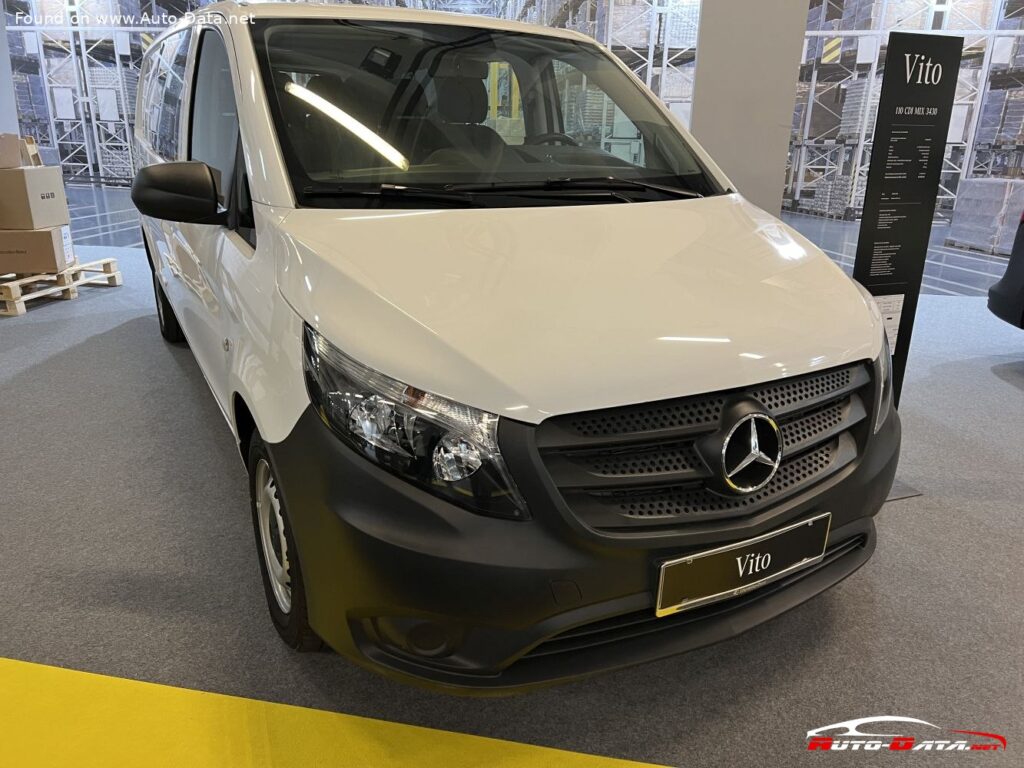
The Mercedes-Benz Vito (W447), particularly the Extra Long Panel Van variant with the 41 kWh battery pack, represents the brand’s entry into the electric commercial vehicle segment. Introduced with a facelift in March 2020 and produced through December 2021, the eVito was primarily aimed at the European market, where demand for zero-emission delivery vehicles was – and continues to be – substantial. While not officially sold in the United States, understanding the eVito provides insight into Mercedes-Benz’s broader electrification strategy and the evolving landscape of electric vans globally. This model offered a practical, albeit modestly powered, solution for urban logistics and delivery services seeking to reduce their carbon footprint.
Mercedes-Benz Vito eVito 41 kWh: An Overview
The W447 Vito, launched in 2014, is the third generation of the mid-size van that replaced the Vito W639. The eVito, an all-electric version, was added to the lineup in 2020 as part of Mercedes-Benz Vans’ eVan offensive. The “41 kWh” designation refers to the gross battery capacity, with 35 kWh being usable. The Extra Long wheelbase provides a substantial cargo volume, making it suitable for a variety of commercial applications. The eVito’s primary function was to offer a viable electric alternative to traditional diesel-powered vans, catering to businesses operating in increasingly stringent low-emission zones.
Engine & Performance
The eVito 41 kWh is powered by a single electric motor, designated EM6000, producing 116 horsepower (Hp) and 295 Nm (217.58 lb.-ft.) of torque. This front-wheel-drive configuration utilizes an asynchronous electric motor and a single-speed automatic transmission. Performance is geared towards efficiency rather than outright speed. Acceleration from 0 to 100 km/h (0-62 mph) takes 19.4 seconds, while 0 to 60 mph is achieved in approximately 18.4 seconds. The top speed is electronically limited to 120 km/h (74.56 mph). The weight-to-power ratio is 19 kg/Hp, and the weight-to-torque ratio is 7.5 kg/Nm, reflecting the van’s focus on utility over performance.
Design & Features
The eVito maintains the functional design of the standard W447 Vito, characterized by its boxy shape optimized for cargo space. As a panel van, it features minimal exterior styling flourishes, prioritizing practicality. The Extra Long wheelbase significantly increases the cargo area, offering a substantial 6600 liters (233.08 cu. ft.) of minimum trunk space. The van typically seats three occupants and has between four and five doors, depending on the configuration. Key features include an independent McPherson strut front suspension and an independent coil spring trailing arm rear suspension, providing a reasonable level of ride comfort despite the van’s commercial purpose. Safety features, standard for the era, include ABS (Anti-lock Braking System) and electric power steering. The battery pack is located under the floor, minimizing intrusion into the cargo area.
Charging and Range
The eVito 41 kWh offers a usable battery capacity of 35 kWh at a voltage of 365V. The all-electric range, according to WLTP (Worldwide Harmonised Light Vehicles Test Procedure) standards, is between 147-150 km (91.34 – 93.21 mi). Using the older NEDC (New European Driving Cycle) standard, the range is quoted as 150-184 km (93.21 – 114.33 mi). Real-world range will vary depending on driving conditions, load, and temperature. Energy consumption is rated at 27.3-29.6 kWh/100 km (43.94 – 47.64 kWh/100 mi) under WLTP and 20.5-24.9 kWh/100 km (32.99 – 40.07 kWh/100 mi) under NEDC, translating to approximately 77-71 MPGe and 102-84 MPGe respectively. The vehicle offers a consumption rate of 3.7 – 3.4 km/kWh and 2.3 – 2.1 mi/kWh.
Technical Specifications
| General Information | |
| Brand | Mercedes-Benz |
| Model | Vito |
| Generation | Vito (W447, facelift 2020) Panel Van Extra Long |
| Type (Engine) | eVito 41 kWh (116 Hp) |
| Start of production | March, 2020 |
| End of production | December, 2021 |
| Powertrain Architecture | BEV (Electric Vehicle) |
| Body type | Van |
| Seats | 3 |
| Doors | 4-5 |
| Performance Specs | |
| Fuel Type | Electricity |
| Acceleration 0 – 100 km/h | 19.4 sec |
| Acceleration 0 – 62 mph | 19.4 sec |
| Acceleration 0 – 60 mph | 18.4 sec |
| Maximum speed | 120 km/h (74.56 mph) |
| Weight-to-power ratio | 19 kg/Hp |
| Weight-to-torque ratio | 7.5 kg/Nm |
| Electric Car Specs | |
| Gross battery capacity | 41 kWh |
| Net (usable) battery capacity | 35 kWh |
| Battery voltage | 365 V |
| Battery technology | Lithium-ion (Li-Ion) |
| Battery location | Below the floor |
| All-electric range (WLTP) | 147-150 km (91.34 – 93.21 mi) |
| All-electric range (NEDC) | 150-184 km (93.21 – 114.33 mi) |
| Average Energy consumption (WLTP) | 27.3-29.6 kWh/100 km (43.94 – 47.64 kWh/100 mi) |
| Average Energy consumption (NEDC) | 20.5-24.9 kWh/100 km (32.99 – 40.07 kWh/100 mi) |
| Powertrain | |
| Electric motor | 1 |
| Electric motor power | 116 Hp |
| Electric motor Torque | 295 Nm (217.58 lb.-ft.) |
| Electric motor model/code | EM6000 |
| Electric motor location | Front axle, Transverse |
| Electric motor type | Asynchronous |
| System power | 116 Hp |
| System torque | 295 Nm (217.58 lb.-ft.) |
| Space, Volume and Weights | |
| Kerb Weight | 2209 kg (4870.01 lbs.) |
| Max. weight | 2800-3200 kg (6172.94 – 7054.79 lbs.) |
| Max load | 591-991 kg (1302.93 – 2184.78 lbs.) |
| Trunk (boot) space – minimum | 6600 l (233.08 cu. ft.) |
| Max. roof load | 150 kg (330.69 lbs.) |
| Dimensions | |
| Length | 5370 mm (211.42 in.) |
| Width | 1928 mm (75.91 in.) |
| Width including mirrors | 2249 mm (88.54 in.) |
| Height | 1945 mm (76.57 in.) |
| Wheelbase | 3430 mm (135.04 in.) |
| Drivetrain, Brakes & Suspension | |
| Drivetrain Architecture | One electric motor drives the front wheels. |
| Drive wheel | Front wheel drive |
| Number of gears and type of gearbox | 1 gears, automatic transmission |
| Front suspension | Independent, type McPherson with coil spring and anti-roll bar |
| Rear suspension | Independent coil spring, Trailing arm |
| Front brakes | Ventilated discs |
| Rear brakes | Disc |
| Steering type | Steering rack and pinion |
| Power steering | Electric Steering |
| Tires size | 225/55 R17 |